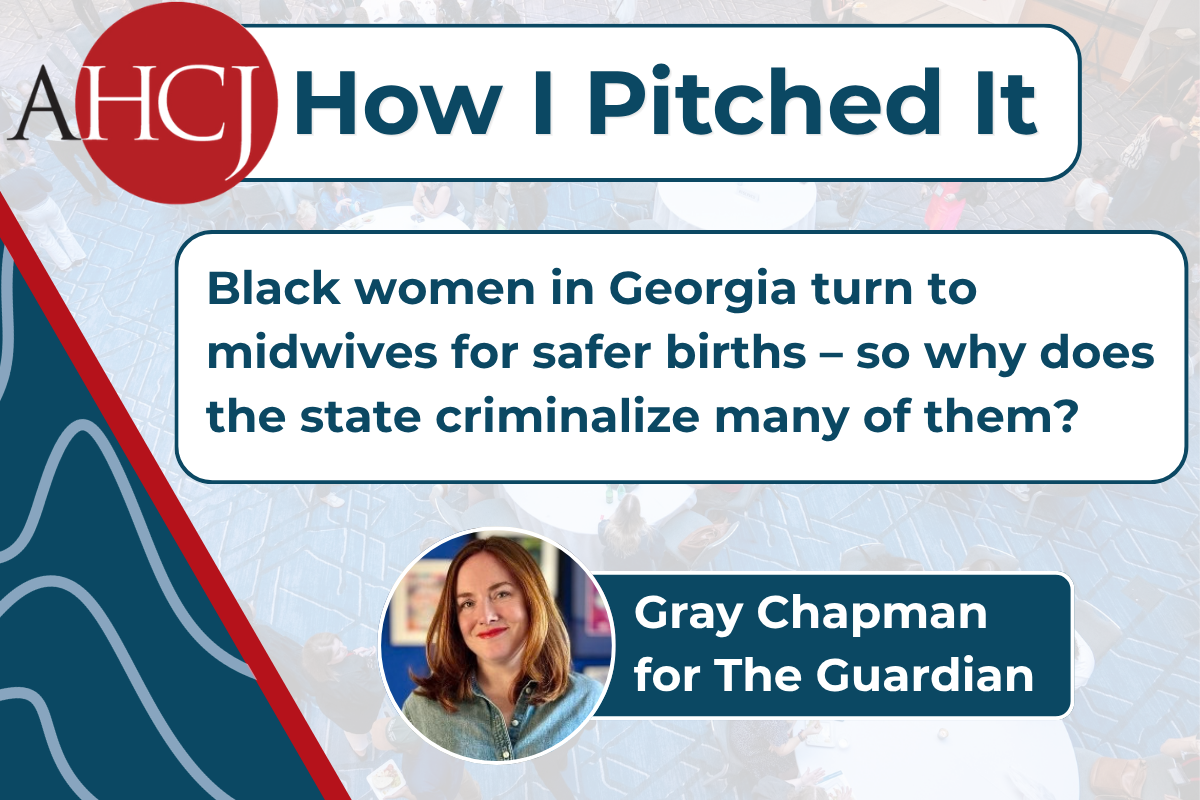
When I asked Atlanta-based freelance journalist Gray Chapman how she got the idea for her April Guardian feature about a battle over who can provide midwifery care in Georgia, she said it was “99% luck.”
I disagree. Chapman — an AHCJ member who has written for publications including The New York Times, the Bitter Southerner and Atlanta Magazine — had been covering maternal health in her state for a few years. She attended an in-person event on the beat. She struck up a conversation while there. She capitalized on timely information. It all led to her pitch being accepted the next day.
So while, as Chapman explains below, there was an element of luck involved, I think she’s being too humble. The idea also required experience, initiative, curiosity and news judgment.
Read on to hear more about how Chapman’s story came to be, including the exact pitch that yielded a Guardian editor’s “yes.” Check out the highlighted parts of the pitch for more of my takeaways.
The Pitch
Hi [editor] — I’m sorry the other story hasn’t worked out thus far, but in lieu of letting that drag on, could I interest you in a different (and much more timely) story altogether?
Medaris: This pivot is so smart and something I wish I had thought to do earlier! When a story that’s been assigned doesn’t go as planned, you risk tarnishing the relationship with that editor (even if it’s not you’re fault). Here, Gray acknowledges that the other story is flailing and redirects with another piece that could still fill a gap in the editorial calendar.
This Thursday in Atlanta, a group of midwives (along with orgs like SisterSong and the Center for Reproductive Rights) will hold a press conference announcing their lawsuit against the state of Georgia over restrictive midwifery laws that make it difficult or illegal for them to practice. (FYI, this info is under embargo til 4/2.)
Medaris: Right away, we have urgency, which is always a good thing for catching an editor’s eye.
Georgia has one of the worst maternal mortality rates, along with some of the strictest midwifery laws, in the country. This group argues that these restrictions worsen the crisis by leaving pregnant people without enough providers in a state riddled with maternity care deserts.
Medaris: Briefly, Chapman puts the news peg into broader context. This shows the story isn’t just about one lawsuit, but matters because of what it says about and could mean for maternal health care across the state and country.
This is following a similar suit in Mississippi in January, as well as one in Hawaii in 2024 (which succeeded) — so while this particular news is Georgia-based, this seems like part of a larger pattern of midwives organizing against state laws as a strategic response to the maternal mortality crisis. What do you think?
Medaris: Finally, Chapman zooms out even further to show why a publication like the Guardian, as opposed to a local magazine, should be interested in publishing it.
Feel free to give me a call if that’s easier.
Can you share more about where this story idea came from?
As part of my reporting for a completely unrelated project, I attended a luncheon held by Motherhood Beyond Bars, an Atlanta-based organization that works with incarcerated moms throughout Georgia.
While standing in the valet line, I learned the woman I was chatting with was the director of the Atlanta Birth Center. When I mentioned that I was a journalist who writes often about maternal health, she asked for my information and said she had some news she wanted to loop me in on.
A few days later, the Center for Reproductive Rights shared the embargoed information about the lawsuit with me. One of the plaintiffs was the woman in line! There were only a few days before the press conference/embargo lift, so I pitched it to the Guardian that day.
Getting the scoop on the lawsuit was a total “right place, right time” bit of kismet. But it was also more proof that getting out of my home office and talking with people is always better than staring at a computer screen hoping for new ideas.
Why was the Guardian the right fit?
I’ve worked with the publication a handful of times over the years, but the editor I predominantly worked with had moved on. I’d been hoping to build some new relationships there.
And though I had [already successfully] pitched a different idea to this new-to-me editor, I was encountering a lot of roadblocks while reporting it. I decided that, instead of toiling away and making her wait on a story that might never come together, I could offer a much more timely replacement and we could both benefit.
What happened after you got the green light?
I followed up with the editor the next day. That’s not my usual cadence, but since the embargo lift was approaching, I wanted to be able to send it elsewhere ASAP if it was a no. Fortunately, she said yes!
I went to the press conference the following Monday morning, and the editor and I got on the phone that afternoon to talk about the approach. We discussed whether this would be a quick-turnaround news story or a longer, more character-driven story. I felt like the lawsuit was a big deal, so we decided to take the faster approach.
I filed the story a couple of days later and we went back and forth on some edits for about a week.
What made the story work?
Access and exclusivity certainly played a role. Being able to join the press conference allowed me to speak to plaintiffs directly, as well as quite a few unlicensed, practicing midwives who are not involved with the lawsuit but were there to show support.
While many of those conversations didn’t make it into the final piece, they really helped color my understanding of what it’s like to practice as a midwife here in Georgia and what this licensing landscape means for the families who come to them for care.
I think it also helped that I have a good understanding of the state’s maternal health landscape. It’s something I first wrote about in 2019. That background allowed me to jump right into the weeds with the people I interviewed, rather than ask for a 101 overview of “why are midwives important.”
Finally, this story cannot be told without the historical context of the role Black midwives served in communities throughout Georgia (and elsewhere of course) and the very intentional, systemic, documented eradication of their ability to provide that care.
Including that background was so important to highlight that this wasn’t just a workforce story, or even “just” a healthcare story. It’s a story about how history is still very much alive in shaping how midwives can operate, how families access maternal care and who our maternal healthcare system leaves behind. I’m glad we were able to dedicate some space to that in the story, rather than just churning out a quick piece that glossed over it.
What were some of the biggest challenges?
I found it difficult to accurately represent the opposing viewpoint. I reached out to Georgia’s Nursing Board, the Georgia OB-GYN Society, the Georgia Hospital Association and the American College of Obstetricians and Gynecologists, but none of them offered a comment.
We had to make do by paraphrasing some of their stances, which are not explicitly “anti-midwife,” but are cautious about opening up licensing pathways. I also looked to other states to see what kind of pushback had been documented.
My editor and I were both on the fence about whether to name some of the unlicensed midwives I interviewed. They were forthcoming in sharing their names with me, but putting those names in print came with real risk to them – any one of them could have gotten a cease-and-desist letter from the nursing board for publicly representing herself as a practicing midwife. Ultimately, I went back to the sources to make sure they were 100% comfortable with the implications, which they were.
What else do you want freelancers to know?
This is not what my process usually looks like! I wish I frequently lucked into stories and got a yes from the first place I pitched them to. In reality, most of the time I’m in my home office agonizing over a three-paragraph pitch or reworking it for the eighth time. I’m more typically following up again and again, trying to bounce back from rejection (or worse, crickets), tracking down editor contact info or questioning whether a single one of my ideas is even worth pursuing. That all might sound a bit terrible, but the stories that do come together make it worth it.
While this piece was an outlier, most of my work is the result of persistence, not being afraid to bother people and stubbornly choosing to believe in the idea. Sometimes that pays off, even if it takes months or years.