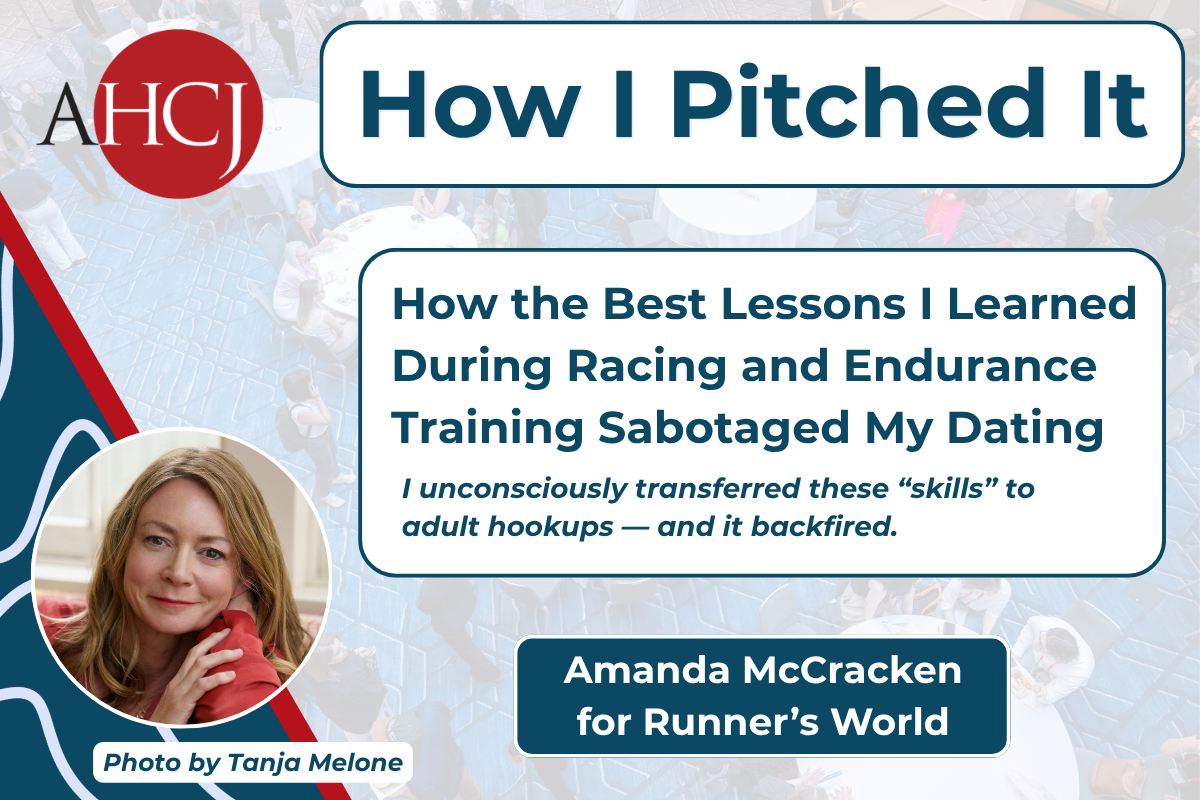
For my latest installment of “How I Pitched It,” I talked to Amanda McCracken, a freelance health, travel and relationship journalist in Boulder, Colo. McCracken, who’s written for outlets including The New York Times, NPR and The Guardian, shares the story behind her May Runner’s World essay, How the Best Lessons I Learned During Racing and Endurance Training Sabotaged My Dating.
Give this Q&A a read — along with my commentary, highlighted — to learn more about what a successful freelance pitch looks like. Here’s the pitch:
Subject: Endurance Running and Dissociation in Intimacy
What happens when a perfectionist with ADHD becomes a competitive endurance running junkie and tries to apply what she’s learned on the athletic field to the dating market?
Medaris: I love how McCracken cuts right to the chase! She saves her credentials for the end, omits empty niceties (“Hope you had a great weekend!”) and starts out with an intriguing, unexpected question that encourages the editor to keep reading.
Per your call for unique but highly relatable stories, I want to write an important essay for RW readers illustrating how endurance running can become an ascetic practice that prepares us to dissociate from emotional intimacy in hookup culture (which can cause long-term damage).
Medaris: A more expected pitch for a running publication might be how endurance sports taught the author something that was positively applied to another area of life. But this does the opposite—how something that works in running can be detrimental to another part of life. And a pitch that has tension or something unexpected usually trumps one that’s predictable.
My training partners and I got really good at pushing past physical discomfort to feel like we were “winning” both on the track and while dating perfect-looking Peter Pans in the elitist running community of Boulder.
Sound strange? I can elaborate and back it up with research, interviews with psychologists and somatic therapists, and testimonies from other female runners. I want readers to become more aware of their patterns, just as I had to position myself to find authentic love.
Medaris: This breezy, conversational tone throughout the pitch shows the editor McCracken knows how to write in a Runner’s World-appropriate voice.
It was in writing my research-driven memoir that I realized how running had served me but also taught me some not-so-handy tricks that were sabotaging my attempt at finding authentic love. When Longing Becomes Your Lover: Breaking from Infatuation, Rejection, and Perfectionism to Find Authentic Love: A True Story of Overcoming Limerence (Hachette) was published last month.
In addition to having written for Runner’s World, my writing has appeared in the New York Times, Guardian, SELF, WaPo, NatGeo, Elle, and NPR. I hyperlinked above a few examples of the types of essay I propose writing.
Medaris: McCracken is concise but impressive when sharing her credentials. It’s also smart to not just link to any clip published at prior outlets, but to link to ones reflective of the style she’s proposing here.
Warmly,
Amanda
www.amandajmccracken.com
My book: When Longing Becomes Your Lover
My podcast: The Longing Lab
Watch my TEDx talk
Read my NYT story on limerence
Instagram: @amandajmccracken
TikTok: @thelonginglab
How did you get the idea for your pitch?
It was an issue I explored in my book, “When Longing Becomes Your Lover,” that I wanted to expand upon in an essay.
Why Runner’s World?
I thought my idea would be something that would resonate with runners and that they perhaps had never considered. I was also looking for outlets where I could publish a companion piece for my book that was off the relationship-coverage beaten path.
I pitched Outside magazine first, but the editor never responded despite two follow-ups. Then, a fellow journalist friend alerted me to a Runner’s World LinkedIn post requesting “unique but highly relatable stories” for the magazine’s online Dispatch section. When I saw that, I pitched that editor.
What happened next?
A week after I pitched the RW editor, I followed up. She responded the same day and asked for more clarity and for some possible headlines she could take to the team to consider.
I then came up with a few potential headlines and sent those to her with a clearer statement of what I was proposing: a personal story with science backing it up. She commissioned the piece, but required it to be just my personal story.
How did the final piece compare to how you expected it to turn out?
I was really pleased with how it turned out. The editor did a great job drawing some more personal details out of me that I wouldn’t have thought would be important or interesting. She also encouraged me to expand upon my drafted conclusion so the reader was left with more of a “satisfying” conclusion.
We wrestled over a few adjectives, and I pushed back on how she trimmed a section. In her attempt to reduce repetition and to condense the piece, I argued that the comparison I was trying to explain — between racing and hooking up — was lost. Fortunately, she understood and agreed with my request to reinsert that information.
I made a compromise, too. In the original draft, I wrote about what my therapist had told me, regarding my body shaking [during intimacy]: “It’s responding as if it’s been raped,” she said. The editor asked if I’d change “raped” to “abused,” since the former is so triggering. I agreed, even though that’s not what my therapist said.
What else would you like freelancers to take away from your experience?
Don’t be afraid to push back on proposed titles. I found the original one — “How the Best Lessons I Learned During Racing and Endurance Training Ruined My Dating” — to be too extreme. I proposed we change “ruined” to “sabotaged,” and the editor agreed.
After we came to an agreement on edits, my editor told me that there would be one final brush stroke of potential edits by a copy editor. I told my editor that really made me nervous, considering how personal the topic was. I’ve had experience with other essays where a copy editor “spruces it up” a bit to their liking and changes the meaning of a sentence with the slightest adjustment in grammar or punctuation. I told my editor that if the copy editor made any more than a small punctuation change, I wanted to review it.
Before I agreed to the payment ($300 for 600–800 words), I requested that the title of my book be allowed to be included in the prose and linked to the Amazon page. I made it clear that I didn’t want it to solely appear in my author bio that someone would only find if they clicked on my name under the title. Fortunately, the editor agreed to include it, as long as it was appropriately woven into the story and not just name-dropped.