Note from the author: This is our third update of this tip sheet, and we hope you will take advantage of the host of new resources from JAMA, the Common Health Coalition, Your Local Epidemiologist, Unbiased Science, and Inside Medicine included at the bottom. The resources also include tips for reporting on vaccine hesitancy and more reliable resources than the CDC about measles, the vaccine, and other infectious diseases. Despite the ongoing coverage of measles last year, many communities have not (yet) seen an outbreak, and you should be prepared to educate and inform your audiences in those areas if a case does occur.
The United States has lost its measles elimination status, the expected outcome of the Pan American Health Organization’s (PAHO) meeting Nov. 10-13.
Five reported measles deaths in November — one in New York, two in Wisconsin, and three in Pennsylvania, bringing that state’s total to seven — brought the total lives lost to the disease to ten in the U.S. in 2026, the most deaths from measles in one year since 1992.
Meanwhile, CDC Director Erica Schwartz, M.D., said the agency would not change its measles response if elimination status was lost — and the CDC refused to acknowledge some of the Pennsylvania deaths as being due to measles.
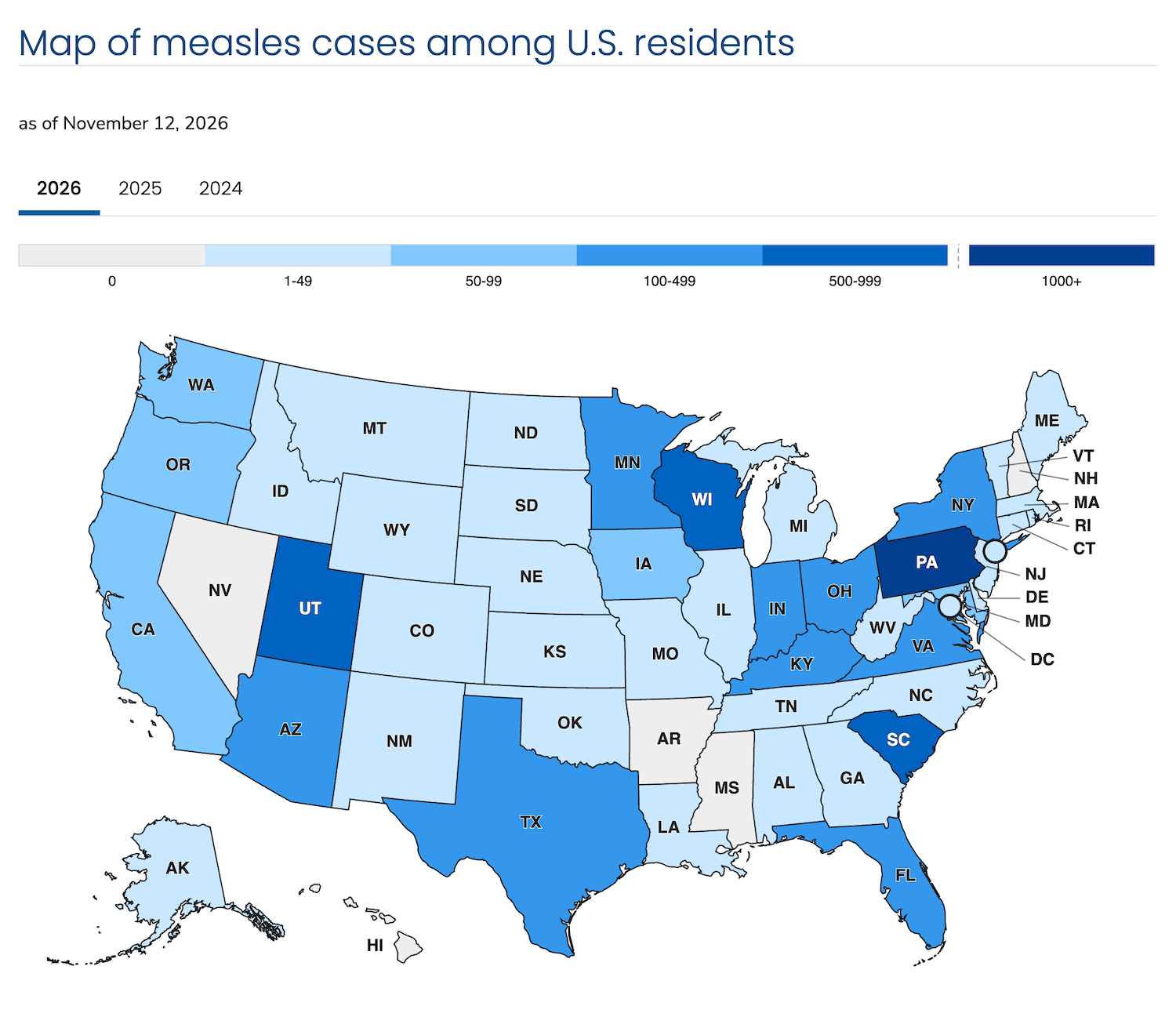
As of Nov. 16, the CDC was reporting 5,412 total measles cases across 45 states plus the District of Columbia, which is undoubtedly an underestimate, said Paul Offit, M.D., an infectious disease physician at Children’s Hospital of Philadelphia and director of the hospital’s Vaccine Education Center. Not all cases are being reported, and it takes time to confirm other cases.
This year’s count, which led to more than 500 hospitalizations (11%) as of mid-November, was already more than double last year’s 2,289 measles cases and still rising.
The process of determining whether a country gains or loses disease elimination status is based on more than simply having cases ongoing for more than a year. Experts must track the chain of transmission to determine if it was a continuous chain of outbreaks. The Common Health Coalition has created a helpful explainer on measles elimination status, including the precise dates involved in the United States determination.
The clock started in the United States on Jan. 20, 2025, with the start of the West Texas measles outbreak. That contributed to some of the 48 additional outbreaks in 44 states in 2025, resulting in three deaths last year.
Most health journalists have likely already spent a significant chunk of time reporting on measles, but it remains important to continue covering the disease and the declining vaccination rates that are helping fuel these outbreaks.
- Facts about the measles vaccine
- When can children get vaccinated against measles?
- How contagious is measles?
- What are the incubation and infectious periods for measles?
- What is the herd immunity threshold of measles, and how does it relate to current vaccination coverage?
- Why is measles returning at such high numbers when it was eliminated in 2000?
- What are the complications and death rate of measles?
- How does measles harm the immune system?
- Is measles worse for kids or adults?
- Does vitamin A treat or prevent measles?
- Who needs a booster for measles?
- Resources
Click to expand.
Fortunately, even more resources are available to support reporting on the disease and the vaccine since AHCJ published its last measles tip sheet. With continuing inaccurate and misleading claims about the disease still circulating, journalists play a crucial role in sharing evidence-based information from reliable sources.
That’s more critical than ever since Health and Human Services Secretary Robert Kennedy, Jr., a longtime anti-vaccine activist, continues to cast doubt on the effectiveness of the measles-mumps-rubella (MMR) vaccine and deny the seriousness of the disease. Health officials in American Samoa have blamed Kennedy for exacerbating a deadly measles outbreak there in 2019 that killed at least 83 and sickened thousands; Hawaii Gov. John Green even alleged Kennedy was responsible for causing additional deaths during that outbreak.
Shortly after the 2026 midterms, Sen. Ron Wyden (D-Ore.) launched an investigation into whether Kennedy — who claimed his 2019 visit to Samoa had “nothing to do with vaccines” — lied about his reasons for traveling to Samoa in 2019, according to The Guardian.
Table of contents
- Facts about the measles vaccine
- When can children get vaccinated against measles?
- How contagious is measles?
- What are the incubation and infectious periods for measles?
- What is the herd immunity threshold of measles, and how does it relate to current vaccination coverage?
- Why is measles returning at such high numbers when it was eliminated in 2000?
- What are the complications and death rate of measles?
- How does measles harm the immune system?
- Is measles worse for kids or adults?
- Does vitamin A treat or prevent measles?
- Who needs a booster for measles?
- Resources
Facts about the measles vaccine
The only way to prevent measles is with the MMR vaccine, which is 93% effective with one dose and 97% effective with two doses. The vaccine was tested in placebo-controlled trials and is very safe. The most common side effects are soreness at the injection site, temporary joint pain or stiffness and a mild fever.
About four in every 10,000 children who get the vaccine between 12 and 15 months old will experience a febrile seizure — a seizure caused by a fever — in seven to 10 days after getting the vaccine, but these seizures do not have any long-term effects. The risk of a febrile seizure is actually higher (9.5 per 10,000) for children who get the vaccine between 16 and 24 months. A rarer risk is a temporary low platelet count, called immune thrombocytopenic purpura, which can occur in one out of 40,000 children receiving the vaccine. The rarest risk is anaphylaxis, estimated to occur in one to two per 1 million children.
More than a dozen studies have confirmed that there is no link between the MMR vaccine and autism. Only two reported deaths have ever been determined to be caused by the MMR vaccine out of more than 803 billion doses given globally as of 2021. Both deaths occurred in North America in severely immunocompromised patients: a 21-month-old who developed measles inclusion-body encephalitis eight months after vaccination in 1999 and a 17-year-old girl with Hodgkin’s lymphoma in 2019.
When can children get vaccinated against measles?
The routine recommendations for the MMR vaccine by the CDC and the American Academy of Pediatrics (AAP) are a first dose at 12 to 15 months old and a second between 4 to 6 years old.
However, during a local outbreak or prior to international travel, the recommendation is that infants aged 6 to 11 months get a dose of the MMR vaccine. That’s recently become even more important in light of recent evidence that infants’ maternal measles antibodies appear to wane below the level of protection by 6 months old. This dose does not count toward the recommended 2-dose series, so infants receiving a dose before their first birthday will still need a dose as a toddler and then at age 4.
How contagious is measles?
Measles is the most contagious human disease known. It’s airborne, and the droplets remain in the air up to two hours after an infectious person leaves an area. At least 90% of susceptible (non-immune) people exposed to the virus will develop measles.
The contagiousness (or transmissibility) of a disease is calculated as the basic reproduction number, expressed as the R-naught (R0). The R0 refers to the number of susceptible people a single infected individual will infect during the course of their illness. The number isn’t static — it can shift based on multiple factors — but for measles, it’s roughly 12 to 18.
What are the incubation and infectious periods for measles?
People infected with measles usually develop the first symptoms, often a rash, about 10 to 14 days after exposure to the virus. However, they are contagious starting about four days before the rash appears and continuing about four days after it appears.
Measures taken to quarantine and track cases must take this math into account, so you should be prepared to ask public officials and others managing an outbreak to answer questions about exposure windows for people who were at locations where an infected person was present.
What is the herd immunity threshold of measles, and how does it relate to current vaccination coverage?
The herd immunity threshold is the percentage of residents in a community who must be immune to a disease to prevent its spread through the population. Since measles is so contagious, the herd immunity threshold is high at 95%.
According to CDC data on vaccine coverage and exemptions in the 2025-2026 school year, only 92.4% received both recommended doses of the MMR vaccine, a 0.1-point drop from 2024-2025 and a 0.3-point drop from 2023-2024.
The average national vaccination rate is, therefore, below the herd immunity threshold and still declining. Further, that 92.4% represents the average, not the rate in individual states or communities. Rates vary considerably between and within states; journalists can download the data files from the CDC showing how many kindergarteners lacked documentation of the MMR vaccine to see the numbers for their state.
In California, for example, which eliminated non-medical exemptions for school vaccination requirements in 2016, 95.7% of kindergarteners were fully vaccinated against measles, below the 96.1% of the previous year. West Virginia, which has never had non-medical exemptions, has the highest rate at 98.9%.
On the flip side, only 75.2% of kindergarteners are vaccinated against measles in Idaho — a substantial drop from 78.5% last year — which restricted non-school vaccine mandates in spring 2025 and previously halted the health department’s ability to administer any Covid-19 vaccines.
Within states, immunization coverage can also vary widely, especially in states with looser laws on vaccination requirements. It’s the pockets within a state — such as the highly unvaccinated region of Texas where the largest outbreak started and similarly highly unvaccinated communities in Pennsylvania — that indicate a community’s susceptibility to an outbreak.
Why is measles returning at such high numbers when it was eliminated in 2000?
In simple terms, vaccination rates have declined, creating large pockets throughout the country where measles can easily gain a foothold. But the reasons for the drop in vaccination are far more complex.
It’s important to familiarize yourself with the complexities and nuances of vaccine hesitancy, vaccine refusal, and anti-vaccine advocacy before reporting on any of these since many misconceptions about them exist. Inadvertently propagating those misconceptions through well-intentioned reporting, or approaching a story on vaccine hesitancy without a strong foundation in the research and nuances, can inadvertently contribute to additional vaccine hesitancy and anti-vaccine sentiment.
For an excellent primer on these issues, check out SciLine’s package on “How to cover vaccines responsibly,” which includes the following:
- Why it’s urgent that journalists understand the science behind vaccines, disinformation
- Covering vaccines: Understand the science, be thoughtful about framing
- For journalists covering vaccines, advice on understanding hesitancy
- Covering vaccine mandates and policy in a polarized community
- Reporting on common vaccine conspiracies and misinformation
- Pulling back the curtain on religious and cultural resistance to vaccines
- Understanding vaccines: Use these free social-friendly graphics
- Vaccines in the news: What to cover and how
- Vaccine safety tip sheet
Oversimplification of the cultural factors around non-vaccinating and outbreaks can impede public health efforts, and stereotypes contribute to these problems, as Katelyn Jetelina discusses in a post about what people are getting wrong about the religious communities in Pennsylvania at the center of several outbreaks.
What are the complications and death rate of measles?
Common complications include ear infections, diarrhea and pneumonia. More serious complications include encephalitis (in approximately one of every 1,000 cases) or severe pneumonia (the most common cause of death in children with measles).
In the U.S., an estimated one to three children per 1,000 with measles will die from complications of the disease during acute infection. Last year, however, three people died of measles out of 2,267 total cases, including two children, so these numbers are only approximations. The fact that there have been 10 deaths among just over 5,000 cases this year suggests underreporting of cases.
Aside from death, the most serious — and terrifying — complication of measles is subacute sclerosing panencephalitis (SSPE), a rare, progressive neurological disorder that develops when the measles virus invades the brain and nervous system and causes inflammation. The subsequent neurological impairment causes memory loss, irritability, language loss, mood changes, cognitive decline, vision loss, seizures, and eventually coma and death. The most recently reported U.S. death from SSPE was a school-age child in Los Angeles last year.
SSPE is always fatal as there is no cure, but symptoms do not present until seven to 10 years after the infection, and deterioration lasts an average of one to three years and rarely beyond four years, though at least one case lasted 13 years. SSPE had previously been thought to occur in only five to 10 of 1 million people who had measles, but the 1989-1992 measles outbreak resulted in a rate of four to 11 cases of 100,000. Another study in 2016 found a rate of one in 1,367 cases, with an even higher rate (one in 609) among children who had measles before age 1. The time to presentation was also longer, an average of 9.5 years. A more recent study on SSPE cases from outbreaks in the Philippines was published this month.
How does measles harm the immune system?
One feature of measles that was only somewhat recently discovered and thought to be unique relative to other viral diseases is that it can cause “immune amnesia.” That is, a measles infection can cause the immune system to “forget” how to fight other diseases it’s already learned to fight: it destroys many of the immune systems’ existing antibodies to other diseases, so it no longer recognizes those pathogens. This phenomenon was first described in a 2015 study in Science, which found that measles can cause an increase in overall childhood infectious disease deaths even among those who initially survive the measles infection because the disease disables immune memory until reinfection or re-vaccination.
Is measles worse for kids or adults?
Measles can be serious at any age, but children under age 5 and adults over age 20 are at greater risk for complications. Others at higher risk include those who are pregnant or immunocompromised. Children under age 2 appear to be at higher risk for developing SSPE.
Does vitamin A treat or prevent measles?
The only way to prevent measles is through vaccination. The primary treatment of measles is supportive care, which means treating the symptoms and complications. There is no cure or direct treatment for measles. Vitamin A cannot prevent measles. In fact, cases of vitamin A toxicity have been reported in West Texas as Kennedy was inaccurately and irresponsibly promoting vitamin A as a way to prevent the disease.
Measles does, however, deplete the body’s stores of vitamin A, and the National Foundation for Infectious Diseases does recommend that physicians administer an age-appropriate dose of vitamin A to children hospitalized with measles, but it should not be administered by caregivers without a doctor’s recommendation or supervision.
Who needs a booster for measles?
Two doses of the MMR vaccine have been recommended for children since 1989. Most people born between 1957 and about 1983 likely only received one dose and would be eligible for a booster. People born before 1957 are presumed to have had a childhood infection and be immune. Those who got a vaccine between 1963 and 1967 may have received a less effective vaccine and might want to consider a booster.
Some physicians may advise people to check their titers (antibodies) to find out whether they are immune to measles before getting a booster. However, the MMR vaccine induces two types of immunity, only one of which is antibodies, so titers can be low even in people who are protected. Titers are therefore not necessarily clinically useful for determining whether someone needs a booster.
See this Q&A in Scientific American and this Yale Medicine article for more on who needs a booster.
Resources
- CDC measles outbreak dashboard — note that the CDC numbers may not be accurate due to political interference with reporting deaths.
- Johns Hopkins University (JHU) Measles Tracker Visualizations
- Check with individual state health department dashboards for measles cases, such as the ones for Pennsylvania, New York, and Wisconsin
- Red Book Online for Measles
- South Carolina Department of Public Health and their measles dashboard
- “How to cover vaccines responsibly” tip sheets by SciLine
- Center for Infectious Disease Research and Policy (CIDRAP) at University of Minnesota and their Vaccine Integrity Project
- State exemption policies for vaccination requirements
- Vaccination Coverage and Exemptions among Kindergartners (includes 2025-2026 data and past years’ data for comparison)
- Measles can ravage the immune system and brain, causing long-term damage – a virologist explains
- KFF’s Race-Based Vaccine Myths Spread Amid Measles Outbreaks
- List and short summary of 25 studies showing no link between MMR vaccine and autism
- Clinical information on measles (The Yellow Book)
- Measles Clinical Diagnosis Fact Sheet for health care providers
- Expert Vaccine Analysis Team for experts on infectious disease and vaccines
- Infectious Disease Society of America
- American Academy of Pediatrics info on measles, on the measles vaccine, and their Healthy Children site for parents
New Resources
- Common Health Coalition Measles Elimination Status Explainer
- What many get wrong about Amish or Plain Anabaptist communities, measles, and health by Your Local Epidemiologist
- Spotlight: Measles elimination status is brewing behind closed doors by YLE
- Why Is There Still No Cure for Measles? by Unbiased Science
- The State of US Vaccine Policy by Unbiased Science in collaboration with CIDRAP (an ongoing, highly recommended series)
- Exclusive: CDC’s internal system still counts two Pennsylvania measles deaths by Inside Medicine
- Update: CDC removes two measles deaths from internal count. Kennedy wins, for now by Inside Medicine
- RFK Jr: Secretary of Measlesland by Paul Offit
- Making Sense of Lancaster County’s Controversial Coroner by Paul Offit
Resources from JAMA
- What Is Measles? and Measles — two useful links for including in articles for general consumer-friendly information
- Strategies for Communicating With Parents About Vaccines — by Sean O’Leary, an excellent source for articles on vaccine hesitancy
- The Measles Resurgence — lessons on past outbreaks
- Revising US MMR Vaccine Recommendations Amid Changing Domestic Risks — proposes earlier vaccination of infants in certain circumstances
Recent peer-reviewed research articles from JAMA
- Cost of a Measles Outbreak in an Urban Shelter — shows public health costs of outbreaks
- Tracking County-Level Measles Cases in the US — describes the new platform for tracking county-level case counts, geographic spread, vaccination status, age distribution, and local versus imported infections
- Geographic Variation in Measles Vaccine Coverage Among Children Aged 7 Years in Northern California
- Measles-Containing Vaccine Use for Children Aged 12 to 47 Months, 2015 to 2025
- Delayed or Absent First Dose of Measles, Mumps, and Rubella Vaccination
- Early MMR Vaccine Adoption During the 2025 Texas Measles Outbreak
Table of contents
- Facts about the measles vaccine
- When can children get vaccinated against measles?
- How contagious is measles?
- What are the incubation and infectious periods for measles?
- What is the herd immunity threshold of measles, and how does it relate to current vaccination coverage?
- Why is measles returning at such high numbers when it was eliminated in 2000?
- What are the complications and death rate of measles?
- How does measles harm the immune system?
- Is measles worse for kids or adults?
- Does vitamin A treat or prevent measles?
- Who needs a booster for measles?
- Resources