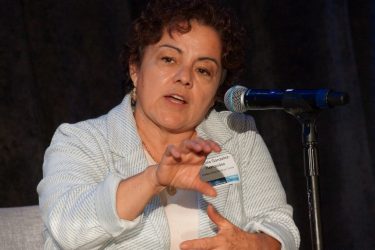
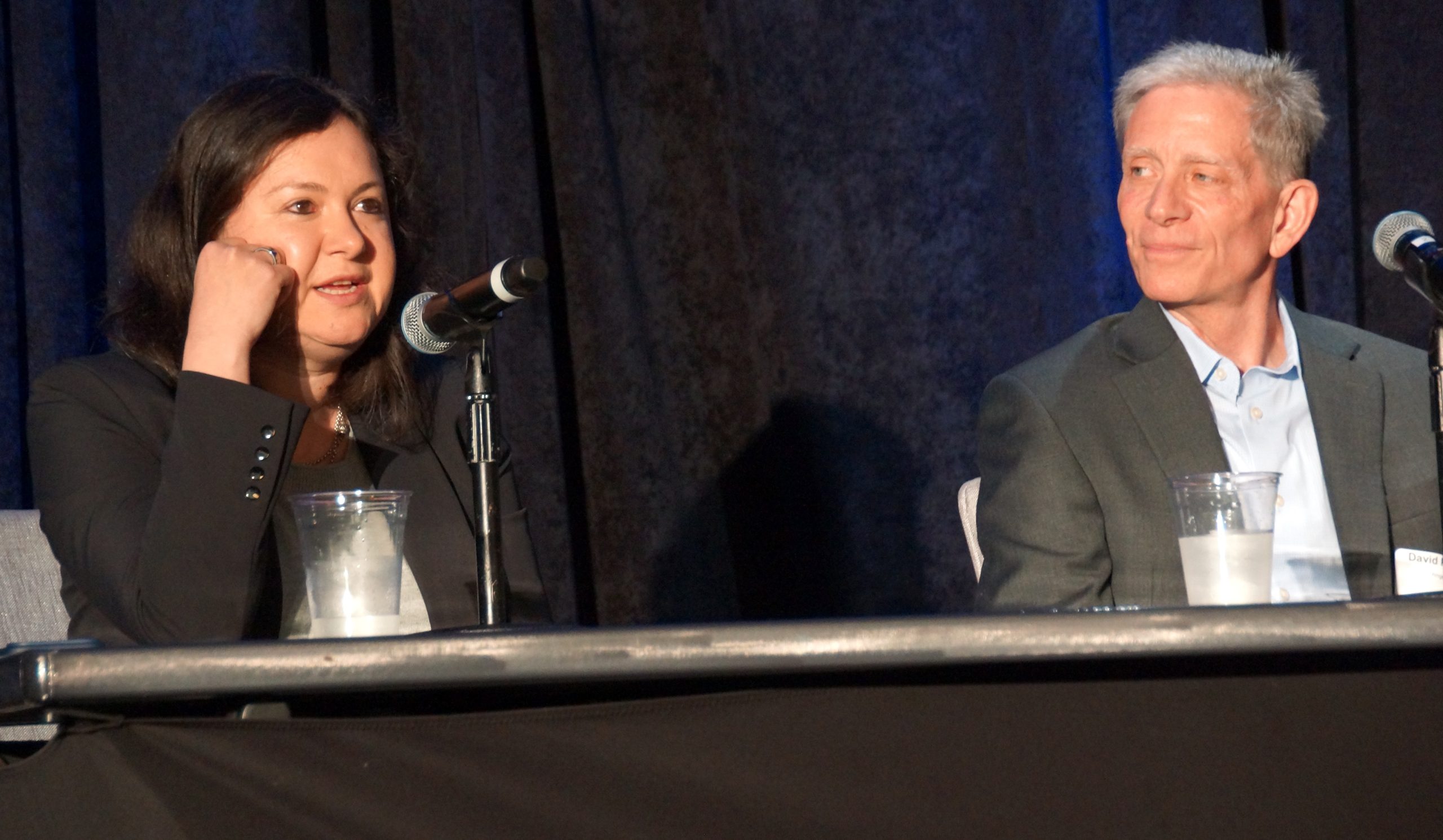
- Moderator: Jonathan Rockoff, health business editor and deputy coverage chief, The Wall Street Journal; treasurer, AHCJ
- David Reese, retired executive vice president and chief technology officer, Amgen
- Mary Rozenman, Ph.D., CFO and CBO, Insitro
Some technology executives promise that their artificial intelligence models will cure “all disease” over a decade or so. But drug development and biotechnology experts say those promises are out of touch and ignore the field’s staggering complexity.
“The folks saying that generally have never actually worked on disease biology, and don’t have an appreciation for just how complicated it is,” said David Reese, retired executive vice president and former chief technology officer at the biopharmaceutical company Amgen.
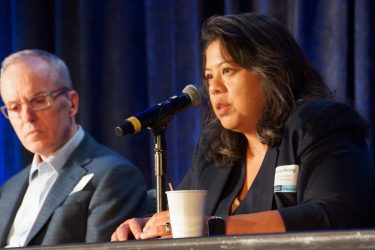
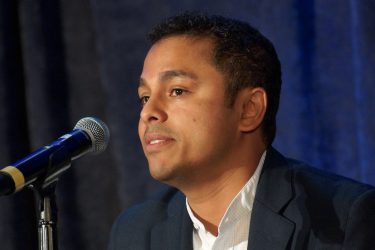
Reese was one of two experts on a panel at AHCJ’s fall summit in Los Angeles. The panelists explained that AI tools accelerate certain computational tasks and help researchers understand underlying drivers of disease, but are far from a magic fix.
Where AI delivers real results
Understanding why a disease happens, not just what happens, is key to developing medicines that work. But figuring that out at the genetic and cellular level takes months or years, stalling much of global drug development.
That’s an area AI is showing promise.
One example is AI tools that predict the exact three-dimensional shape of proteins — the microscopic machinery inside our cells. When proteins fold into the wrong shape, they cause diseases. Now, AI tools can predict these shapes in a fraction of the time it used to take humans, allowing scientists to identify new targets for drug development.
“Now a scientist sits there and clicks an icon on their desktop and in some cases in minutes can have a protein structure,” Reese said. “You just took six months or a year out of the process.”
Other platforms, like ones built by biotechnology company Insitro, create virtual human cell models with population-scale genetics to build AI systems that can uncover the causal drivers of disease. This also lets researchers test how drugs affect whole human systems in minutes.
Mary Rozenman, Ph.D., chief financial officer and chief business officer at Insitro, said this supercharges drug development efforts and significantly lifts the industry’s dismal 8% to 10% success rates in human clinical trials.
Rozenman said that Insitro has partnered with some pharmaceutical giants to tackle diseases such as MASH, a severe liver disease that is the leading cause of liver transplants, and amyotrophic lateral sclerosis or ALS, a progressive nervous system disease that destroys nerve cells in the brain and spinal cord.
The biological data bottleneck
But AI models are only as good as the data they’re trained on.
The panelists said the primary hurdle facing AI in drug discovery is a lack of high-quality, standardized data. That’s because biological AI models require data generated under strict laboratory conditions to avoid learning experimental noise.
“That gap and that caveat is a little bit inconvenient for software companies because it turns out that data doesn’t exist,” said Rozenman. “You have to generate it. You have to understand a whole heck of a lot of complexity.”
She noted that simply dumping unstandardized data from pharmaceutical companies and other sources into an AI model generates errors rather than cures.
Both panelists agreed that there is no sign that AI alone can cure diseases overnight or answer some of the most complex biological questions humans face.
“We have to stand humbly in front of nature and we have to bring the expertise and the respect for the complexity of biotechnology as we do that work,” Rozenman said. “Biology is so complicated and the stakes could not be higher.”
The full recordings of this panel discussion and other fall summit coverage assets are available on our website.