
Demystifying community engagement: How listening leads to better health reporting
By I’Jaz Ja’ciel/New York Health Journalism Fellow
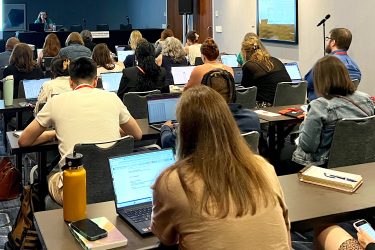
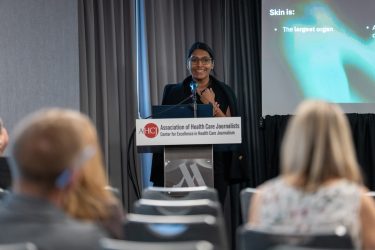
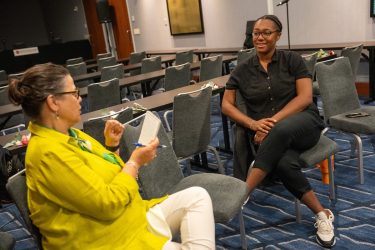
While journalists may rely on “go-to” sources when covering certain communities or issues, seeking a wider range of voices can offer new perspectives to stories and better serve both reporters and their audiences. That was the main takeaway from an HJ26 workshop on the importance of journalists engaging with and immersing themselves in the communities they cover.
Community engagement becomes especially relevant in a society where distrust in news media, especially around sensitive topics like health, are at an all-time high.
You have to pull back the curtain, let people come in, see how the sausage is made, and even think about co-creating, truly co-creating with communities.
Marlene Harris-Taylor
Director of community engagement
American Press Institute
Her philosophy clearly distinguishes authentic community engagement – creating with readers, viewers and listeners – from audience engagement – creating for consumers.
The workshop emphasized that when a reporter changes their approach to community engagement, opportunities arise for new stories to be developed and for accountability to improve.
Community asset mapping is a particularly helpful tool, as it can aid in expanding sources and create a foundation for community-centered journalism. It requires the journalist to think about how to maximize their environment to find and build sources.
The workshop demonstrated how simply drawing a map to identify institutes, recreational spots and other places people gather can help reporters connect with sources who can add depth to their stories. Mapping in the literal sense can also help identify places that resonate more with the everyday person than mainstream media.
“Nonprofits, schools and libraries can really be your friend, they could send you to other places,” said panelist Michelle Levander, founding director for the Center of Health Journalism at the Unversity of Southern California.
Another useful tool for reporters: questionnaires. A Google Form can help bridge the gap between a reporter and a source, while allowing journalists to use simple and cost-effective resources.
Panelist Kristen Schorsch, a public health reporter with WBEZ Chicago, said she used questionnaires to help track down data in the wake of the Dobbs v. Jackson Women’s Health case. When she couldn’t find the information she needed, Schorsh built her own database by soliciting responses from the community.
“Some of those people turned into stories, and others really just helped me understand all types of perspectives on reproductive rights,” she said.
All of the speakers agreed that community engagement relies on engagement approaches. Crowdsourcing a story with a callout or questionnaire, for example, is a unique and innovative way to develop information for and of the community.
Lexis-Olivier Ray, a Center for Health Journalism fellow, used a texting service to receive tips when his public records requests were not being fulfilled about sanitation sweeps that affected the unhoused population in Hawaii.
A key takeaway from this session: A reporter’s work is not done when the story is published. Community engagement means building and maintaining relationships. Hosting community forums, partnering with in-language media, and meeting people where they are creates a more sustainable dynamic between journalists and sources, steering reporters away from media-ready voices and toward people lived experiences.
I’Jaz Ja’ciel is a multimedia reporter with Buffalo Toronto Public Media NPR in Buffalo, NY.