Repairing the body from within: Advances in regenerative medicine
By Larry Beresford/California Health Journalism Fellow
A panel on regenerative medicine at Health Journalism 2026 highlighted progress and promise in the expanding field of regenerative medicine, which is the replacement or regeneration of human cells, tissue or organs to restore their normal functioning. Work in this field largely starts with human stem cells, unspecialized cells capable of dividing indefinitely and developing into specialized cells and tissues.
Media enthusiasm for stem cells dates back to 1998, and coverage of their initial cultivation appeared in the New York Times and elsewhere, said panel moderator and independent journalist Meryl Davids Landau. More recently, journalists have had to debunk many unproven marketing claims, such as those made by stem cell therapy clinics.
But techniques for reversing cell damage with cell regeneration are coming tantalizingly closer.
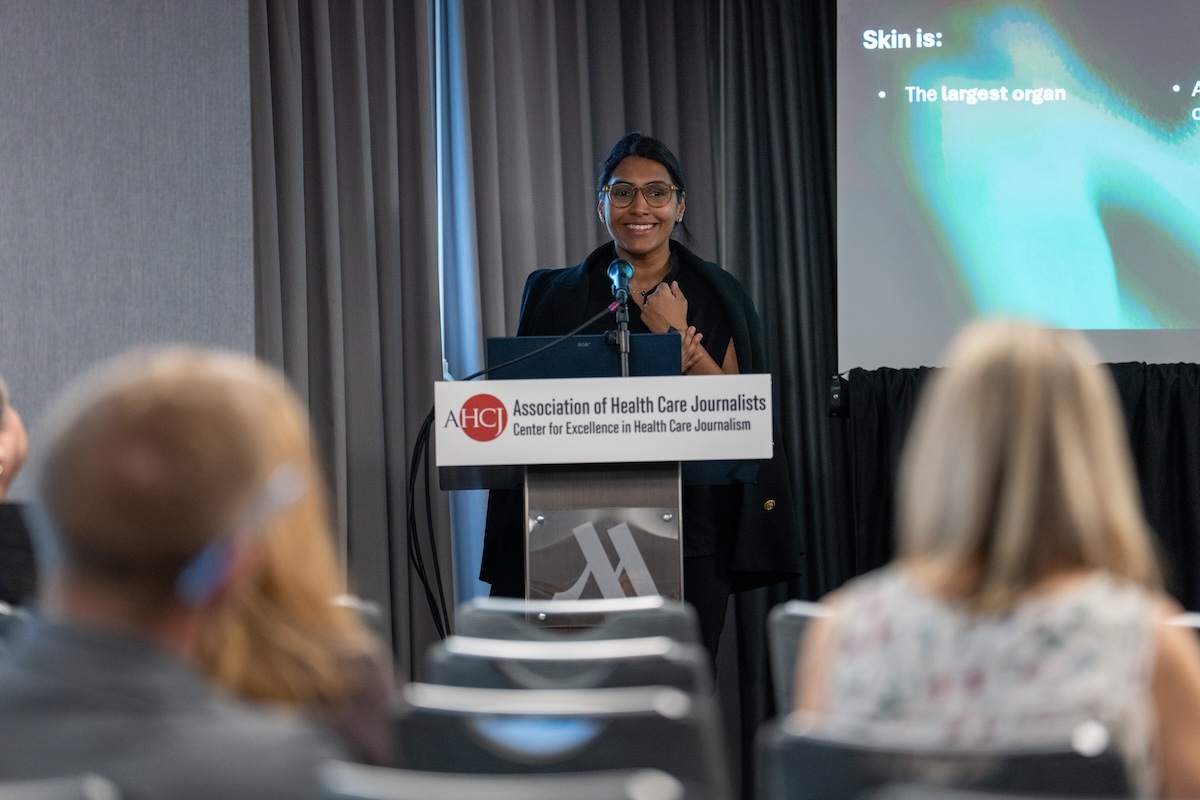
Two speakers, Saranya Wyles, M.D., Ph.D., of the Mayo Clinic and Bhairab N. Singh, Ph.D., of the University of Minnesota, highlighted the latest regenerative research in the specialties of dermatology and cardiology, respectively.
In highlighting her concept of “skinspan,” which refers to how long skin maintains healthy function across the lifespan, Wyles highlighted the expanding understanding of the roles the skin plays and the inevitable senescence of growth-arrested skin cells.
Wellness companies offer a variety of products, many lacking evidence, for rejuvenating the skin, which is the body’s largest organ. In many cases, the simplest approaches work best. The regular application of SPF 30 or higher sunscreen when outside is the number one skin longevity habit, according to Wyles. product.
What does the future hold?
Wyles is pursuing a 3D-bioprinted human skin model, produced by a machine analogous to a desktop printer, setting down layer after layer of human tissue cells to make skin models that can be used to test new drugs and other dermatologic treatments.
Singh noted that heart disease is the leading cause of death in the U.S., and that heart tissue has been shown to be significantly less efficient at regeneration than other organs.
“Our lab has been working on cardiac regeneration for nearly 15 years,” he said. “We ask: Why does human heart tissue regenerate so slowly, and what are the strategies to repair it?”
Cardiac regeneration research has focused on cardiomyocytes, the cells that make up the heart’s muscular wall, and how to stimulate their proliferation to re-enter the cell cycle.
Researchers create 3D organoids from stem cells, and when they differentiate the cells’ function, these start to beat in the laboratory, Singh said. The goal is to create patches that can be applied to damaged tissue in the living heart to encourage tissue regeneration.
Larry Beresford is a freelance health care journalist in Oakland, Calif., and a recipient of the California Health Journalism Fellowship.