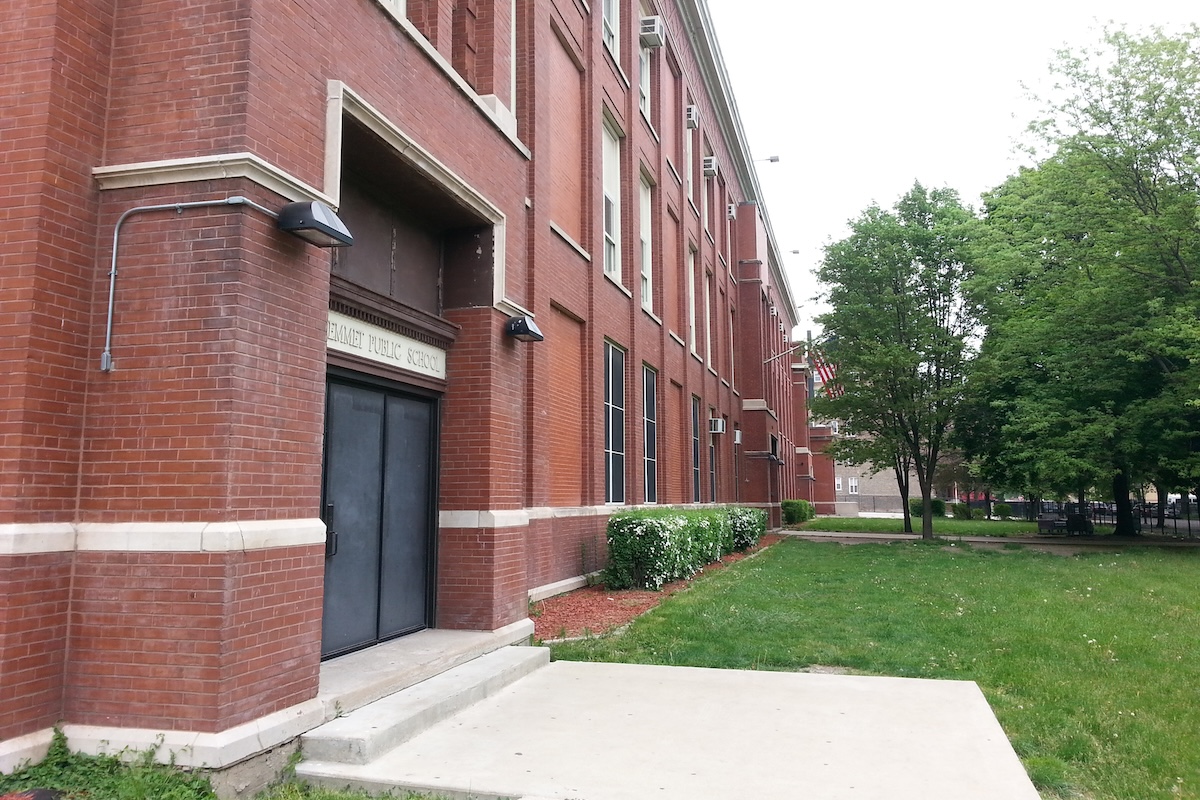
Thirteen years after Chicago closed 50 public schools, researchers found that shootings rose in the areas surrounding the vacant school buildings.
An August study from the University of Chicago and the Johns Hopkins Bloomberg School of Public Health found a link between increased gun violence and the city’s decision in 2013 to shutter the 50 schools, the most at one time in American history. Reporters can use this analysis in coverage of how gun violence is often an unintended consequence of policy decisions.
“We found that school closure and subsequent building vacancy were associated with significant increases in firearm violence in affected neighborhoods, and that this association appeared to be partially mitigated by subsequent school buildings reuse,” the researchers wrote in the study published in Social Science & Medicine.
The closures were associated with a 10.2% increase in shootings near the vacant schools compared to neighborhoods with similar racial demographics and poverty rates where schools remained open.
Some of those school buildings have been repurposed, and researchers found no meaningful increase in gun violence in those communities.
In their study, the authors write that closing schools is a “contentious policy decision” that’s been playing out in several U.S. cities, not just Chicago. Opponents often point to the negative effects closures can have on urban neighborhoods, they noted.
Potential story angle
Have schools closed in your community? What are the impacts? If officials in your community are weighing this, consider how potential school closures would affect the neighborhoods they’re in.
The researchers said the findings suggest that long-term school vacancies are “potentially a key factor contributing to increased firearm violence” and their analysis “demonstrates the importance of public investment in neighborhoods and the important protective roles public schools may play in mitigating firearm violence.”
Findings
The study used police crime data from 2010 to 2019 to identify the 10% increase in violence near closed schools, primarily on Chicago’s South and West sides. Those communities also saw increases in weapons violations and firearm-related assaults and batteries.
Researchers acknowledged limitations in their findings and in their ability to interpret the results as causal. Those limitations include that schools were closed, in part, because of factors like student performance and enrollment numbers, which likely reflect underlying issues in the surrounding neighborhoods, the authors wrote.
Regardless, the study’s authors emphasized the “significant association” they found between shootings and vacant school buildings.
“Multiple U.S. cities are once again considering significant school closures,” the researchers wrote. “While the decision to close a school is extremely complex and politically charged, this study indicates that there may be broad consequences — including potential increases in firearm violence — if schools are vacated without concomitant plans for community investment and development.”
Resources
- The study’s lead author: Thomas Statchen, Pritzker School of Medicine at University of Chicago, thomas.statchen@uchicagomedicine.org
- The K-12 School Shooting Database documents when a gun is fired, brandished or a bullet hits school property, regardless of the number of victims, time, day or reason. The database has over 2,380 school shootings from 1966 to the present. The open-source database offers some of the most comprehensive and thorough data on shootings that happen on U.S. school campuses. (We’ve covered this in a previous data dive.)
- The Gun Violence Archive is a nonprofit that provides comprehensive and detailed data on gun violence incidents in the U.S. Check out our explainer on how to use this resource.