Better ethical decision-making: It takes a team — and practice
By Kevin Stark/California Health Journalism Fellow
Health journalists today face major ethical questions, especially when reporting complex investigations.
That decision-making becomes easier when reporters and editors work collaboratively, share a clear vision and involve newsroom colleagues early in the process.
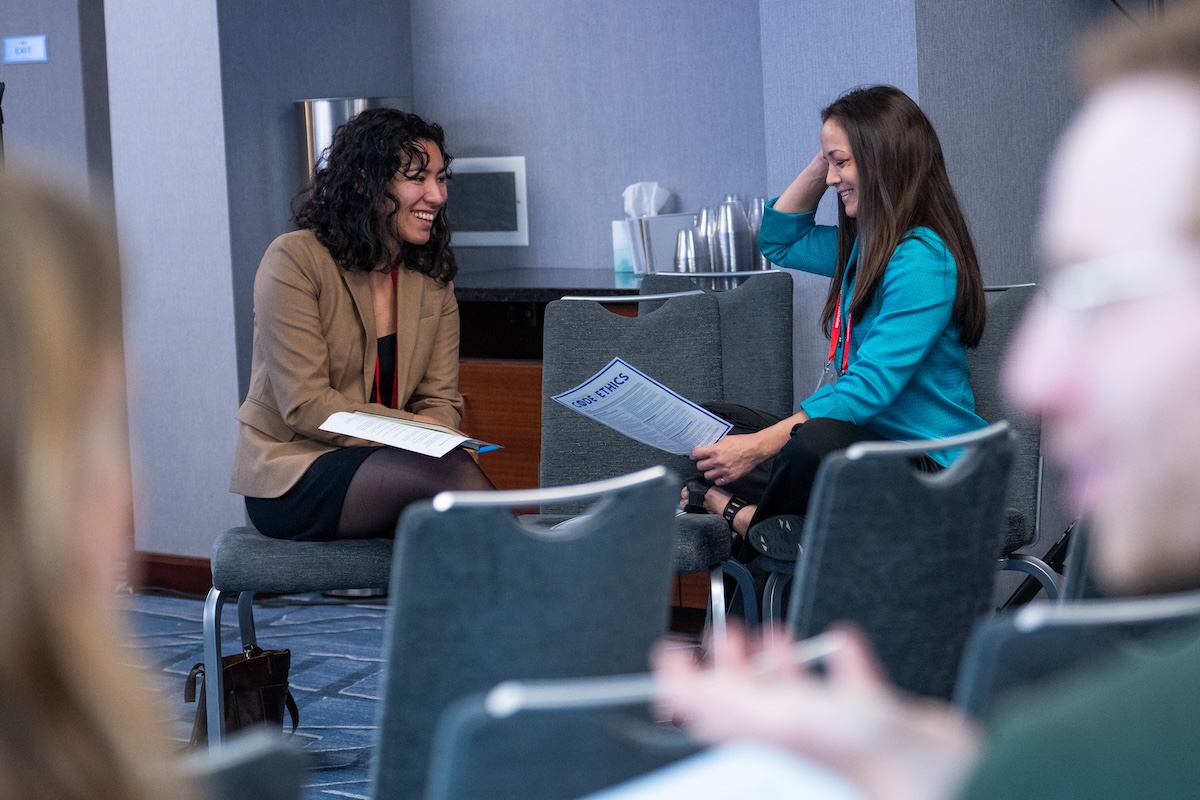
That was a main takeaway from The Seattle Times’ Hannah Furfaro and Diana Samuels, who discussed their work in an interactive fishbowl session at AHCJ’s annual conference in Minneapolis, titled, “Better ethical decision-making: It takes a team — and practice.”
 Photo by Zachary Linhares
 Photo by Zachary Linhares
 Photo by Zachary Linhares
 Photo by Zachary Linhares
The editor-reporter duo detailed the process behind a recent investigation into the largely hidden and unregulated practice of medical staff across the country restraining mental health patients by pulling coverings over their faces. These so-called “spit hoods” are approved for use by law enforcement but are not classified for medical use.
At the heart of the report was graphic video footage obtained by The Seattle Times showing medical staff holding down a struggling patient with a hood pulled around the person’s face and neck. To an average viewer with no context, it appeared the patient was being suffocated.
Samuels and Furfaro had to decide whether to publish the video, which clearly showed an unidentified patient in crisis. While the patient could not consent to the images being widely shared, publishing them could help expose what experts the reporters interviewed viewed as an unregulated and dangerous practice.
Ultimately, after consulting numerous editors and visual journalists, the team published select stills from the video and illustrations that obscured the individual’s identity. After the investigation published, Washington state drafted a statewide spit-hood policy, and some facilities banned the devices outright.
A mental health reporter at The Seattle Times, Furfaro said she always considers the equity issues at play. How might publishing a story or images affect an individual or their family?
“Thankfully, I’m not in this alone,” Furfaro said. “I work in a newsroom that values collaboration. Sometimes that means as many as eight or 10 people — reporters, visual journalists and editors — brainstorming how we should balance our obligations as watchdog journalists with our desire to protect vulnerable sources.”
The pair acknowledged that not all newsrooms operate this way, but they shared several practices that made their collaboration successful. Samuels, assistant metro editor at The Seattle Times, said involving the newsroom’s visual team early allowed staff to experiment with different illustrations, photos and layouts.
She said it’s also important to involve newsroom leadership early, once a reporter has developed a clear hypothesis about where an investigation may lead.
“I don’t want to bring them a fuzzy topic and say, ‘Hey, this is going to be really murky and epically tricky, and can we spend several months on it?’” she said. “I want to say, ‘Hey, this is the story, the hypothesis and our plan for it.’”
Early in the reporting process, Furfaro and Samuels purchased spit hoods and wore them while exercising to observe how the devices affected breathing and mobility as their heart rates increased. They also tested how effective the hoods were at preventing spitting. That reporting helped confirm the story was worth pursuing aggressively.
Kevin Stark is the senior science editor of KQED Public Radio.