As the leader of AHCJ’s New York City chapter, I organize a variety of in-person panels, tours, book talks and workshops for our local members. I was delighted to hear recently from a regular attendee Julia Daye that, for her, they’ve also led to invaluable connections with editors and actual published stories.
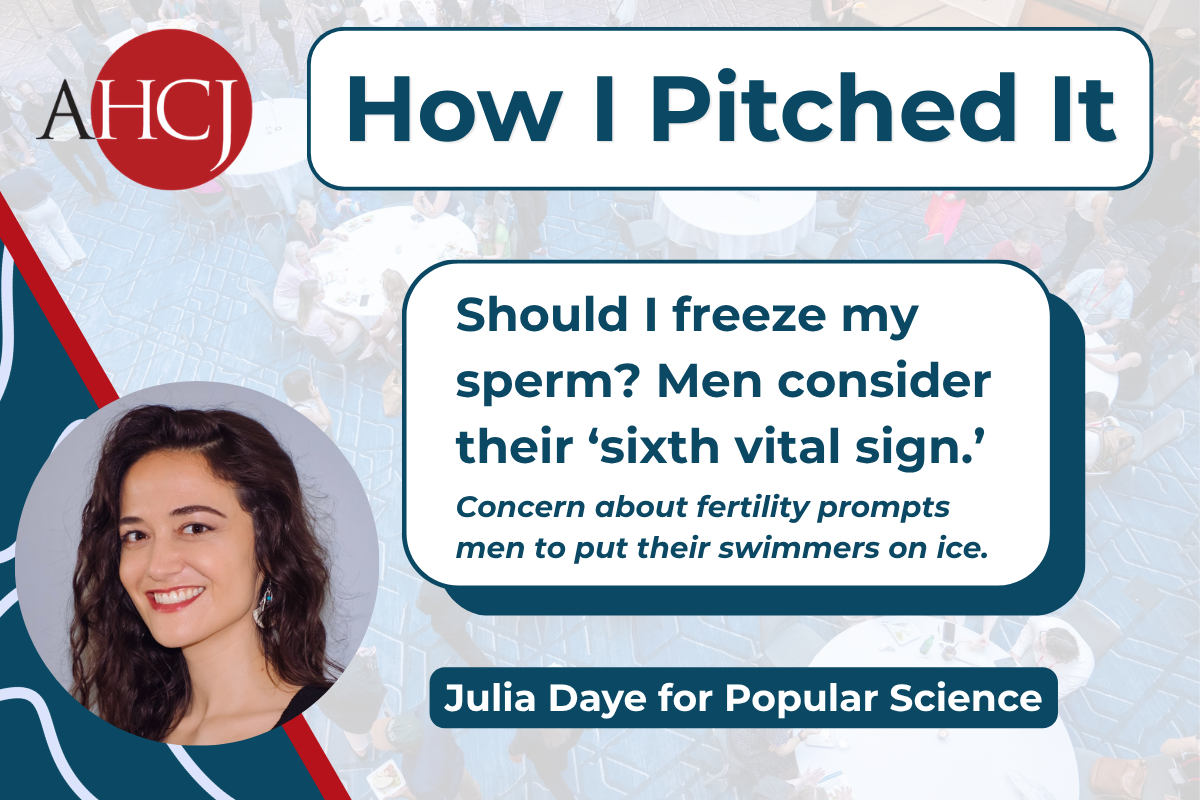
For example, when Daye, a freelance health and culture journalist in Brooklyn, came to a panel on covering fertility and modern family building that I moderated last spring, she left with a fresh angle for a concept she’d been long pondering and a connection to a helpful source. The idea eventually became the Popular Science article, Should I freeze my sperm? Men consider their ‘sixth vital sign,’ which was published last summer.
Here, Daye shares the exact pitch that landed the assignment, and a bit more about how the idea came to be. Check out the highlighted parts, too, for my commentary on what Daye’s pitch does well.
Here’s the pitch:
Should I freeze my sperm? Age and environment affect male fertility too, experts say
Egg freezing is booming. For a long time, men believed they could dodge the age-related fertility concerns that plague women, but research is proving that to not be true.
Medaris: Taking something that seems to be common knowledge and turning it on its head can often be a good hook.
Male fertility studies (like this one) have found a decline in males’ ability to fertilize eggs after age 35. Other studies have found developmental issues and miscarriages come from aging sperm or sperm that’s been exposed to elements over time. While many men do remain fertile into advanced age, the risk of challenges and complications surges. These realities are encouraging men to preserve their fertility with sperm banking.
Medaris: Importantly, Daye takes her assertion — that men’s fertility actually can decline with age — and backs it up with a few studies. This saves the editor the hassle of asking her to prove her point before deciding whether to assign the piece.
This piece would explore the lesser-known realities of male fertility and the pros and cons of banking sperm for later use. For this piece, I’d speak to Dr. Tia Jackson-Bey, a reproductive endocrinologist I met at an AHCJ panel, urologist and male fertility specialist Dr. Michael Eisenberg, and Dr. Guy Morris, a researcher in the male fertility study linked above.
Medaris: Had Daye left this out, I’m suspect the pitch still would have been approved. However, noting that you know or have met a source at an industry event can give editors confidence that you’re well-connected and will be able to secure the sources you’ve mentioned and more.
Where did the idea come from?

For a few years, I had been closely following conversations about egg-freezing. I like to look at health topics through a cultural lens, and this was a massive, ballooning movement. Women I knew were taking out loans, going to daily doctor’s appointments, injecting themselves at the kitchen counter and enduring bizarre side-effects. Many of them did this completely out of view of the men in their lives. Despite the science saying otherwise, the burden of babymaking was clearly still seen as “a women’s issue.”
However, this perception contradicted the research. Biologically, men don’t have eight decades to risklessly reproduce as people once thought. Sperm is affected by age and environment, impacting every stage of family building — from ease of conception to the health of the pregnancy to the health of the baby. In some of the panels I attended, doctors encouraged men to freeze their sperm, but by and large, discussions about fertility omitted half the story.
[I came to believe] sperm freezing for future family planning is as good an idea as egg freezing. It’s also cheaper, faster and less painful. A subset of men who knew the science were beginning to do it. And while this wasn’t happening at the rate of egg freezing, I wanted to write about the science behind why these men may be onto something.
Why did you think Popular Science was the right fit?
Popular Science is a great publication for highly relevant, sciency stories approached from a less-explored angle. Fertility is such a trending subject. I knew this was an underdiscussed aspect and thought it might have a shot with the editors there.
Timing played a role as well. Simply being fresh in someone’s mind can be an opportunity on its own. I had just finished another story for Popular Science and had been sitting on this male fertility pitch for a few months. The editor I worked with on the previous piece asked me if I had anything else, so I sent this pitch alongside another one in an email. She chose this one.
How did the idea evolve from there?
This pitch started off as scribbles in my notebook while at the AHCJ panel on fertility. I initially thought the story would singularly be a dive into the science behind geriatric fatherhood. Although, in further prereporting, I learned about the growth of sperm banking for later use. There was a small surge of men who wanted to give themselves more assurance of their futures as parents, much like the women I knew freezing their eggs. I thought this would be an interesting hook.
Once the pitch was accepted, the editor and I exchanged a few emails solidifying specs and sourcing. It was clear this was going to be a larger feature with numerous voices from different areas of male fertility.
What helped make the story a success?
I was lucky when it came to sourcing for this one. A few of the people I wanted to interview had participated in a panel I attended, which helped when it was time to reach out. Currently, the world of male fertility research is relatively small — a lot of people know each other. So at the end of early interviews, I asked the subjects who else they recommended. I then started my next email letting the following person know the name of who sent me. These kinds of references can help the next source feel more comfortable agreeing to a conversation.
It also helped that I had been immersed in this subject matter for some time already. I was passionate and knew a lot of the language of the field. I had done significant prereporting in the months leading up to the pitch out of sheer interest in the subject.
How did the final piece compare to what you expected when you pitched it?
I ended up doing twice the number of interviews I expected to do. There was also an unanticipated finding in the reporting that broadened the piece – the concept of sperm as men’s “sixth vital sign.” Health-conscious men weren’t just banking their sperm, but testing it as well. In interviews, experts emphasized that sperm tests can be used to measure overall health, even at a young age and regardless of whether you’re immediately interested in having children. This became a central aspect of the final piece, and the editor even made it part of the title.
What other advice do you have for freelancers?
Go to book talks, panels and literary events! An editor I’ve gotten to work with numerous times at Popular Science was someone I knew and then ran into at a book talk. I pitched her a few days after our run-in, and we’ve worked together regularly ever since.
These events can also be troves of story ideas and potential sources. Several of my sources for this piece were people I had recently shared a room with. Get people’s contact info, even if you don’t pitch the story for a few months. Even if they don’t remember you, they’ll likely remember the event.