
This year, U.S. workers are once again facing rising health insurance costs, continuing a trend that has persisted for decades, according to KFF’s 2026 Employer Health Benefits Survey, published yesterday, Oct. 22.
The survey results show employers’ and workers’ health insurance costs rose this year in multiple ways. First, workers’ average annual contribution toward family health insurance premiums rose by $621 (9%) to $7,471, from 2025.
Second, rising health insurance premiums can put pressure on employers to limit wage increases, meaning workers and families may feel the effects in their paychecks, too.
Then, third, rising health insurance can cause workers to have higher out-of-pocket costs when they seek care. The average annual family deductible rose to almost $2,000 annually, the survey noted.
For single workers, the average deductible this year is $1,955, an increase of $69 (3.65%) over the $1,886 workers paid last year, the survey showed. The average annual deductible for single coverage at small companies was much higher ($2,624) than what workers pay at large companies ($1,772), KFF noted.
Consumers struggle to afford care
“I have health insurance but I feel like I don’t have health insurance,” one young mother told me.
Journalists seeking to interview families trying to pay for health care can interview patient advocates who will know patients needing help paying their hospital and other health care bills.
Multiple state and federal laws require nonprofit hospitals to inform patients about their financial assistance policies, including by putting that information online, on hospital bills or posting it publicly. The financial assistance staff will know patients who need help and may refer those patients to reporters.
“People tell us in polls that their health care costs are their top cost-of-living concern, tied with gas prices,” KFF President and CEO Drew Altman said in an interview with Reed Abelson of The New York Times. “The fact that workers’ share of premiums went up almost three times faster than inflation in 2026 helps explain why.”
In her article: “Employers Shift Rising Health Care Costs Onto Millions of Workers,” Abelson explained how rising premiums and deductibles are forcing people to forgo treatments and doctor’s visits while budgets are strained from higher food and gas prices.
Another view on employers’ costs
In an interview last month, Jenny Goins, interim president and CEO of the National Alliance of Healthcare Purchaser Coalitions, said that rising health care costs have strained employers’ budgets for many years.
“We’re reaching a breaking point, which is a fact that employers recognize now as a business issue,” Goins said. “Employers are recognizing that health care costs are affecting their businesses because wages are being impacted along with their bottom line numbers.”.
In August, the National Alliance published this report, Pulse of the Purchaser 2026 Survey Results, showing 83% of respondents said their health insurance premiums were cutting into the wages they paid.
“So not only do employees get hit with premium increases, but also they’re not getting the same wage increase they might have gotten in the past,” Goins explained. Almost all survey respondents (93%) expected to shift more health insurance costs to employees, the survey showed.
Employers have stories to tell
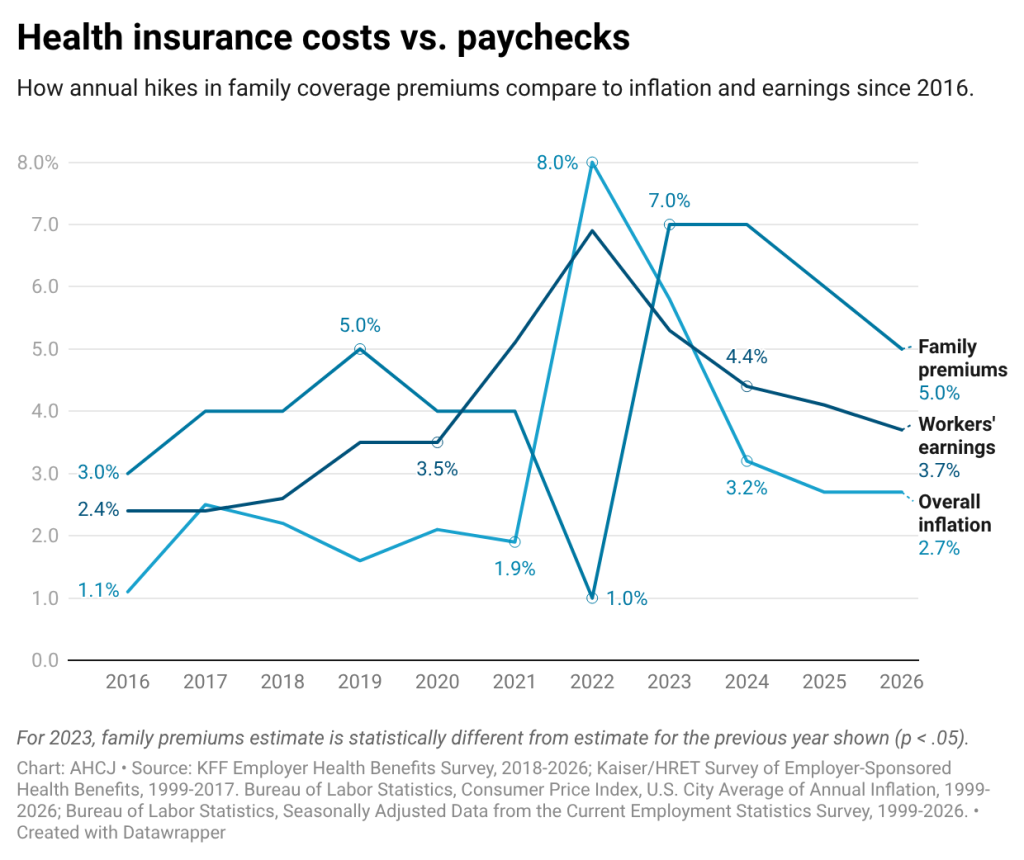
As Goins suggested, one way to cover the KFF survey is to interview employers who struggle to retain their workers while also paying for rising health insurance costs every year. Note that the KFF report shows health insurance premiums have risen more than workers’ earnings and inflation almost every year since 1998, the report’s first year. Over the past five years, family premiums rose 28%, compared with a 26.9% increase in wages and a 24.4% increase in general inflation. (see chart).
For other employer sources, see the multi-part series STAT’s business of health care reporter Bob Herman is doing about employers’ rising costs called Out of Pocket, Out of Reach. On Aug. 19, AHCJ hosted a webinar with Herman, Covering health care affordability, a big story with major impact, in which he explained what he uncovered in the first four parts of the series.
In his articles, health care reporters will find good examples of employers struggling to retain their workers while health insurance and health care costs rise steadily.
Another way to cover the KFF survey is to read the series of articles investigative reporter George Joseph wrote for The Guardian US. Titled “Too Big to Care,” the multi-part series stretched over many months and focused on Parkview Health, a health system in Fort Wayne, Ind., that operates 16 hospitals in Indiana and into Ohio. Joseph reported on how Parkview acquired multiple formerly independent doctors’ offices and hospitals in both states.
“With this growing market power, the Fort Wayne-based system had pushed health insurance companies to agree to some of the highest hospital prices in the country–increases one employer thought were being dumped onto his company,” Joseph reported.
For more ideas about how to cover employers’ rising health insurance costs, see Joseph’s article, “Patients and employers accuse not-for-profit Indiana hospital of price gouging.” Other articles in that series also are worth reading for the results they produced in Indiana.
Resources
- Hospital and pharmaceutical prices are smothering America’s businesses, Bob Herman, STAT News, Oct. 5, 2026
- Covering health care affordability, a big story with major impact, AHCJ webinar with Bob Herman, health care business reporter, STAT News, Aug. 19, 2026
- How health care costs are undermining America’s public-sector employers, Bob Herman, STAT News, Aug. 18, 2026
- America’s employer health insurance is decaying, Bob Herman, STAT News, July 7, 2026
- This whistleblower took on a health insurance giant and a political machine. She’s not stopping there, Bob Herman, STAT News, July 7, 2026
- For a Georgia entrepreneur, health coverage has never been affordable, Bob Herman, STAT News, Aug. 18, 2026
- America’s small businesses are giving up on health insurance, Bob Herman, STAT News, July 7, 2026
- Patients and employers accuse not-for-profit Indiana hospital of price gouging, George Joseph, The Guardian, Oct. 24, 2024