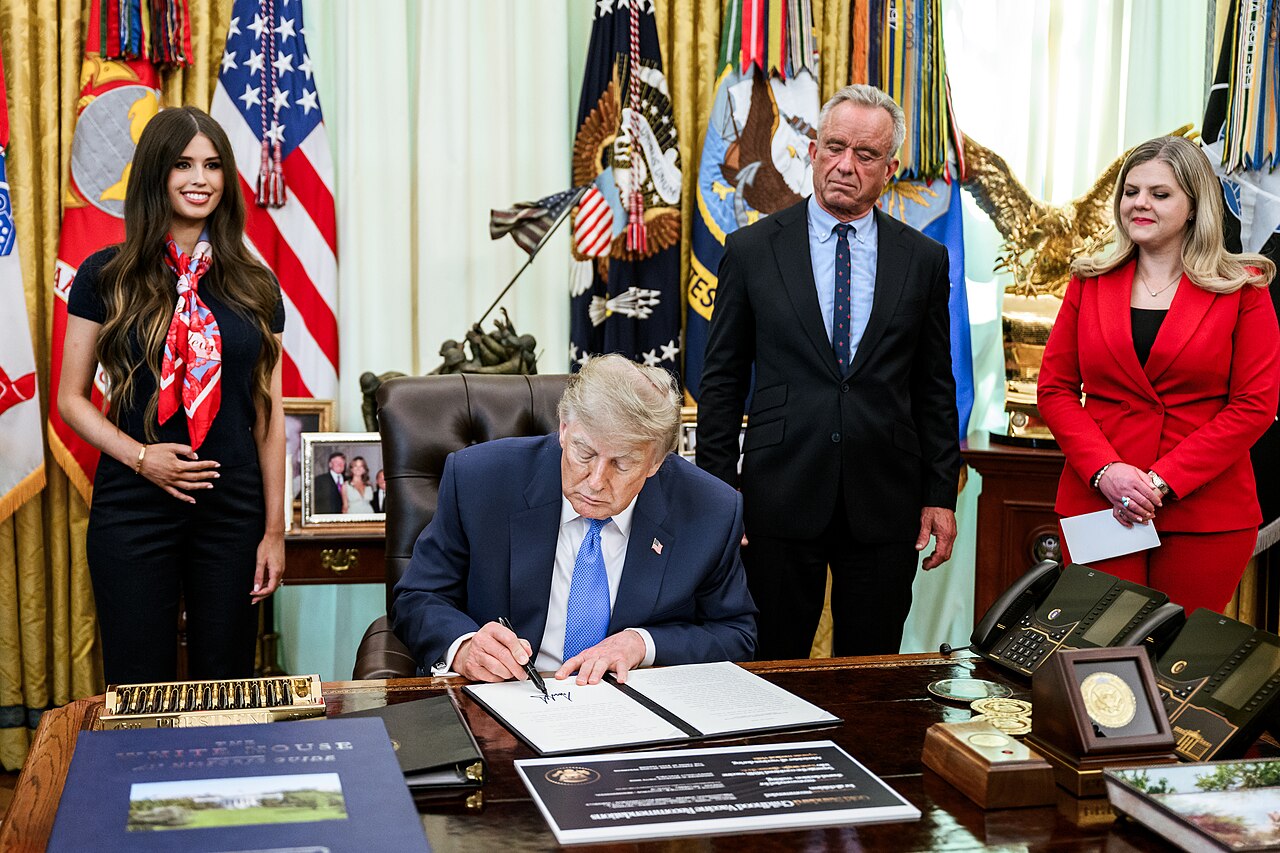
The Trump administration issued an executive order on childhood vaccine recommendations Monday. It’s important that your reporting on the order clarifies what it does and doesn’t mean for families, including whether it changes actual national policy on vaccines (it does not). This quick primer can help journalists navigate the key points to better inform their audiences.
What happened?
President Trump issued an executive order, “Delivering Gold Standard Childhood Vaccine Recommendations for Americans,” on August 10. The order had been expected but, importantly, can’t legally change the current recommended childhood immunization schedule. Changing the schedule can only be done by the CDC director following an open meeting of the Advisory Committee on Immunization Practices. As the Pharmacy Times accurately reported, the executive order “does not alter the immunization schedule pharmacists work from” but “is likely to drive a fresh wave of parent questions.”
The key message journalists should convey to their audiences is that the executive order does not change vaccine policy, and both insurance and Vaccines for Children will continue to cover all childhood vaccines that have been covered.
The order repeats several suggestions made by previous presidential memos or orders (see below) but goes further with several new recommendations.
The order recommends giving the measles-mumps-rubella (MMR) vaccine as three separate shots once such a product becomes available domestically. However, breaking up the MMR vaccine is extremely unlikely because it is difficult and potentially dangerous. The order also suggests that other vaccines be offered as single disease shots, which would increase the number of total injections children would receive.
The order recommends that all childhood immunizations be administered at separate medical visits “to the maximum extent feasible.” Journalists should speak with pediatricians and researchers about what the problems are, scientifically, financially, and ethically, with that proposal. The AAP can recommend sources to those who do not already know whom to contact.
The executive order advises HHS to seek alternatives to adjuvants containing aluminum. Adjuvants are additives to vaccines that enhance their potency and effectiveness. Multiple experts, such as those recommended by the AAP and Infectious Disease Society of America, can explain why aluminum is an effective adjuvant and the scientific challenges to finding alternatives. The order tells HHS to “assess the ideal timing and sequencing of all core childhood vaccines” and adjust the schedule to align with science, but the current schedule is aligned with current evidence.
Also, the order implies that the current recommended childhood immunization schedule needs updating to align with current scientific evidence. However, the proposals made in the order go against current medical evidence, which journalists can make clear through their sources and linked resources from the AAP, other medical organizations and peer-reviewed research.
Although the order itself does not mention autism, Trump repeatedly mentioned autism during the signing, again reviving a claimed link to vaccines that scientific research has definitively rejected repeatedly (resources below).
What’s the background and context?
This order is the most recent of several presidential attempts to influence vaccine policy with a specific agenda that does not align with established evidence on childhood vaccines.
The first was a brief presidential memo on December 5 directing HHS to conduct a report on peer nations’ vaccine schedules. The American Academy of Pediatrics (AAP) published an explanation of the problems with that memo’s implications.
The January HHA report following that memo was criticized by vaccine researchers for creating confusion. The report was authored by Tracy Beth Hoeg, acting director of the Center for Drug Evaluation and Research (CDER) at the FDA. Hong is a sports medicine physician who has no training beyond basic medical school in pediatrics, infectious disease, vaccines, or immunology.
Following the report, a January 5 presidential memorandum proposed a revised childhood and teen immunization schedule that claimed to advise adjusting the U.S. schedule to align with other countries’ schedules. That memo, like the executive order, did not have legal power to change the schedule. Regardless, HHS Secretary Robert Kennedy Jr. unilaterally changed the schedule. AHCJ covered that change here and hosted a webinar on it.
In March, a federal judge blocked Kennedy’s revised schedule and the new Advisory Committee on Immunization Practices (ACIP) members he had appointed after firing the previous members, a decision issued in a lawsuit by the AAP. That reverted the schedule to its state prior to June 2025. AHCJ covered that decision here. Read more coverage at CNBC, The Washington Post and CNN.
Trump then issued an executive order on May 29 that directed the CDC and ACIP, “to the extent permitted by law, take any appropriate steps to update the United States childhood and adolescent vaccine schedule.” At that time and now, the extent permitted by law is not to make any changes until a legally constituted ACIP is formed. The lawsuit that resulted in blocking Kennedy’s changes is still ongoing.
What will change as a result of the new executive order?
In terms of the federally recommended childhood vaccination schedule and payer coverage of those vaccines, nothing can or will change as a result of the new order.
However, as with previous attempts by Kennedy and Trump to change the schedule, this order is likely to cause confusion for families and contribute to more vaccine hesitancy. Journalists can help families understand what the evidence actually shows and how that evidence supports the current schedule by consulting reliable pediatricians, family physicians, and vaccine and infectious disease researchers.
What do medical experts and organizations say about the executive order?
Multiple medical organizations, such as the AAP, the IDSA, the American Medical Association, the National Foundation for Infectious Diseases, the Pediatric Infectious Diseases Society, the Society for Maternal-Fetal Medicine, and the American College of Obstetricians and Gynecologists (others below), have issued statements about the executive order.
In addition, multiple experts in infectious disease and vaccines have criticized it. An excellent analysis that I would consider required reading for all journalists is at CIDRAP by Jake Scott, a clinical associate professor of infectious diseases at Stanford University School of Medicine. Unbiased Science’s Jess Steier, DrPH, also has an excellent analysis of what this order does and doesn’t mean and how feasible its suggestions are.
Resources
- CIDRAP Op-Ed: What the vaccine executive order gets wrong, and what it will cost us, Jake Scott, MD, CIDRAP
- Trump signs executive order to break up measles, mumps, rubella vaccine, CIDRAP
- Where Is the Line? An executive order on childhood vaccines, and what actually changes for your family, Unbiased Science
- Splitting the MMR vaccine into its three components will be difficult, Dorit Reiss, PhD
- How we know that splitting up the MMR vaccine could be dangerous, Matthew Herper, STAT News
- Fact Checked: U.S. Vaccine Recommendations are Appropriate for Children in the United States, AAP
- AAP Immunization Recommendations Process: 2026
- Immunization Fact Sheets, AAP
- Shifting Public Discourse on Vaccines, Frameworks
- Washington Post Q&A: What does Trump’s executive order on vaccines mean for my kids?
Medical and professional organization statements
For those writing for an audience where faith plays a large role in medical decisions, the Christian Medical and Dental Associations published an analysis of the problems with the Trump administration’s attempts to change the immunization schedule.
- AAP Statement in Response to Executive Order on Vaccines, American Academy of Pediatrics
- SMFM Statement on Executive Order Changes to Childhood Vaccine Schedule,” Society for Maternal-Fetal Medicine
- ACOG Statement on the August 10 Executive Order on the Childhood Vaccine Schedule, American College of Obstetricians and Gynecologists
- IDSA statement on vaccine executive order, Infectious Diseases Society of America
- NFID Statement on Childhood Immunization Schedule, National Foundation for Infectious Diseases
- AMA statement on executive order changing childhood vaccine schedule, American Medical Association
- American College of Physicians: Executive order directing changes to U.S. vaccine schedule problematic, deeply concerning and creates barriers to access
- AAPA Statement on Changes to Childhood Vaccine Recommendations, American Academy of Physician Associates
- PIDS Response to ‘Delivering Gold Standard Childhood Vaccine Recommendations for Americans’ Executive Order, Pediatric Infectious Diseases Society
- American Lung Association: Executive Order on Vaccines Hurts Children’s Health During Back-to-School Season
- 2026 US Childhood Immunization Schedule Reduction and the Christian Clinician: A Bioethical Analysis of Process and Content, Christian Medical and Dental Associations
- Impact of the Advisory Committee on Immunization Practices Recommendations on State Law, Association of State and Territorial Health Officials, June 2025
Resources on autism
- Fact Checked: Vaccines: Safe and Effective, No Link to Autism, AAP
- Evidence Shows Vaccines Unrelated to Autism, Immunize.org
- The Truth About Autism and Vaccines, Vaccinate Your Family and Autism Science Foundation
- The Facts About Autism & Vaccines, Autism Society, Vaccinate Your Family and Immunize.org
Advocacy organization statements
- Vaccinate Your Family’s Statement on the Executive Order Delivering Gold-Standard Childhood Vaccine Recommendations for Americans
- AFV’s Statement on Federal Executive Order on Vaccines, American Families for Vaccines
- Trust for America’s Health Statement in Response to Executive Order on Childhood Vaccine Recommendations