Baby KJ’s next steps: The future of personalized gene therapy
By Jared Whitlock/California Freelance Fellow
When a press release touts a novel medical breakthrough, reporters should be skeptical. That tension between a claim almost too good to believe and a case that turned out to be real was the focus of an HJ26 panel on baby KJ, who benefited from a first-of-its-kind individualized gene editing treatment.
KJ Muldoon was born with severe CPS1 deficiency, a urea cycle disorder in which a faulty liver enzyme allows toxic ammonia to accumulate at deadly levels. Rather than wait for a liver transplant, Kiran Musunuru, the director of the University of Pennsylvania’s genetic and epigenetic origins of disease program, and his collaborator, Rebecca Ahrens-Nicklas, designed a medicine using CRISPR, a drug development tool that can fix mutations in DNA. The case was widely celebrated in news outlets and showed how such technology can benefit patients with ultra-rare conditions.
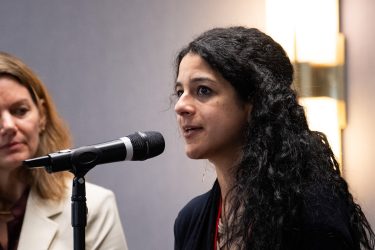
Panelist Sara Whitlock of SciLine offered a vetting toolkit that can help reporters when such stories come to their attention. For example, ask outside sources what counts as success and failure. Ask whether the technology is possible. Find independent experts early by reviewing past interviews and conference talks. And don’t overlook teaching faculty, who can explain complex science to non-specialists.
Moderator Letitia Stein, who edited the Philadelphia Inquirer’s coverage of KJ’s experience, said she’s wary of claimed firsts, and prefers language like “first-of-its kind.” She added it’s also important to address cost, replicability and which patients might benefit. Read journal companion pieces, and define jargon like CRISPR for general audiences too, she said. Musunuru repeatedly cautioned against overselling, saying he has never used the word “cure,” and warned against “irrational exuberance” that might give other families false hope.
KJ, now a smiling toddler, appeared on camera during the session. His mother, Nicole Muldoon, said she’s now an advocate focused on helping families like hers, hinting at a larger challenge: how to scale personalized therapies to reach millions worldwide.
Musunuru described working with the FDA on an “umbrella” trial to treat any patient with one of several urea cycle disorders using the same reprogrammable platform. He noted a new “plausible mechanism” framework meant to speed individualized therapies. The goal, he said, is to move toward repeatable and reimbursable treatments.
Jared Whitlock is a freelance reporter who has covered rare disease research for outlets like Stat and Kaiser Health News, and in his prior role as a features editor and writer at Endpoints News.