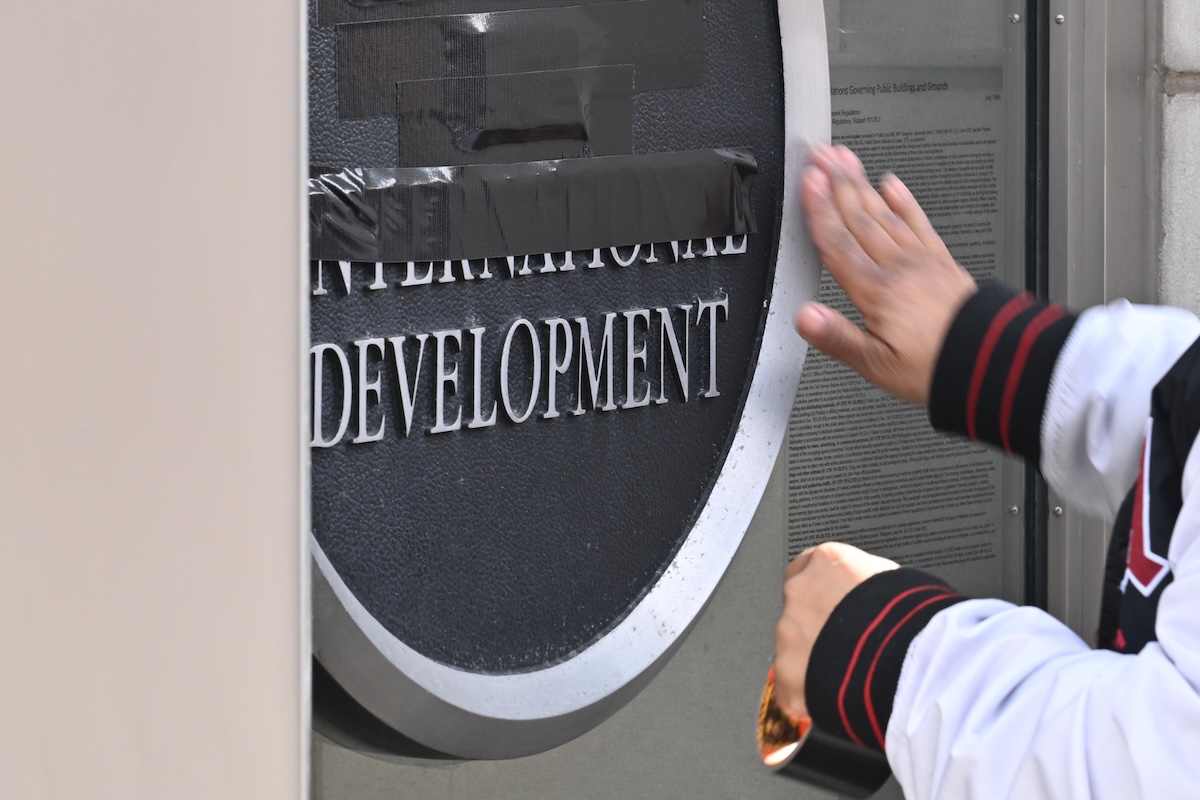
U.S. foreign aid is facing the steepest funding cuts in modern history since the Trump administration dismantled USAID last February and shifted foreign assistance to the federal Department of State. In communities worldwide that rely on U.S.-funded health and humanitarian programs, the effects were felt almost immediately.
As those changes unfolded, ProPublica reporters Anna Maria Barry-Jester and Brett Murphy set out to document what the scale-down meant for people on the ground. Their Pulitzer-finalist work traced the dismantling of USAID from the nation’s capital to refugee camps in Kenya, South Sudan and Vietnam, and revealed the human toll of shuttered aid programs including disease outbreaks and worsening hunger. Their work was a finalist for a Pulitzer Prize this year.

Shortly after the federal Department of Government Efficiency (DOGE) cut USAID’s funding early in 2025, Barry-Jester and Murphy began reporting the story in Washington, D.C., Murphy said. So much of USAID’s staff had been cut, however, that they lacked the sources needed to report the story.
“One reason we went [to Africa] was because there was so little visibility about what was happening,” he said. “A lot of the people had been laid off, or they weren’t allowed to talk to anyone anymore.
“We wanted to go [to Africa] to fact-check what the administration was saying,” Murphy added. “Publicly, they said nobody had died, and we wanted to know: ‘Is that true? Let’s go see.’”
700,000 deaths and counting
Since early 2025, the loss of USAID funding has led to an estimated 700,000 deaths, NPR reported on July 17. By 2030, researchers estimate as many as 14 million people could die, including 4.5 million children under age 5, according to a July 2025 study in The Lancet.
Barry-Jester discussed how the reporting evolved from breaking news into a months-long investigation, why persistence matters more than perfection, and how reporters can build deeper enterprise stories even on daily deadlines.
The interview below has been edited for length and clarity.
How did this reporting project begin?
When the administration took office, I had already been covering global health for years and was trying to understand what the U.S. priorities would be. My colleague, Brett Murphy, was covering the State Department. Almost immediately, sources inside government began telling us that what officials were publicly saying about preserving lifesaving aid programs didn’t match what was actually happening.
Our first goal wasn’t to produce an investigation. It was simply to answer a basic reporting question: ‘What is actually happening?’
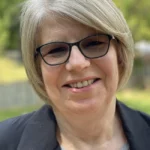
Anna Maria Barry-Jester
Reporter, ProPublica
We talked to a huge number of people in a short period of time to build as accurate a picture as we could. From there, it became clear this wasn’t just a temporary disruption. We kept hearing that a congressionally mandated agency was effectively being dismantled. So we continued following the story.
At what point did you realize you needed to report outside Washington?
We were reporting simultaneously on two questions. One was what decisions were being made inside government and who was making them. The other was what those decisions meant in the real world.
As we continued reporting, we kept hearing about potentially enormous health consequences around the world. We knew we had to document those just as rigorously as the policy decisions.
Both Brett and I spent weeks reporting in Kenya and South Sudan after extensive planning and pre-reporting. We were still covering Washington while also trying to understand what was happening on the ground. Those two strands of reporting informed each other throughout the project.
Your reporting described an ‘American-made hunger crisis.’ How did you reach a conclusion like that with confidence?
We had the advantage of reporting on this consistently throughout the year. By the time we published those deeper stories, we had accumulated a tremendous amount of reporting.
Just as important, we spent significant time in the communities we covered. We talked with residents, community leaders, NGO workers, camp administrators, police and government officials. We wanted to understand exactly what had changed.
These communities already faced war, poverty and food insecurity. We weren’t claiming those problems suddenly appeared. What we documented was that people lost essential services they depended on because of specific policy decisions. We were very careful not to make that conclusion until we had extensive reporting to support it.
The stories ultimately stretched from Africa to Vietnam. How did you decide where to go?
We tried to follow the reporting rather than start with a geographic plan.
As we investigated what was happening in Washington, sources kept pointing us toward programs experiencing serious consequences. Vietnam was one example. The United States had paused an Agent Orange cleanup project after contaminated soil had already been excavated, creating potential health risks for nearby communities.
Our approach was to ask: Where is the greatest harm occurring? That’s what guided our reporting decisions throughout the year.
What kind of response did the series receive?
We heard from readers who appreciated having a clearer picture of what their government was doing. We also heard from people who wanted to help after reading about the communities we covered.
The Agent Orange story generated particularly strong responses from veterans and families affected by Agent Orange exposure.
We also sought responses from the administration throughout our reporting. Officials defended the disruptions as necessary reforms while disputing that the cuts had caused deaths. Including those responses was an important part of documenting what was happening.
Many health reporters don’t have months to devote to one project. What advice would you offer for producing stronger ‘day two’ stories?
Don’t stop calling people after the first story.
If an issue matters and you know it’s going to continue evolving, keep talking to your sources. The best enterprise stories often come from many smaller conversations over time rather than one big interview.
Anna Maria Barry-Jester
Reporter, ProPublica
Organization is also incredibly important. You never know which interview, document or source will become essential months later. Having a system that lets you find those notes and reconnect with those people makes a huge difference.
Think about your North Star. What is the larger question you’re trying to answer? In investigative journalism, that often comes back to accountability: Who made these decisions? Why? How? Keeping those questions front of mind sounds fundamental, but those questions have always been great places to start.
Resources
- “People Will Die”: The Trump Administration Said It Lifted Its Ban on Lifesaving Humanitarian Aid. That’s Not True,” Barry-Jester and Murphy, ProPublica, Jan. 31, 2025.
- “In Breaking USAID, the Trump Administration May Have Broken the Law,” Barry-Jester and Murphy, ProPublica, Feb. 9, 2025.
- “Trump Halted an Agent Orange Cleanup. That Puts Hundreds of Thousands at Risk for Poisoning,” Barry-Jester and Murphy, ProPublica, March 17, 2025.
- “Trump Officials Celebrated With Cake After Slashing Aid. Then People Died of Cholera,” Barry-Jester and Murphy, ProPublica, Dec. 15, 2025.
- “Inside the Trump Administration’s Man-Made Hunger Crisis,” Barry-Jester and Murphy, ProPublica, Dec. 17, 2025.
- “The Summer of Starvation: Amid Trump’s Foreign Aid Cuts, a Mother Struggles to Keep Her Sons Alive,” Barry-Jester and Murphy, ProPublica, Dec. 17, 2025.
- “The Human Cost of DOGE’s War on USAID,” David Remnick and Atul Gawande, M.D., The New Yorker, June 12, 2026.
- Into the Wood Chipper, A Whistleblower’s Account of How the Trump Administration Shredded USAID, book by Nicholas Enrich and forward by Atul Gawande, M.D., Simon and Shuster, April 14, 2026.