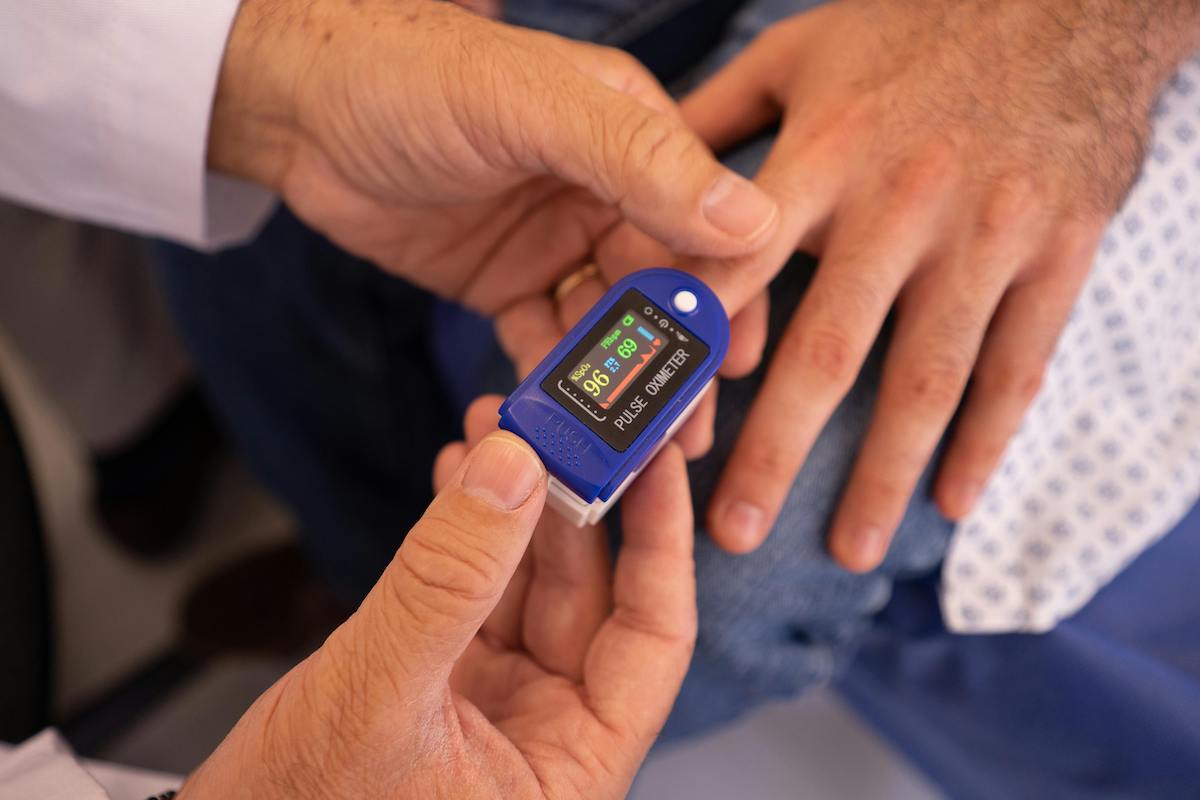
The U.S. Food and Drug Administration in early January released a proposed guidance document advising how manufacturers should evaluate and label pulse oximeters used for medical purposes. Pulse oximeters — noninvasive devices placed on a finger and used to measure a patient’s blood oxygen level and pulse — are used commonly in medical settings.
The new guidance comes “decades after studies showed that the widely used devices work less well on patients with darker skin and more than four years after new research on the problem was published during the COVID-19 pandemic, when the devices were instrumental,” AHCJ member and STAT reporter Usha Lee McFarling and colleague Anil Oza wrote in a recent article. McFarling has covered this issue extensively over the past few years.
“Subsequent studies have shown the problem has led to some patients not being admitted into emergency rooms for severe cases of COVID, or not receiving supplemental oxygen they needed while being treated in ICUs, and may have led to a higher number of cases of organ failure and death for patients with darker skin,” McFarling and Oza wrote.
Comments received by March 10 will be considered before the agency works on the final version, Healthcare IT News reported. The draft guidance does not apply to pulse oximeters sold as general wellness products or sporting/aviation products, which are not evaluated by the agency before sale, according to an FDA press announcement.
Prior to issuing the guidance, the FDA held two advisory committee meetings, in 2022 and 2024, and issued a discussion paper to consider the devices’ accuracy and ways to improve and evaluate their performance, the press announcement said.
If you haven’t been following this issue, here’s a primer to get you up to speed.
How do pulse oximeters work?
The devices, invented in the 1970s, emit light beams that travel through the skin to estimate pulse rate and blood oxygen levels. They shine two types of light (infrared and red) through the finger and measure how much of both types of light are absorbed, according to a video produced by STAT. Oxygenated blood absorbs more infrared light, while deoxygenated blood absorbs more red light. Comparing how much of each type of light is absorbed provides an indirect measure of how much oxygen is in the blood. This helps detect a person’s lung health status, University of Michigan pulmonologist Michael Sjoding, M.D., explained in an AHCJ webinar last fall. A reading of above 95% is considered healthy.
Why do they work differently in some people with darker skin tones?
Melanin in the skin can interfere with light absorption or change the way light is sent through the skin, Sjoding said. This can cause the devices to give a false reading and appear as if the oxygen level is higher than it is. Poor performance of the devices on darker skin was detected in studies decades ago but not widely known until recently, the STAT video explains. New studies conducted during the COVID-19 pandemic, when the devices were used extensively, brought this concern back to light.
The FDA issued a safety alert in 2021 after it became known that less accurate readings in people with darker skin could lead to hidden hypoxemia, low levels of oxygen in the blood.
What alternatives exist?
Physicians can use an arterial blood gas analysis, which requires a special blood draw into the wrist to measure oxygen and carbon dioxide levels in the blood, Sjoding said. Unfortunately, it is a painful procedure for patients. Other devices in development are looking at shining several wavelengths of light at once, or different methods of shining the light, he said.
What is in the FDA’s updated guidance document?
The document recommends testing the devices on more people and provides clearer direction on the makeup of populations and skin tones they should be tested on, McFarling and Oza wrote.
“Previous guidelines asked for 200 data points,” they wrote. “The new guidelines suggest manufacturers submit 3,000. They also increase the suggested sample size for studies of pulse oximeters from 10 people to 150 or more.”
The guidance also suggests that manufacturers use tools like the Monk Skin Tone scale — an open-source, 10-shade scale describing human skin color developed by Harvard professor Ellis Monk in partnership with Google and released in 2023 — and individual typology angle, a tool that classifies skin types into six groups, to judge skin tones when testing, McFarling and Oza noted.
“The FDA stipulates that at least 25% of subjects should be in each of three groups: those with light, medium, and dark skin tones, and that half the participants in the dark skin tone group include subjects with very dark skin,” they wrote. The guidance also stated that if equal performance is demonstrated, the device package insert should include a prominent statement conveying that the device has been evaluated to perform comparably across people with a variety of skin tones, they said.
Manufacturers should “prominently display appropriate warnings” in the devices’ instructions, such as informing patients that “differences in skin pigmentation may cause differences in pulse oximeter sensor performance,” according to a story by CNN.
Where can I find more information about these issues?
- Review news coverage of the issue by McFarling and colleagues on STAT’s website.
- Review documents found on the FDA website, including the new 2025 guidance and a 2021 safety communication informing the public and health care providers of the limitations of the devices.
- Review other news agencies’ coverage of this ongoing issue. AHCJ board member Joyce Frieden, Washington editor for MedPage Today, and Healthcare IT News reporter Andrea Fox also have been following this news.
Story ideas
- Talk to manufacturers about how they may implement the guidance or about any updated versions of pulse oximeters or similar devices they are working on.
- Talk to physicians/bioethics experts about what they think of the draft guidance. Will it be effective? How long could it be before we see results?
- Talk to researchers working on novel versions of these devices (McFarling has covered some of them for STAT here). What features are they including in their designs? How soon could these come to market?
- Researchers with the FDA and Stanford University are conducting a clinical study to evaluate the accuracy of pulse oximeters in children. Some information is available in this slide deck. Interview investigators for an update, or talk to pediatric experts in your area to assess their level of concern.
- Researchers with FDA and the University of California, San Francisco, are conducting a clinical study to evaluate pulse oximeter errors in hospitalized patients. Some information is available in this slide deck. Interview investigators for an update.
Resources
- Pulse Oximeters for Medical Purposes – Non-Clinical and Clinical Performance Testing, Labeling, and Premarket Submission Recommendations — a FDA guidance document from January 2025.
- FDA Proposes Updated Recommendations to Help Improve Performance of Pulse Oximeters Across Skin Tones — a FDA news release, Jan. 6, 2025.
- FDA releases long-awaited guidance to improve accuracy of pulse oximeters for all skin tones — a STAT article from Jan. 6, 2025.
- FDA issues draft guidance to improve accuracy of pulse oximeters for people with darker skin tones — a CNN article, Jan. 6, 2025.
- FDA updates guidance on pulse ox devices used in health care — a Healthcare IT News blog post, Jan. 7, 2025.
- Fixing pulse oximeters requires federal might and possible legal action, researchers say — a STAT article, Dec. 30, 2024.
- Biased devices: Reporting on racial bias in health algorithms and products — an AHCJ webinar, October 2024.
- Pulse oximeters and their inaccuracies will get FDA scrutiny. What took so long? — a STAT article from Nov. 1, 2022.
- How pulse oximeters work, and why they sometimes do not — a STAT video, Nov. 2022.