
Pills, prices, and policy: Prescription drugs in the Trump era
By Alexander Castro/Rhode Island Health Journalism Fellowship
A frequent and longstanding lament for American health care consumers is the cost of drugs.
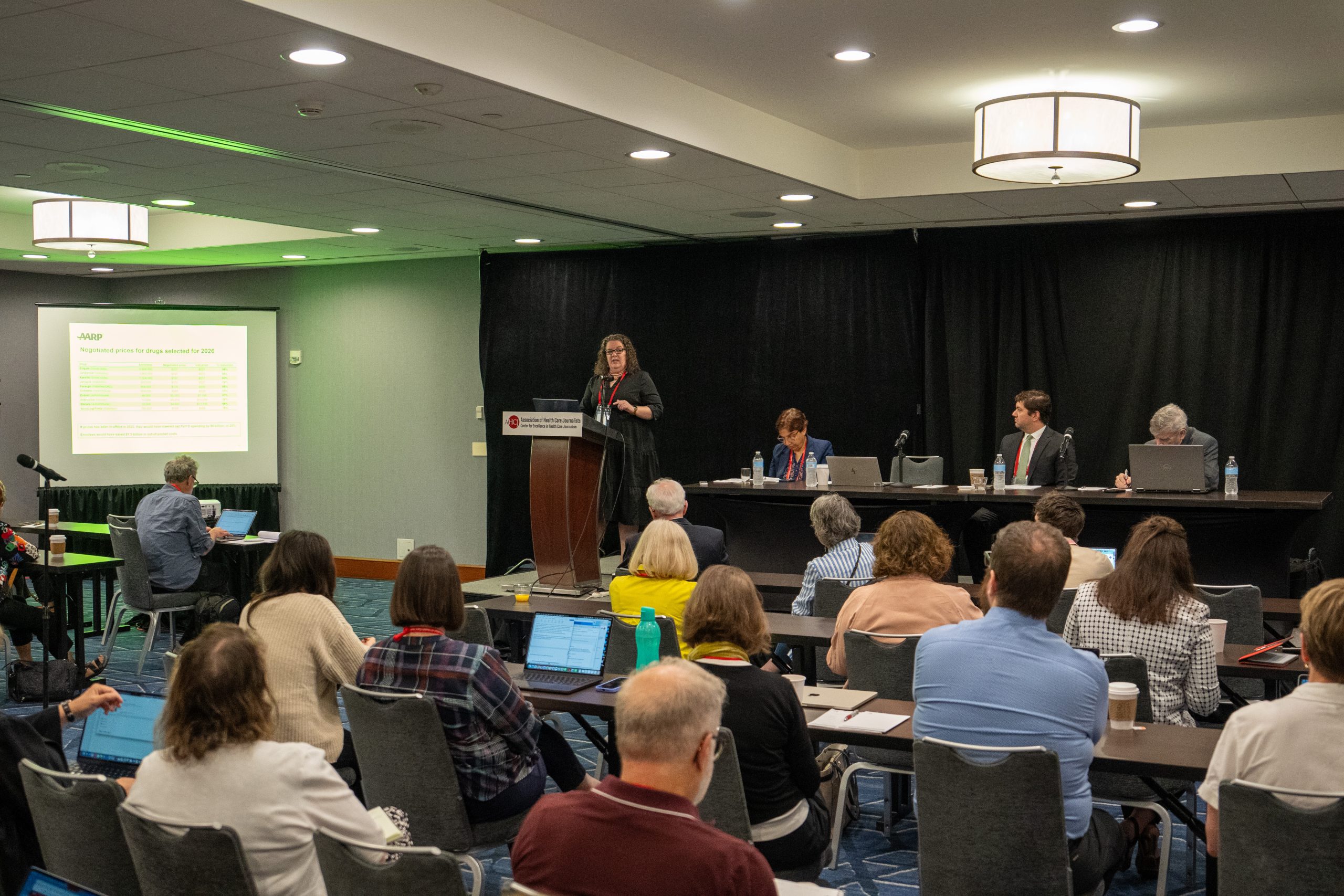
Both states and the feds have in recent years tried to strong-arm drugmakers into cheaper outcomes. A panel titled “Pills, prices and policy: Prescription drugs in the Trump era” at HJ26 examined how Medicare drug pricing negotiations, most favored nation pricing proposals, and other measures may be affecting the market for medicines.
Leigh Purvis, prescription drug policy principal at the AARP Public Policy Institute, said the issue remains rooted in the high prices of the drugs themselves — both present and future, as well as annual increases in a product’s price tag.
Reducing cost sharing — or out-of-pocket costs for insured customers, such as premiums and co-pays — without corresponding changes to the underlying drug prices may often amount to shifting savings around, Purvis said. She added that even cost sharing has become untenable for some customers, with deductibles costing tens of thousands a year.
“The reason it’s high is because the price that’s being covered is high, and so if you only address the cost sharing, you effectively are squeezing the balloon,” Purvis said.
Pres. Donald Trump’s administration, meanwhile, has employed a more aggressive negotiation style in his dealings with drugmakers. But that hasn’t swayed the market structure at large, said Michael Baker, director of health care policy at the American Action Forum.
That’s because “the through line is that there is not a desire to alter the market,” Baker said, but rather “a desire to pressure someone into accepting what the administration has deemed the goal, which is certainly a choice.
“But the actions that are there have very little to do with what truly drives what a price is,” he said, adding that the administration’s preferred fixes “are the wrong tools,” as the drugmaking supply chain is intricate, its links more impervious to direct reshaping.
Stephen Schondelmeyer, a professor of pharmaceutical economics at the University of Minnesota College of Pharmacy and director of PRIME Institute, argued that “we’ve entered a new era of drug pricing.”
Schondelmeyer, who helps negotiate with pharmaceutical manufacturers for his university’s health plan, credited Medicare negotiations for select drugs as a major source of this progress.
But other discounts witnessed in the market, Schondelmeyer cautioned, are associated only with cash-paying customers, who comprise about 8% of patients, many of whom already have trouble paying for their drugs, with about half of customers in this category living at four times the federal poverty level.
Panelists also discussed the role of pharmacy benefit managers (PBMs), the increasingly maligned middlemen who manage drug benefits for insurers. The entities have come under more and more scrutiny from lawmakers and regulators, but Schondelmeyer said a recent Federal Trade Commission settlement is unlikely to radically alter how PBMs do business.
The panel suggested that reporters should watch new Medicare discount programs in Medicare, like GUARD and GLOBE, as well as other Trump administration strategies to see whether they actually reduce prices for consumers long term and produce the billions in savings they’re intended to.
“The downward pressure is very real,” Baker said of the various market mechanisms now at work. “I just worry about doing all the things that all three of us just covered all at the very same time.”
Alexander Castro writes about state policy and statewide issues in health, education and technology for Rhode Island Current, part of the States Newsroom network. A 2024 and 2026 AHCJ Fellow from Rhode Island, he lives and works in the state’s capital city of Providence.