Documentary spotlight: Telling the story of racism in health care
Efforts to pump Black clinicians into the pipeline of physicians, midwives and other health care workers. Lack of transportation and other everyday barriers to accessing good medicine. Some health care providers’ incorrect, negative biases about a Black patient’s education, income and savvy about the health care system.
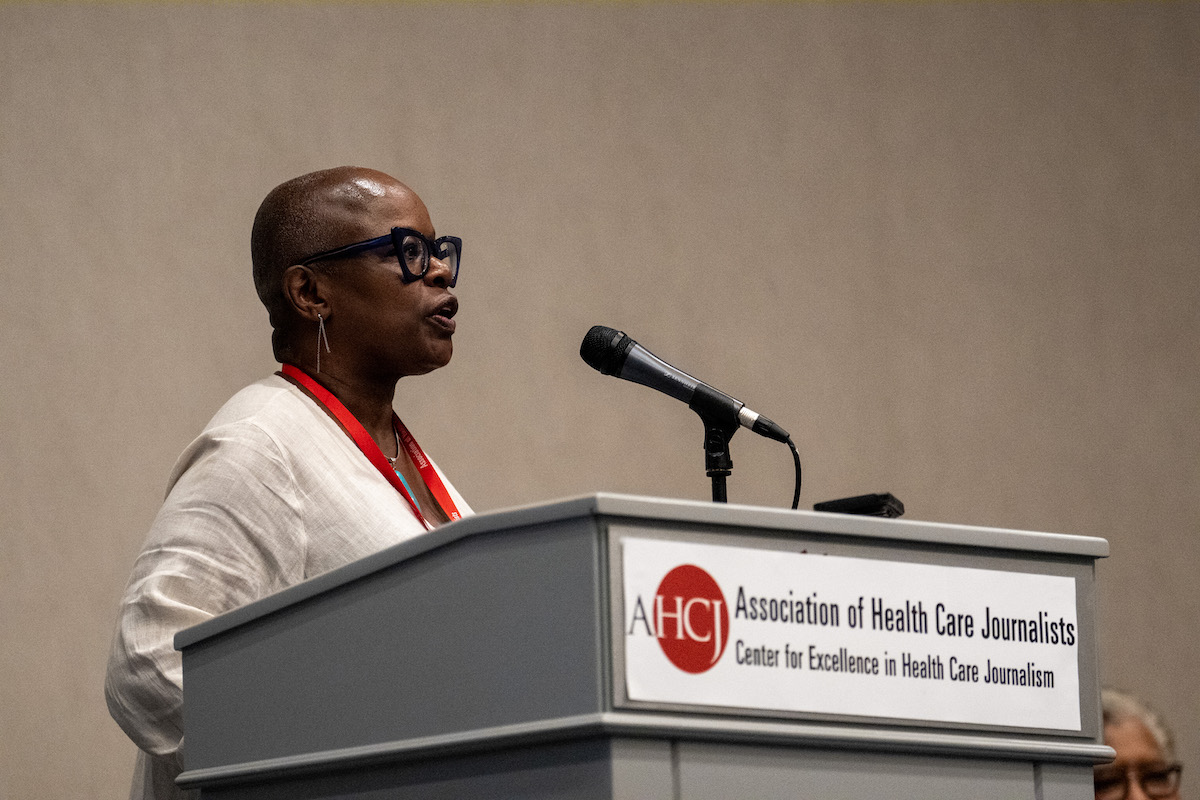
Those are among the issues tackled in indie film “Deliver Us,” and PBS-distributed “Critical Condition: Health in Black America,” two documentaries that were partially screened at Health Journalism 2025 in Los Angeles. During a panel discussion on racism in health care, the filmmakers and spotlighted health care providers explained what prompted their involvement in both projects.
The filmmakers said their projects are outgrowths of present facts and American medicine’s history with Black people. Cyndy Readdean, who produced “Critical Condition,” noted how a white physician manufactured a fake disease, drapetomania. “Slaves who ran away had this disease … a mental condition that was, of course, only treatable by more punishment and more whipping.”
Thomas Jefferson, a slaveholder with no medical training, posited that Black people’s lung structure made them well-suited for slavery, Readdean added. “This idea gets embedded into the medical system, so that, even until recently, today … there was a [controversial] race adjustment [of spirometer-measured lung capacity] for Black people,” Readdean said. This “was not based in medicine at all, but medical decisions were being made for Black people based on false assumptions about the Black body.”
The residual effects of faulty science and physician and systemic bias linger, said MLK Community Healthcare CEO Dr. Elaine Batchlor, whose 1.3 million patients are largely uninsured residents of South Central Los Angeles.
“My medical training … was at a county hospital where I cared for low-income patients, mostly Black and brown, and where I saw how poor access and quality was designed into the system of care. I saw how it negatively impacted their health,” said Batchlor, whose hospital is part of Charles R. Drew University of Medicine and Science.
Drew and MLK Community have been pivotal to the practices of what is L.A.’s comparatively small network of Black midwives and their patients, according to midwife Allegra Hill.
“A majority of the clients that we serve now are very much aware of the statistics. And they are scared,” said Hill, co-owner and co-founder of 5-year-old Kindred Space birth centers in L.A. and Lancaster, California. She was referring to higher risks of maternal death and injury for even Black women of higher income.
“They don’t want to die to have a baby,” Hill said. “They don’t want to have mistreatment.”
She started her career apprenticing at a boutique birth center in wealthy Mar Vista, which, at the time, was the only birth center in Los Angeles County. When a Black midwife left that Mar Vista center, Hill and several other Black midwifery students followed her to launch Community Birth Center on Florence Avenue in the heart of Black L.A.
At that time, Community’s founder was the only Black out-of-hospital midwife in L.A. “That was, maybe, 13 years ago,” Hill said. “…This community was waiting for somebody to come and take care of us.”
Health and criminal justice journalist Katti Gray’s bylines are in AARP, ABC, CBS, CNN, Health Affairs, MLK50, Reuters, The Washington Post and other publications.