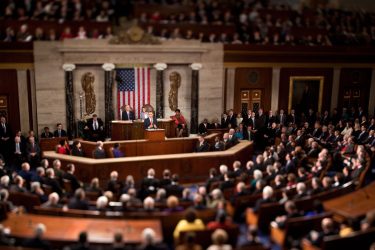

When Congress passed the Affordable Care Act (ACA) in 2010, lobbying from health insurers and physicians helped to kill a potentially significant provision: a government-run public option health insurance program.
In early versions of the ACA, President Barack Obama proposed that it include a public option that could compete with private insurers and keep them honest, as Robert Pear reported for The New York Times.
But, the American Medical Association (AMA) did not support the public option, Pear explained. “The introduction of a new public plan threatens to restrict patient choice by driving out private insurers, which currently provide coverage for nearly 70% of Americans,” the AMA said.
The American Hospital Association did not take a position on the public option but testified to the Senate Finance Committee in 2009 that its 5,000 members were concerned “that implementing another public program could exacerbate the underpayment of providers by paying rates at Medicare or Medicaid levels.”
This article is the last of five articles on the ACA. In part one, we outlined current efforts to undermine the ACA. In part two and part three, we covered the law’s features, and in part four, we explained some of its failings and attempts to weaken the law.
States pursue their own options
Since 2010, efforts to pass a federal public option have generally stalled, Lanhee J. Chen, Ph.D., wrote in JAMA Health Forum last year. The most recent stall came during President Biden’s term, as Elizabeth Rosenthal reported last year for KFF Health News.
“Although proponents argue these plans reduce health costs for both consumers and the government, critics claim that these savings are illusory because the required cuts in reimbursement rates to hospitals, physicians, and other clinicians necessary to produce savings are unsustainable,” explained Chen, a fellow at the Hoover Institution at Stanford University.
Rather than wait for federal action, four states are forming public option–style plans, Chen added. Colorado and Washington state have enrolled consumers in public-option coverage, and Nevada (in 2026) and Minnesota (in 2027) plan to start public option plans, he wrote.
Public option or Medicare for All?
On April 29, Democratic members of Congress announced the Medicare for All Act during an event with health care professionals at the U.S. Capitol. In support of Medicare for All, Sen. Bernie Sanders (I-Vt.) said more than 85 million Americans are uninsured or underinsured, 25% of Americans cannot afford prescription drugs, more than 500,000 go bankrupt due to medical debt and more than 60,000 die because they cannot afford to go to a doctor.
Medicare for All seeks universal coverage from cradle to grave, as KFF explained in 2019. Under a public option, however, individuals could be at risk for coverage lapses when life events (such as a job loss or change in income) intervene, KFF noted. To achieve universal coverage would depend on how much it would increase affordability of insurance through lower payments to providers and more subsidies for individuals, KFF added.
Any proposal that could limit health insurers’ profits, however, would face stiff opposition from those companies, said Wendell Potter, a former public relations executive for health insurers Humana and Cigna.
From Wall Street to Congress
During the ACA debates in 2009, Potter testified in favor of the public option. In addition to Obama, other Democrats and some Republicans supported the public option while health insurers and their lobbyists argued against it, Potter said in an interview. What’s more, Potter saw that Wall Street investors and financial analysts exerted outsized influence over chief executives, financial officers and others in health insurers’ C-suites, and health insurers hire lobbyists to sway members of Congress, he added.
“Most people have little understanding of how Wall Street controls their health care system,” Potter added. “That’s who they answer to, and you better answer the way they want you to answer, or you’re likely to lose your job.”
Needed: Robust health plan design
To succeed in Congress or the states, a public option needs at least three basic elements, said Edmond S. Weisbart, M.D., a retired internal medicine physician and volunteer for Physicians for a National Health Program, a nonprofit that supports universal single-payer national health insurance, such as Medicare for All.
“First, it needs to be built on traditional Medicare, not a privatized version of Medicare such as Medicare Advantage, and it can’t be built on a state version such as Medicaid,” he said in an interview. That means it would use traditional Medicare’s full national network of physicians.
Second, it would need to offer substantial benefits, including medical care, a drug plan, vision, hearing, dental and reproductive health care, Weisbart said. Without those benefits, it could not compete against other health insurers.
Third, the public option would need to avoid attracting the highest-cost patients who have costly illnesses, he said. Attracting those members from other health insurers would lead to adverse selection, driving the public option’s costs above what it would collect in revenue.
“Health insurers would be glad to send all those sickest patients to the public option, but that would lead to a death spiral,” Weisbart noted.
A public option with at least those three elements would be robust enough to force other health insurers to be more competitive and could limit their ability to be the market-dominant entities they are today, he said.
“They claim that their profit-centric model drives them to be more efficient and effective than any public program,” Weisbart commented. “If they competed with a well-designed public option on a level playing field, they would have to prove that such a premise is true.”
An alternative option
Another way to establish a public option would be to allow health insurers to sell policies across state lines and to spread their insurance risk across all lines of insurance, such as life, health, automobile and liability coverage, Richard J. Boxer, M.D. said in an interview. Boxer is a health policy expert and professor of urology at the David Geffen School of Medicine at UCLA.
An analysis from RAND researchers in 2020 showed that health insurance premiums for a public option would be lower than private individual market premiums because physicians, hospitals and other providers would be paid at lower rates than they received in traditional insurance plans.
Boxer and other experts explained this public-option idea in an article in Health Affairs in 2020. They recommended using parts of a public option that former President Biden proposed to allow Americans under age 65 to enroll in Medicare.
In addition, they suggested using an initiative that President Trump proposed in his first term. Trump’s idea would let workers in small and medium-sized businesses deposit pre-tax funds into Individual Coverage Health Reimbursement Arrangements (ICHRAs), they wrote. Using those funds, workers and businesses could buy qualified health plans in the individual market, they added.
Resources
- Health Coverage by Race and Ethnicity, 2010-2023, KFF, Feb. 13, 2025.
- Whatever Happened to Biden’s Public Option?, Elizabeth Rosenthal, KFF Health News, April 26, 2024.
- Here’s How to Pay for the Public Option Without Raising Taxes, Real Clear Policy, Sept. 2, 2020.
- Bipartisan Tax-Free Solution to Health Care Financing: Coupling HRAs with a Public Option, Health Affairs, June 30, 2020.
- Effects of a Public Option on Health Insurance Costs and Coverage, RAND, May 28, 2020.
- 10 Key Questions on Public Option Proposals, KFF, Dec. 18, 2019.
- Senate Democrats Drop the Public Option to Woo Lieberman, and Liberals Howl, The Commonwealth Fund, Dec. 15, 2009.
- Doctors’ Group Opposes Public Insurance Plan, Robert Pear, The New York Times, June 10, 2009.