
Among the ways to limit enrollment in the Affordable Care Act (ACA) is to cut funding for the navigators who provide free, unbiased assistance to consumers, and to cut back the open enrollment period.
On Feb. 14, the federal Centers for Medicare and Medicaid Services (CMS) slashed funding for trained navigators from $98 million last year to $10 million this year. These budget cuts limited the number of navigators available to help enrollees get the most savings from tax subsidies to help them pay their health insurance premiums. This cut is significant because the ACA’s tax subsidies benefit low- and moderate-income Americans.
Less than a month later, the federal Department of Health and Human Services issued new rules requiring consumers to provide more information proving they are eligible for premium subsidies and special enrollment periods, as Julie Appleby reported for KFF Health News. The new rules also would shorten the annual enrollment period by a month, limit eligibility for immigrants in the country illegally who were brought here as children (called dreamers), and eliminate the year-round special enrollment period for people with very low incomes, among other changes.
After Trump was elected in 2016, he slashed spending for the navigator program, as Tami Lubhy reported for CNN. Following that cut, enrollment dropped among lower-income Americans, Hispanic adults, and people who didn’t speak English, Noah Weiland reported for The New York Times, citing research published in the American Journal of Health Economics in 2022.
The primary job of navigators is to guide consumers through a complex eligibility and enrollment system, Sabrina Corlette, a research professor at the Center on Health Insurance Reforms at Georgetown University’s McCourt School of Public Policy, told Weiland. “And they’re supposed to be working with the most complex cases,” she added. Navigators primarily work with rural Americans and immigrants, she noted.
A landmark law
In 2010, when Congress passed the Affordable Care Act (officially the Patient Protection and Affordable Care Act), the law was hailed as a landmark step toward improving the notoriously weak patchwork of health insurance programs that failed to provide thorough coverage from cradle to grave. Even saying the United States had a health insurance system is a stretch because U.S. health coverage is woefully inadequate compared with the health insurance available to citizens in other large, industrialized nations.
Among 10 high-income nations, the United States spends the most on health care and, for that money, gets the worst health outcomes, as we reported in September and as a report from the Commonwealth Fund showed.
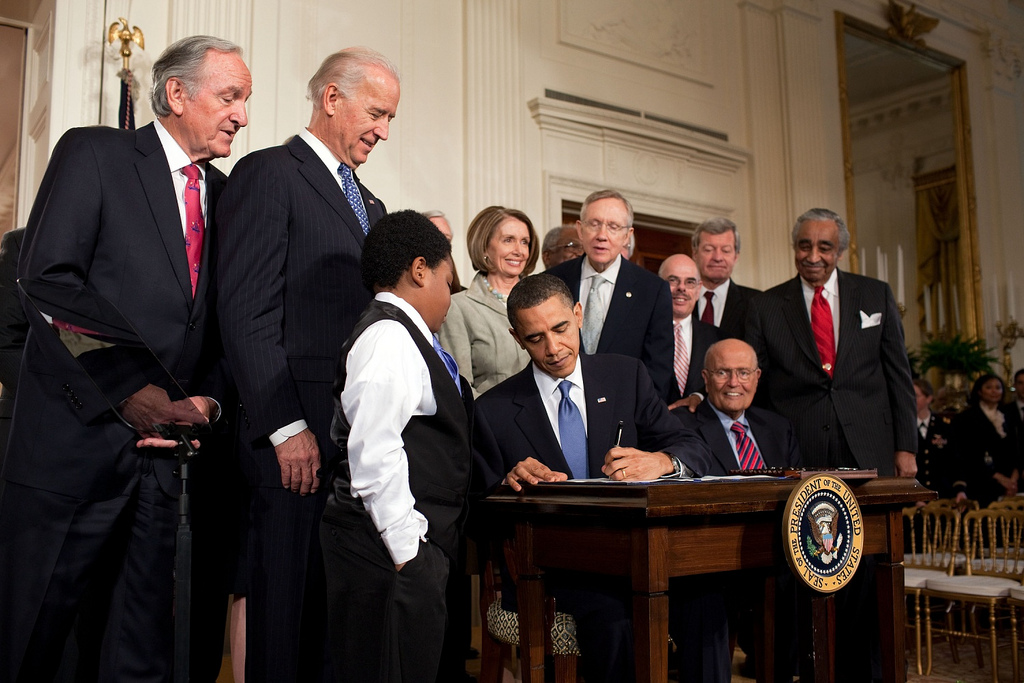
In 2010, the health insurance available to Americans was much worse than it is today thanks mostly to the improvements built into the ACA, also called Obamacare. Former President Barack Obama signed that legislation into law on March 23, 2010, 48.6 million Americans of all ages (16%) were uninsured, according to this report from the National Center for Health Statistics.
Five years of record enrollment
Since then, the number of Americans without health insurance has been cut dramatically. In the second quarter of 2024, the percentage of Americans without health insurance was 7.6% according to a report in January from the Office of the Assistant Secretary for Planning and Evaluation (ASPE) at the federal Department of Health and Human Services (HHS).
CMS enrollment data showed that as of Jan. 17, more than 24.2 million Americans selected ACA plans for this year, including 3.9 million who selected these plans for the first time. Not included in the 24.2 million enrollees were consumers in four states and Washington, D.C., where open enrollment continued through the end of January.
Americans have found that ACA Marketplace plans are among the best and most comprehensive forms of health insurance today. Since 2021, the ACA has had record enrollment and those numbers hit repeated records in 2023, 2024 and again this year, according to this HHS report on Jan. 8.
Not only has the ACA improved health insurance coverage, but it also has improved health care for all Americans enrolled whether they are enrolled in Marketplace plans or health insurance outside of the ACA. The law also requires much more of other health insurers, the Jan. 8 HHS report showed.
“The ACA has filled a really important gap in our health insurance coverage landscape,” commented Katherine Hempstead, a senior policy officer at the Robert Wood Johnson Foundation and author of the book “Uncovered, The Story of Insurance in America,” published in June (Oxford Academic). The 7.6% of Americans who do not have health insurance is at a historic low, she added.
“That milestone is a real achievement attributable to the ACA, both through the individual market and through the expansion of the Medicaid program in 40 states and the District of Columbia,” she said. “It’s almost hard to believe, but not that long ago, if you did not get an offer of coverage from your employer, and you didn’t qualify for Medicaid, and [if] you weren’t old enough to be on Medicare, you were uninsured. In other words, you were really out of luck.”
Louise Norris, a health reform analyst and health insurance agent in Wellington, Colo., agreed. “It’s easy to forget all the big ways that the ACA absolutely has improved health insurance because so much of it has just become entrenched now,” she said. Norris writes for Verywell Health and Healthinsurance.org and is the author of “The Insider’s Guide to Obamacare’s Open Enrollment.”
Multiple significant reforms
Hempstead and Norris both noted that a key provision of the ACA allowed states to expand eligibility to people with incomes up to 138% of the federal poverty level ($21,597 for an individual this year). The Medicaid expansion also enhanced the federal matching rate (FMAP) that the federal government pays the states for their expansion populations, as KFF explained here.
After the Supreme Court ruled in 2012 that the penalty for states not to adopt Medicaid expansion was unconstitutionally severe, all states could choose to adopt that expansion or not. Since then, 40 states and the District of Columbia have expanded Medicaid enrollment, providing health insurance to 21.3 million Americans, according to this KFF report. The 10 states that have not expanded Medicaid are Alabama, Florida, Georgia, Kansas, Mississippi, South Carolina, Tennessee, Texas, Wisconsin and Wyoming.
Resources
- House Republican Attacks on Medicaid Expansion Would Threaten Coverage for 20 Million People, Center on Budget and Policy Priorities, March 20, 2025.
- Marketplace Enrollees Rely on Enhanced Premium Tax Credits for Affordable Health Coverage, Center on Budget and Policy Priorities, Center on Budget and Policy Priorities, March 18, 2025.
- 2025 Marketplace Integrity and Affordability Proposed Rule, CMS fact sheet, March. 10, 2025.
- CMS Announcement on Federal Navigator Program Funding, Feb. 14, 2025.
- A Look at ACA Coverage through the Marketplaces and Medicaid Expansion Ahead of Potential Policy Changes, KFF, Jan. 15, 2025.
- Access to Preventive Services without Cost-Sharing: Evidence from the Affordable Care Act, HHS Office of Health Policy, Jan. 11, 2022.