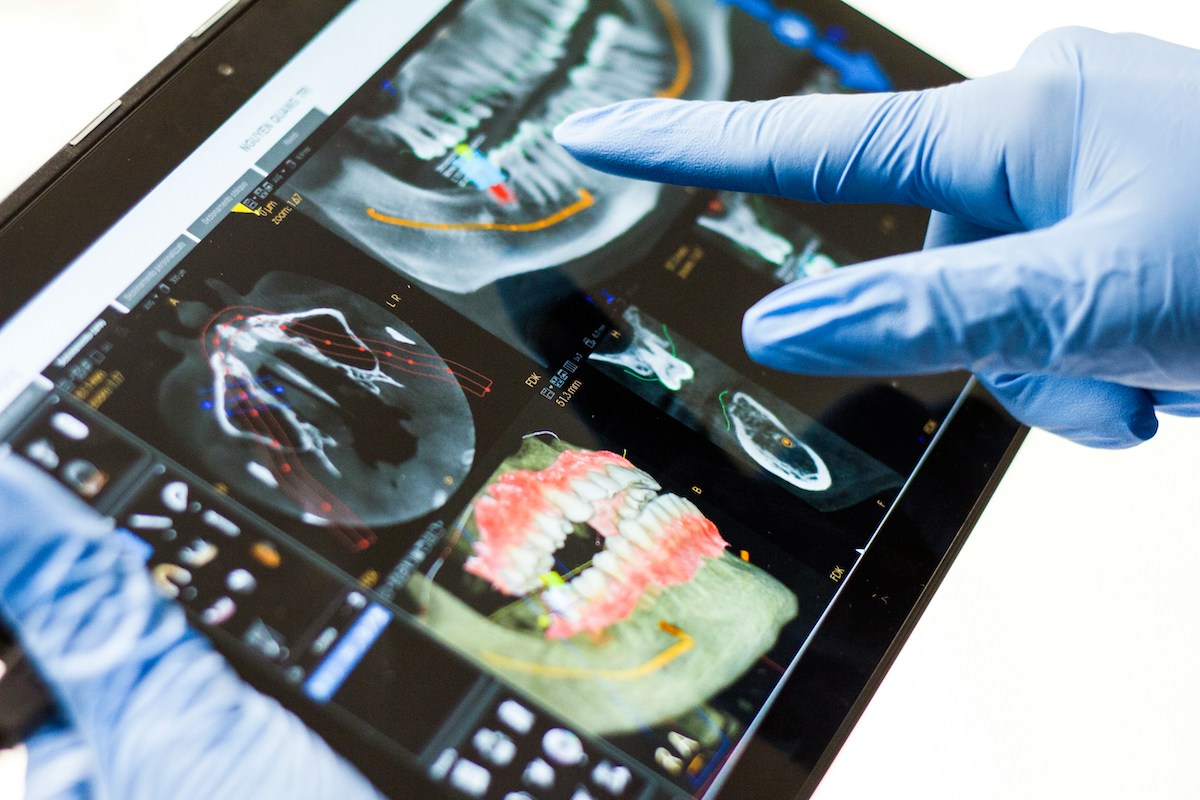
New software products are exploding in the field of dentistry, with many in the category of detection aided by artificial intelligence.
These products are designed to review images of a dental patient’s teeth and identify early signs of cavities, tooth decay or bone loss, prompting the dentist to intervene and potentially treat teeth before the problems worsen. Eight such products have been approved by the FDA so far, according to a recent article in STAT, with “many more on the way.”
“We are now entering a mass adoption phase of this technology, and within five years or so, this is going to be an absolute standard of care,” said Ophir Tanz, CEO of dental AI company Pearl during a January presentation at the Johns Hopkins University School of Medicine.
I moderated a webinar on this topic for AHCJ in February with Roya Zandparsa, a dentist who teaches at Tufts and Harvard universities, and Casey Ross, a national technology correspondent at STAT. This tip sheet, culled from information given in our webinar and Tanz’s talk, is designed to provide some basics and background to help jumpstart your reporting.
Why dentistry?
Dentistry is particularly well-suited to a rapid infusion of AI, Tanz said. The field historically has been one that has been pushed forward by a series of technological innovations, from the toothbrush to the dental drill and more, he added.
Artificial intelligence technologies can translate well to different countries because of their visual nature, and because the manner in which dentistry is delivered is fairly consistent from location to location.
About 1.4 billion dental X-rays are captured annually, Tanz said, yet there are few radiologists dedicated to dentistry.
“In dentistry, the radiologist is the dentist, and dentists have very full plates and a lot of responsibilities,” Tanz added.
What are some applications of AI in dentistry?
Besides the tools referenced above, there are other applications of AI and dentistry, Zandparsa said. These include:
- An intraoral scanner, a hand-held tool incorporating a camera that orthodontists or other dental professionals can use to capture impressions of teeth.
- AI-enabled printing software for mouthguards.
- Touchless periodontal charting, in which a dentist can talk out loud to tell a computer program how much gum tissue is surrounding each tooth, instead of alternately touching the patient’s mouth and the keyboard in quick succession. A voice-enabled software program enters the information directly in patient charts.
- Teledentistry, programs that enable dentists or orthodontists to check on patients via telemedicine.
- Virtual reality programs that allow dentists to study 3D images of teeth up close.
- Practice management tools that track appointment requests and cancellations, and number of missed calls; or that can help with coding and billing.
Benefits and limitations of these technologies
In the case of computer-aided detection, the programs can serve as a virtual second opinion and potentially identify issues that a dentist might miss, Zandparsa said. They can detect cavities early where dentists can intervene before a more invasive, costlier procedure is necessary. They also can be helpful in teaching younger clinicians and hygienists in spotting early tooth decay. They are generally accurate in scheduling X-rays and exams, she said.
However, as with all technologies, they have a learning curve, and there may be some technical difficulties and startup costs, as well as a need for proper training. In testing some artificial intelligence detection programs, Zandparsa noticed that the software may inaccurately flag some areas where teeth overlap or are very close together as an area of possible decay.
How to balance the hype with solid reporting
When reporting, ask questions about these tools to get behind the sometimes exaggerated claims about what a technology can accomplish for a given task, Ross advised. Ask questions such as:
- What data were used to develop the tool?
- What testing was done on the tool?
- Is the testing data different from the data on which it was trained?
Good story angles
Ask dentists and patients what they like about the technology, and what its limitations are. On the business side, you could look into the data dental offices have collected on their return on investment:
- What did they pay for these technologies and how are they benefiting?
- Are they performing more procedures?
- Is earlier intervention saving patients money?
- How accurate are dentists finding these tools?
- Do they help patients understand what procedures may be necessary?
How to find unbiased sources
Dental professors like Zandparsa are good sources of information. Higher education institutions tend to have independent experts who are looking carefully at these technologies and are not benefiting from their use, Ross said (but always ask about disclosures as some may also be paid consultants for companies).
You can search social media to find experts commenting on the subject, and also can try national groups such as the American Dental Association or its state chapters. You can also reach out to the Dental AI Council, a nonprofit promoting research and education concerning AI’s role in dentistry.
What’s on the horizon?
Look for dental chairs outfitted with technology to serve as a data collection hub as soon as a patient sits down, Zandparsa said.
She showed a photo of one chair that included features like a chair sensor that can determine the time a patient sits down and leaves, a close-angle camera for viewing and recording of a treatment session, and a wide-angle camera for viewing and recording the operatory environment.
AI also could improve health care professionals’ ability to detect oral cancer earlier, she said.
Resources
- Covering the growing field of AI and dentistry – a February 2024 webinar hosted by AHCJ.
- AI is coming to your dentist’s office – an article from STAT.
- AI May Be Just What the Dentist Ordered – an article from Harvard School of Dental Medicine.
- Dental AI Council – a nonprofit looking to advance research and education about AI’s role in the dental industry.
- FDA list of approved artificial intelligence and machine-learning enabled medical devices