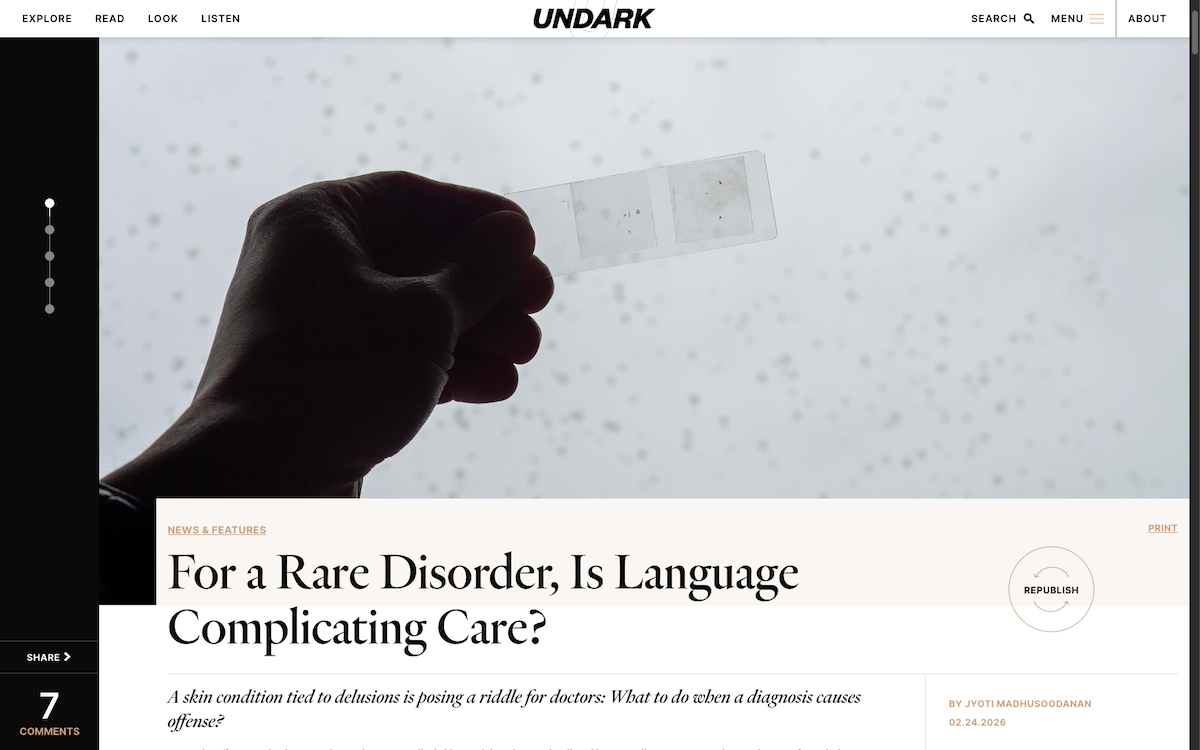
Jyoti Madhusoodanan, a freelance science and health journalist in Portland, Ore., had been curious about Morgellon’s disease ever since coming across it while studying microbiology in graduate school. The condition — which causes intensely uncomfortable sensations like crawling, burning or stinging under the skin, leading to scratching and sores — is controversial among clinicians and researchers, who disagree about its roots.

“I have revisited the literature on the topic off and on over the years as a freelancer, but I struggled to find an angle that would feel fresh,” said Madhusoodanan, a former AHCJ civic science fellow who has written for publications including The New York Times, NPR and Nature. Then last year, she came across something new, and eventually had her story, “For a Rare Disorder, Is Language Complicating Care?,” published in Undark in February.
Here, Madhusoodanan shares the pitch that landed the assignment, and more about the story behind the story. Check out the highlighted sections of her pitch, too, for some of my takeaways on what else freelancers can learn.
What finally made your story idea viable?
When I revisited the idea last year, I stumbled across work by Jesse Keller, M.D., a local dermatologist who had several recent publications about the condition. I’ve written over the years about medical stigma and how language can shape medical care, so I synthesized these strands into the pitch.
It took me a long while to trust my curiosity and realize that sometimes, what’s new about a topic like this is where you can take the story with your questions. I think this is true of a pitch too: Sometimes the “new” of a pitch is not an exciting upshot, but the journey you take your readers (and editors) on as you weave through the landscape of evidence.
What did the pitch look like?
Here’s the pitch that got the go-ahead. There was an earlier version that the editors had some questions about, like “Why now?” So I reported some more before sending this one in. I’ve highlighted in bold the “timely” bits; I included these in my top note to my editor.
To the vast majority of clinicians, Morgellon’s disease is a form of delusional parasitosis. Patients experience a sensation of invisible bugs crawling under their skin, causing an incessant itch and burn so intense they dig sores into their skin to get the parasites out. The condition is most common in older adults and often crops up suddenly in otherwise healthy people.
Medaris: This term alone is likely to catch the attention of an editor at a science-heavy publication like Undark. I always tell people who pitch me story ideas: “Tell me something I don’t know.” This strategy applies to pitching editors as well: Don’t dilly dally with a fluffy opening like “It’s spring again so allergy season is upon us” — that’s not news to pretty much anyone. But do tell them something they don’t know and might want to learn more about like, in this case, that a condition related to a “delusional” parasitic disease even exists.
Psychiatrists have found the condition is treatable with a low dose of antipsychotic pills. The greatest challenge is convincing patients to take the treatment. Many disagree with doctors: they’re not delusional.
That’s in part because an alternative explanation exists: A cadre of clinicians, researchers, and patients who say the symptoms and the mystery fibers that clutter Keller’s office are caused by an infection. Some link it to chronic Lyme disease, others to parasites or microbes named spirochetes. Instead of a term that signals disbelief and medication that treats something that’s just in their head, these clinicians offer patients antibiotics and antiparasitic drugs such as ivermectin.
Medaris: Despite how interesting the disease is on its own, the fact that something exists is rarely a story idea. Editors often say “pitch me a story, not a topic,” and here’s where Madhusoodanan takes it to that level.
The divide between the two groups delays treatments and worsens patients’ mental distress caused by the symptoms. But the two camps agree on one thing: “The symptoms are real, the patient is suffering,” says psychiatrist Peter Lepping. “Where we disagree is what the origin of the symptoms is, what the underlying illness is.”
Now, new studies of the biology of delusions hint at ways to bridge the divide. In preliminary studies, Keller has reported inflammatory biomarkers in the skin that are elevated in people with Morgellon’s disease. A group in Italy has identified differences in brain imaging that could explain why some elderly people experience physical delusions (July 2025 paper). On MRI scans, researchers have found dysregulation of the brain’s sensory-processing pathways.
Medaris: Here’s where Madhusoodanan is answering a question that’s always important to address in a pitch: “Why now?”
The evidence could lead to a more integrated, less stigmatizing path to hope for those who suffer this rare condition. It could also nudge clinicians toward more inclusive language – a key hurdle to patients accepting treatment.
This ~3-4k word narrative will center around Keller and some of his patients, but he’s not a lone hero sort of figure. Lepping and other clinicians follow similar strategies and concur that the term “delusional parasitosis” itself can dissuade people from seeking help. The most effective antipsychotic treatment is an old, off-patent drug that was never approved for use in the U.S. – another barrier to effective care.
The battle over what’s real in Morgellon’s is, in many ways, a microcosm that represents the health information landscape right now, where different factions struggle to balance the weight of scientific experience against people’s lived experiences.
Medaris: This is a smart ending note, which zooms out from the specific disease and offers what the controversy around it might mean or represent in the broader culture. In other words: Why should readers who aren’t directly affected by Morgellon’s care?
Why did you pitch this to Undark?
I’ve been writing for Undark off and on since 2018. I worked closely with them during my Knight Science Journalism project fellowship in 2020, and was brought on as a senior contributor to the magazine in 2024. In that role, I have to deliver features at preset deadlines. So, I regularly pitch my editor there features.
I can’t imagine having done this story elsewhere. I knew it would be a complicated process for many reasons, including the topic and the need to synthesize reporting from siloed, opposing areas of research. There’s almost no one in the story who is “objective” about this disease. I knew the editorial team at Undark would not force the story to pick a side and would respect my vision for it.
Tell me about your prereporting process, and how that strengthened the pitch.
Before I pitched the first version, I had spoken with Keller and confirmed that I could visit to see his work. I also confirmed that he could connect me with patients. I have turned to patient communities online to find people with real-world experience for other stories. But for this one, it was especially important to speak with people who could reliably recall specific details needed for the piece. I usually tend to speak with at least a few patients for such stories, because each person’s experience is unique and sheds light on a different facet of the diagnostic journey.
What were the biggest challenges you faced once securing the assignment?
I had hoped to find at least some overlap between the two sides of the debate over Morgellons’ origins, but there’s really not much aside from some reviews or critiques in the published literature. Medical rhetoric research is a small-ish field, and it was challenging to find a researcher who could engage with the line of inquiry I needed to pursue. And lastly, it’s always difficult to hear from people who have struggled to find effective care for their condition. So learning to manage my own mental health as a journalist through the process was important.
What other pitching advice do you have for freelance health and science writers?
That it’s okay to sit with an idea until it feels ready and you find the right outlet/editor for it!