The truth behind Alzheimer’s research, funding and oversight
By Emily Bazar, California Health Journalism Fellow
As science faces attacks from the Trump administration, online conspiracy theorists and corporate interests, investigative journalist Charles Piller wants you to know it also faces attacks from within.
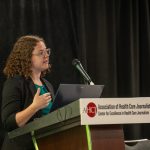
In his book, “Doctored: Fraud, Arrogance, and Tragedy in the Quest to Cure Alzheimer’s,” Piller delves into the world of Alzheimer’s research and a whistleblower’s concerns about hundreds of apparently doctored images in scores of research papers. During an HJ25 talk moderated by STAT national science correspondent Usha Lee McFarling, Piller described how his reporting reinforced those suspicions ⸺ and raised additional questions about seminal research underpinning the “amyloid hypothesis” that has dominated the field.
“Because of the incredible dominance of this way of thinking,” Piller said, “other ideas have clearly been starved for funding and … people have been forced out of the field, even because of their contrary views of how to approach the research and clinical problem of Alzheimer’s disease.”
The amyloid hypothesis posits that a build-up of beta-amyloid proteins causes a cascade of degenerative changes in the brain. As a result, funding and research have largely focused on drugs and therapies that target and destroy beta-amyloid plaques.
Piller said proponents of the amyloid hypothesis claim there is “no amyloid mafia trying to control things behind the scenes, there is no group of exalted scientists who are trying to suppress other ideas, and yet this is exactly what they were doing.”
But that obsessive focus has not substantially paid off for the more than 6 million Americans whose lives have been rocked by the disease. While some new drugs have been developed, including the controversial Aduhelm, a monoclonal antibody that was discontinued last year, “none of these drugs arrest the symptoms or reverse the symptoms of Alzheimer’s disease,” Piller said. “No one’s getting better. They’re just getting worse at a slightly slower pace.”
Piller blames, in part, scientists who care more about their careers than about patients and who suffer the “occupational hazard” of arrogance. “Experts in the field need to learn humility and how to listen and how to reach people where they’re at in a way that is impossible to do if you’re just saying, ‘We are the experts, you should listen to us,’” he said.
Asked by McFarling about the genesis of the book, Piller, who is currently at Science magazine, pointed to his 2022 investigative article, saying it raised more questions than answers about the scope of the misconduct.
As Piller continued to report for his book project, uncovering more proof of image tampering, he said he faced a dilemma: Should he hold onto his explosive findings for his book, or scoop himself?
He decided the news couldn’t wait and wrote additional, short-term investigations for Science. “This was a breaking news story basically, and also important to patient safety, so I couldn’t possibly hold that back for the book,” he explained.
One of these “mind-blowing” findings was that 132 published scientific papers by Eliezer Masliah, then-director of the Division of Neuroscience at the National Institute on Aging, “had been based on apparently doctored data.”
The damning findings in his articles and book, which was published in February, have faced pushback from some accused scientists and institutions, who doubled down on their research results. However, some researchers have lost their positions or funding as a result of Piller’s revelations.
“I believe that science is self-correcting,” Piller said. “The problem is that it often takes weeks, months, years, decades for false information in the scientific record to be found out, to be fixed. And in the meantime, it’s skewing thinking in the field. It’s wasting funds, precious funds that we need to do real scientific work.”
Emily Bazar is an independent journalist based in Sacramento, Calif.