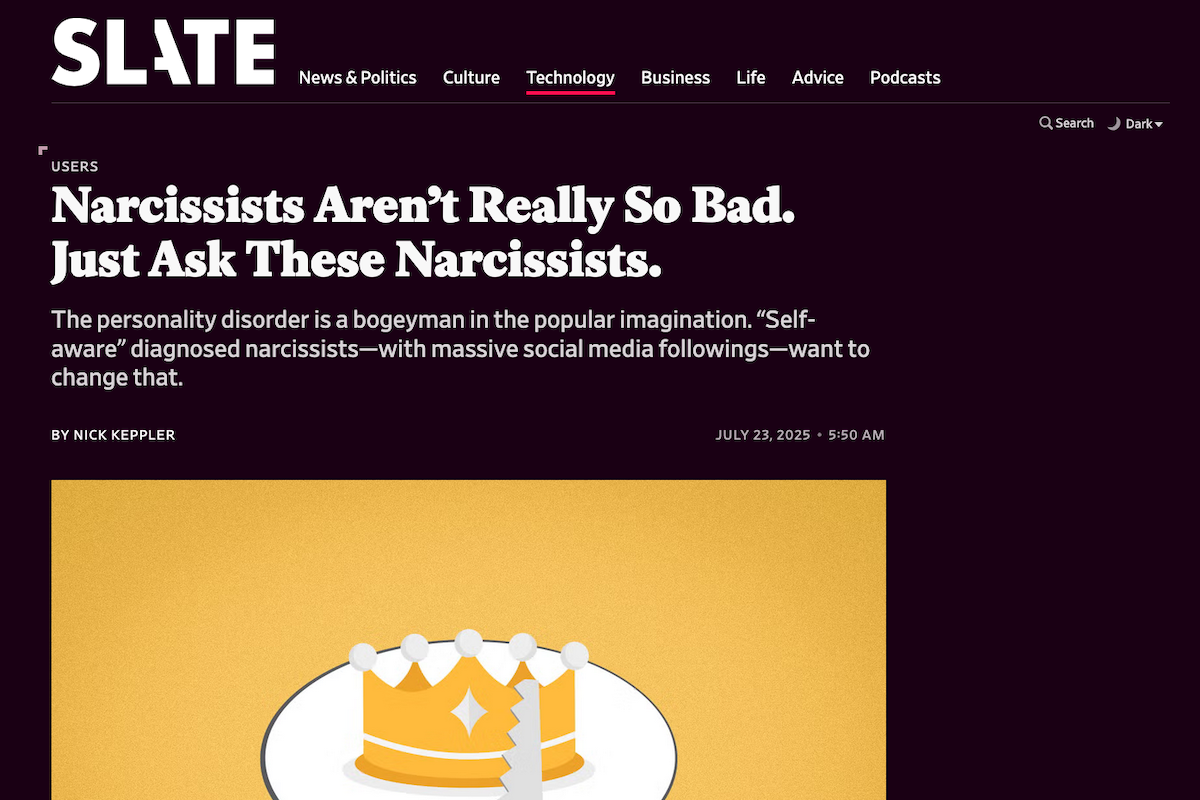
For our second installment of “How I Pitched It,” I talked to Nick Keppler, a freelance journalist in Pittsburgh about his July Slate story, “Narcissists Aren’t Really So Bad. Just Ask These Narcissists.“
Keppler had previously worked with the publication’s health editor on stories including on the overdiagnosis of bipolar disorder and discontent over how clinicians measure suicidal risk, and knew she was interested in “health care stories that contradict popular notions,” he said.
Keppler also has experience writing about politics, public policy and psychology for publications including The Washington Post, The New York Times, Vice, The Daily Beast and Men’s Health.
Here’s a copy of his recent pitch for Slate. Click the highlighted text to see my commentary.
Dear [editor],
I came up with this idea when I hit upon the small world of narcissist TikTok.
Medaris: I like how Keppler jumped right into the pitch.”My style could be a bit informal because I’ve worked with this editor before,” Keppler told me. I agree; I often start with something like “Me again, back with a few pitches!” If it’s a new editor, I’ll take just 2-3 sentences to introduce myself before getting to the real reason I’m emailing.
“Most narcissists don’t set out to destroy people who love them. That is not the intent,” one creator Lee Hammock explains, sitting on that frequent soapbox of online video makers, the car driver’s seat.
Medaris:This is a clever observation, and including some voice in the pitch shows the editor how Keppler actually writes. As he knows, a good pitch doesn’t just tell an editor what the story will be about; it shows how it might read.
“During the love bombing phase, narcissists really feel connected to you. They want to be everything you want and need.” But, Hammock explains, “a switch goes off in a narcissist’s brain that disconnects them from you.” The loss of that initial infatuation causes a flood of letdown, which narcissists are ill-equipped to handle.
Hammock would know. He is a self-described “self-aware narcissist” and a figure in a movement pleading for some understanding of people with narcissistic personality disorder, a sect treated with an antipathy that rarely extended anymore to anyone else grouped together by DSM condition.
Since 2008, Google searches for narcissism have increased. Supposedly narcissistic parents and ex-partners are increasingly blamed for root traumas.
Medaris: Here, Keppler transitions from an anecdotal lead and zooms out to the bigger picture. Using some numbers and data — even if it’s as simple as “searches have increased” — helps show the editor how big of an issue your idea is, and why it matters now.
There are Facebook and Reddit forums for the “survivors” of narcissists dedicated mostly to skewering them. Posters share memes with wording like, “Narcissist (n): a more polite term for a self-serving, manipulative, evil jerk with no soul or compassion” or “To preserve one’s mental health, one must abandon the narcissist.” The Wikipedia category for “people with narcissistic personality disorder” is stuffed with infamous murderers.
Donald Trump is endlessly branded a narcissist and, by extension, narcissism might be the source of every shocking development in the news cycle.
Medaris: Keppler said part of why he thinks this pitch worked is because “it tapped into the zeitgeist — a link to Donald Trump and the feelings he was inspiring in Slate’s demographic — without necessarily tying it to that week’s news.” Finding that sweet spot has been a challenge this year, he said. “There is so much alarming news, it’s hard to know where freelancers fit in and get an editor’s attention. I don’t have a solution.”
Despite all this, narcissists are not uncommon. About one to two percent of the U.S. population might meet the criteria for NPD, a condition defined by a sense of grandiosity, a need for admiration and a lack of empathy.
Some narcissists are trying to reframe their condition as, well, a psychiatric condition to be treated and understood. Comedian and impregnator Nick Cannon announced he suffered from narcissistic personality disorder last year and plead for understanding, telling People magazine, “I just embrace mental health and therapy in such a strong way.” The largest Facebook group that offers support for people with NPD, and three other “dark” personality disorders, has 6,500 members. Self-aware narcissists are doing Reddit AMAs that show their thought patterns are gross but not unfathomable.
I am proposing a story on what it means to have narcissistic personality disorder right now and the movement to reverse stigma. I would profile one or two diagnosed people, talk to professionals specializing in treating or researching NPD and reach out to the administrators of narcissism victim “support” pages. I would explore what it is like to have the most stigmatized psychological condition, the one that people are permitted to hate.
Medaris: Keppler ends with an overview of what else, and who else, his story would include. The last clause is also thought-provoking — “the [condition] people are permitted to hate” — which can leave the editor wanting more. And they can get more by giving Keppler the assignment.
Let me know what you think.
Nick Keppler, freelance writer
Nickkeppler.com
How did you come up with this idea?
I can’t remember exactly, but I had heard narcissism used colloquially a lot. I am a fan of advice subreddits, and it kept being slung around. Everyone’s parent or ex was a narcissist. I had a feeling it drifted far from its clinical definitions, and then some googling took me to the community of “self-aware narcissists” on TikTok and YouTube.
Why Slate?
I wrote the pitch with Slate and its health editor in mind. If she hadn’t responded or had given me a “no,” I would have made the rounds of health editors I know or used it to approach a new outlet.
Why do you think your pitch got a ‘yes?’
I showed that I had done my research and knew what I was talking about. I seemed comfortable speaking about how the term narcissism was used online, and its clinical definition. I presented some possible interview subjects and gave her a reporting plan.
Still, I was a bit afraid because there were some other stories about how everyone is narcissist these days. But I used the clique of self-aware narcissists to give it something different.
What other takeaways from this experience can you share with fellow freelance journalists?
It took several pitches to get my first assignment from this editor. After that, I knew more about what she was looking for. It pays to keep at it if you want to work with someone.
If there is any lesson in the pitch in particular, maybe it’s: Don’t be afraid to be a nitpicker or nag. If there is something in the culture that annoys you — like the scapegoating and othering of a DSM-diagnosable condition — a feature story can be a way to explore that.
Ultimately, I was told this piece did pretty well. A public radio show in Dallas emailed me to talk about it, which was nerve-wracking — and rewarding.