
Editor’s note: This article was updated on July 18.
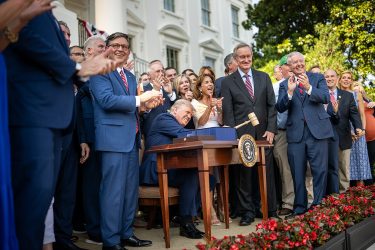
A new work requirement for about 20 million Medicaid members is one of the most important stories to cover about the federal megabill that President Trump signed on July 4. The law requires adults aged 19 to 64 to work at least 80 hours each month to qualify for Medicaid coverage unless they are exempt because they have dependents or certain medical conditions, Alejandra O’Connell-Domenech reported for The Hill on July 7.
The work requirement will go into effect by the end of 2026, and will produce the largest source of Medicaid savings in the bill, according to a June 20 KFF report citing estimates from the Congressional Budget Office. It will cut federal spending by $344 billion over 10 years and result in 4.8 million Medicaid members losing their health insurance, the report stated.
The change will affect Medicaid enrollees in the 40 states and the District of Columbia that expanded enrollment in Medicaid, as Phil Galewitz, Julie Appleby, Renuka Rayasam and Bernard J. Wolfson reported for KFF Health News.
The work requirement also applies in two additional states: Georgia and Wisconsin, according to Jennifer Tolbert, KFF’s director of state health policy and data and deputy director of the program on Medicaid and the uninsured.
“We include Wisconsin and Georgia in the count of states that will have to implement the work requirements,” Tolbert wrote via email. “Although Georgia already has a work requirement, the state may have to make some changes to comply with the new federal requirement.”
Louise Norris, a health policy analyst for healthinsurance.org who writes for VeryWell Health, said Wisconsin does not currently have a work requirement for BadgerCare, the state Medicaid program. But on July 15, the Department of Health Services posted an explanation about the megabill, saying 63,000 Wisconsin adults would be at risk of losing their coverage due to the work requirement.
“In the Medicaid expansion states, the work requirement applies only to people who are either enrolled in or applying through that Medicaid expansion pathway,” explained Norris.
‘The largest legislative rollback of coverage’
“A lot of what’s really important to understand with this law is that it makes these cuts in ways that aren’t as visible to the general public,” Benjamin Sommers, M.D., the Huntley Quelch Professor of Health Care Economics at the Harvard T.H. Chan School of Public Health, said in a media video call on July 9.
“This is the largest legislative rollback of [health insurance] coverage that — potentially — we’ve ever seen,” he said.
“Short of the ACA repeal attempt that failed in 2017, this [megabill] was the most ambitious effort to undo some of the coverage efforts in the Affordable Care Act, particularly with policies that are largely focused on the Medicaid expansion population in the 40 states plus D.C. that have expanded coverage,” Sommers said.
The megabill is also part of a larger legislative and regulatory agenda that will make it harder for Americans to afford and keep their coverage, whether through the ACA marketplaces or Medicaid, he added.
Hard lessons from earlier efforts
As Sommers warned, the work requirements may not be immediately visible because, in part, they could cause Medicaid enrollment to decline over time.
For journalists, the experience of two states (Arkansas and Georgia) provides harsh lessons learned about work requirements. What’s more, the new work rules are more extreme than the requirements in those two states, Allie Gardner wrote in a June 12 report for the Center on Budget and Policy Priorities.
“Research and real-world experience both show that work requirements don’t help people find or maintain work,” Gardner said. Medicaid work requirements mainly cut people from health coverage, including many people who are working or should be exempt but get tripped up by the paperwork needed to prove it, she noted.
When Arkansas implemented a work requirement in 2018, 18,000 people lost their Medicaid coverage, and state officials reported no increase in employment, KFF explained. Most Medicaid adults under age 65 are working already (without a requirement) or they face barriers to getting work, KFF added. Many adults on Medicaid already work in low-wage jobs at small firms and for employers that may not offer health insurance, KFF reported.
In an article for The Bulwark, Jonathan Cohn cited the experience of Georgia’s Pathways to Coverage program. In 2023, the first year of Pathways, state officials estimated that as many as 100,000 residents would sign up for Medicaid, but fewer than 5,000 did so, Cohn wrote.
Over 10 months, more than 18,000 befuddled Georgians lost their coverage because they couldn’t make the verification process work or got rejected for unexpected reasons, Cohn explained. Instead, they were uninsured and, in some cases, stuck with medical bills they couldn’t pay.
Last year, the Commonwealth Fund reported that the Pathways program cost at least $26 million, and most of the funding (90%) went toward administration, not medical services.
Margaret Coker, editor-in-chief of The Current GA, wrote a series of articles for ProPublica on the failures of Georgia’s work requirement program called “Broken Pathways.” It explains how the program failed and the lengths state officials went to promote the effort.
Paperwork rules’ effect on Medicaid unwinding
In an interview before the bill was passed, Adrianna McIntyre, Ph.D., an assistant professor of Health Policy and Politics at Harvard, said paperwork requirements often result in Medicaid members losing coverage because they’re unaware of the rule. “Or they may not be checking their mail, or maybe their address on file with the state is wrong,” she said.
“Ideally, if someone’s going to lose Medicaid coverage, you don’t want them to lose that coverage if they’re not supposed to and you wouldn’t want them to learn when they’re showing up trying to get care,” she said.
During Medicaid’s unwinding last year, about 70% of people who lost Medicaid coverage were disenrolled due to administrative or procedural reasons, such as the inability or failure to complete paperwork, according to a study McIntyre and colleagues published in 2024.
Work requirements are costly for states, and not all states have well-integrated information systems — so states don’t know whether Medicaid members are complying with work rules, McIntyre said. She cited that as one reason many Medicaid members lost their coverage during the unwinding. Another is that they were unaware of when or how that happened, she added.
McIntyre was worried that the same story would play out now that Republicans have passed a new work requirement, she said.
Where to find sources
Journalists seeking consumers who cannot afford their coverage or are kicked off Medicaid may find sources at safety-net hospitals and federally qualified health centers, especially after as many as 17 million Americans lose their health insurance under Medicaid and the Affordable Care Act marketplaces, as we reported July 8.
Nurses and administrators at these hospitals and federally qualified health centers may know patients needing financial aid. Physicians and faith leaders can also help journalists find sources, as Alvin A. Reid noted for the St. Louis American.
Food pantries will be another source for journalists because the megabill calls for deep cuts in spending for the Supplemental Nutrition Assistance Program, as Geoff Mulvihill and David A. Lieb reported for the Associated Press.
Some details on the new work requirements
Under the Affordable Care Act, 40 states and D.C. allowed adults earning as much as 138% of the Federal Poverty Level to enroll in Medicaid. This year, that level is $21,597 for an individual and $44,367 for a family of four.
Of the 71.3 million adults on Medicaid, only about 20 million are enrolled through the expansion pathway and will need to comply with the work requirements unless they qualify for an exemption, said Louise Norris, a health policy analyst for healthinsurance.org who writes for VeryWell Health.
Those 20 million people represent about 25% of Medicaid members in all states and almost a third (31%) of those enrolled in the expansion states and D.C., according to the KFF report.
The report outlines qualifying work activities, including community service, as well as mandatory exemptions for disabled veterans, Native Americans, Alaska Natives, and adults with dependent children. And it lists optional hardship exemptions, such as inpatient status in a hospital, nursing home, or similar facility.
Resources
- “The ‘Big Beautiful Bill’ has passed. Here’s how it could affect health care in NC,” North Carolina Health News, July 10, 2025.
- “Here’s how the Trump tax bill will impact Colorado, from Medicaid to new tax breaks to energy credits”, Seth Klamann, Meg Wingerter, Judith Kohler, Elise Schmelzer, The Denver Post, July 10, 2025.
- “When will key aspects of Trump’s ‘big, beautiful bill’ take effect?”, Alejandra O’Connell-Domenech, The Hill, July 7, 2025.
- “What will change with DSS benefits following the passing of federal H.R. 1?”, Connecticut Department of Social Services, July 3.
- “House Republican Bill Would Impose a One-Size-Fits-All Medicaid Work Mandate on States,” June 12, Center for Budget and Policy Priorities.
- “What Does the One Big Beautiful Bill Act Do to CHIP?” Center for Children and Families, June 4, 2025.
- “House Republican Tax Bill Extends — and Expands — Costly Tax Breaks for the Wealthy” Center on Budget and Policy Priorities, June 4, 2025.
- “Lessons Learned from Arkansas’ Experience with a Medicaid Work Requirement,” Millbank Memorial Fund, June 4, 2025.
- “Medicaid and CHIP Cuts in the House-Passed Reconciliation Bill Explained,” Center for Children and Families, May 27, 2025.
- “House Budget Bill Would Impose Administrative Barriers for Kids, Families, Seniors, and People with Disabilities in Medicaid,” Center for Children and Families, May 19, 2025.
- “By the Numbers: House Republican Reconciliation Bill Takes Food Assistance Away From Millions of People,” Center on Budget and Policy Priorities, May 19, 2025 (updated June 6, 2025).
- “Experiences with Medicaid unwinding among low-income adults in 4 southern states,” Health Affairs Scholar, April 16, 2025.
- “Coverage and Access Changes During Medicaid Unwinding,” JAMA Health Forum, June 29, 2024.