Congress finally funded gun violence research. Could it all go away again?
By Estefania Arellano-Bermudez, Firearm Violence Reporting Fellow
Gun violence is a public health issue, not just a criminal one. That was the key message from speakers on this Health Journalism 2025 panel, who urged journalists to disseminate gun violence research to policymakers and the public.
“Go to hospitals and talk about hospital-based violence intervention programs, talk to victims of gun violence and prove that no, this is not solely about police courts and crime,” said Abené Clayton, a reporter for the Guardian U.S., who has covered gun violence in black and brown communities.
After years of being underfunded, gun violence research was revived in 2019 with $25 million annually from the National Institutes of Health and the Centers for Disease Control and Prevention. This funding renewal allowed for a substantial expansion of research into community violence intervention programs, firearm suicide prevention, and studies on the impacts of gun violence and children.
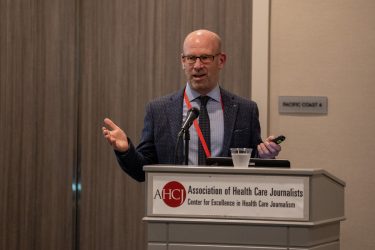
Garen Wintemute, director of the UC Davis Centers for Violence Prevention, said that implementing multiple policies at the same time can maximize efforts in gun violence reduction. In the case of California, bundling multiple anti-violence policies and mental health reforms has made the rates of gun violence go down.
“This is a complex problem. The one right thing to do is a whole bunch of things at the same time,” Wintemute said.
“Bundling” has shown promise in places like Oakland where initiatives such as the Operation Peacemaker Fellowship have caused a significant reduction in shootings by pairing 16- to 25-year-old residents with mentors, support services and financial incentives.
Yet, much of this progress rarely makes headlines.
Clayton points out that it’s vital to ensure these stories are told so that promises made in press conferences after shootings become real policies.
Clayton added, “It’s really about accountability and making sure that after these horrible things happen and people put out their statements saying, ‘We need to do this, we need to do that.’ As reporters, we need to ask, ‘Are you doing it? If not, I’m going to tell everybody.’”
The takeaway from the panel — journalists need to report deeper and aim the spotlight on the voices of survivors, those in trauma units, and delve into how firearm violence affects communities long after a shooting occurs. Most of all, it’s detrimental to track whether or not solutions are a) being implemented and b) actually working.
As the Trump administration proposes cuts to funding for numerous health research programs, the fate of firearm-related research once again hangs in the balance.
Estefania Arellano-Bermudez is an Independent Journalist based in Detroit, Michigan. She writes for El Central Hispanic News and Planet Detroit.