
Reporting on medical studies and the crucial role DEI plays in health research
By Karen Fischer, New Mexico Fellow
A Health Journalism 2025 session on how to report on medical studies opened up with panelists showing a photo of a hand holding a firehose spraying water so dense, the viewer couldn’t see through it. The words “YOU ARE HERE” with a black dot transposed above the hose provided an introduction to all of the work that goes into reporting on medical studies accurately, and asking the right questions about results.
“I often have people come to this workshop every year or three times, four times, because it’s a lot of information,” said panel moderator Tara S. Haelle, AHCJ’s health beat leader for infectious diseases.
Only a subset of any national population reads the news seeking to go deep on a subject, but medical studies tend to go wide and capture the attention of most of the general public, Haelle explained. The problem is, the reporting on these studies can be convoluted, misunderstood, or miss the key point. At its worst, this can disseminate misinformation to people who need sound health advice, and sow distrust from the public towards the media and scientific communities at large.
Haelle cited 2025 coverage on a new research study linking sleep, cognitive performance, and depression from the University of Texas at San Antonio as an example, which correlated too much sleep to causing cognitive decline, and ultimately urged people not to sleep too much without clearly articulating how depression often causes people to sleep more. The problem isn’t too much sleep, it’s symptoms of depression, but the reader can’t tease that out easily.
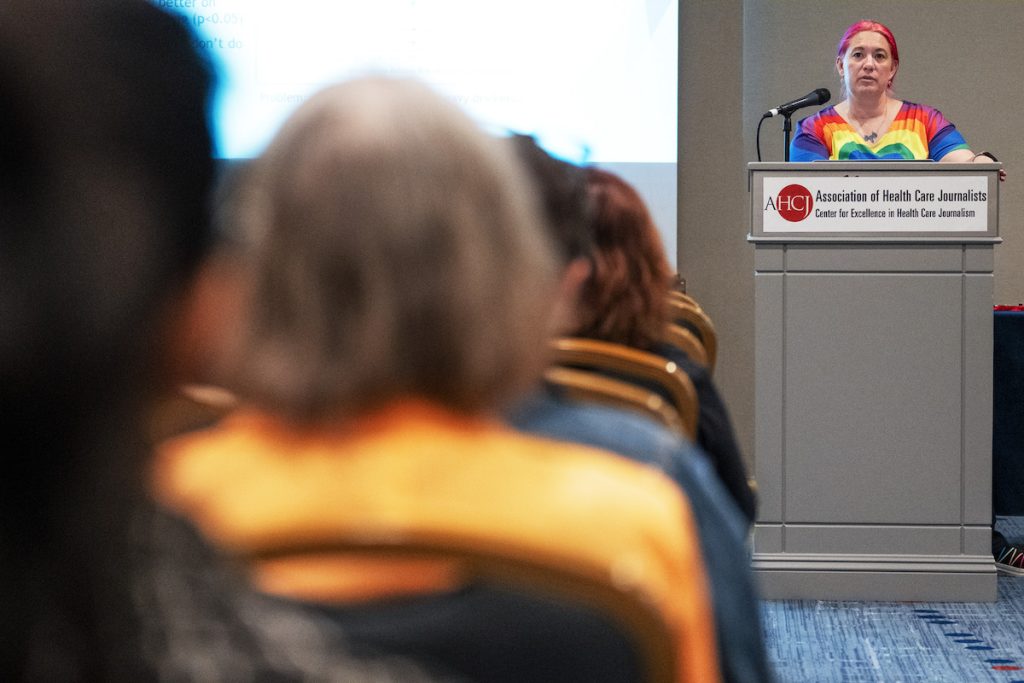
“The headline was right to say association, the problem is that the story is still putting us in the direction of, ‘Oh my god, I’m getting too much sleep,’” Haelle said. “The last thing we want is for people with cognitive decline not getting enough sleep.”
Beyond the nuts and bolts of breaking down the taxonomy of a research study, reviewing various mathematical principles, and what pieces of a research study journalists should analyze to develop quality questions, Haelle also touched on other ethical considerations when covering a research study, such as who funded the work and what motivation they may have for acquiring certain findings over others.
“Just because it’s not a pharmaceutical company or is a nonprofit doesn’t mean it’s clear of bias,” Haelle said.
The workshop also discussed how to decipher policy studies, and the value of DEI-related health concepts as a research field in and of themselves.
“The goal of policy research is to understand how policies, regulations, and practices influence health,” said Jessica E. Bylander from Health Affairs. “[It’s] less so a drug’s impact, but more so, what does Medicaid expansion mean for health?” Some of the larger themes of health policy research include analyzing a policy’s impact on care access, quality, cost and unintended consequences.
Another challenge of health policy research reporting is that many conflicting policy factors may ultimately influence a health finding for a community. It takes time and resources to be able to define why specific communities experience certain health outcomes, and while these findings need time to come to the forefront, basic conclusions must be made that use sex, race, or ethnic background as a placeholder for a larger unknown factor.
“You have an interplay between genetics and environment, and we don’t know if more Black women are getting [a certain type of cancer] at the allele level [genetically], or […] are the mutations being triggered more often in Black women due to environmental factors? […],” said Haelle. “Often we don’t have these answers.”
Karen Fischer is an independent writer and creator of The Gumbo Pot, a Substack of original reportage on education, health, culture, infrastructure, energy, and food.