Stem cell research in space: A new frontier
By Bonita Gooch, Kansas-Missouri Health Journalism Fellow
Astronauts in the International Space Station are helping a team of cell biologists make progress on their research on the impact of cancer drugs and treatments — like chemotherapy or radiation — on the heart.
As part of their space station-based research, this team of Cedars-Sinai cell biologists, led by Arun Sharma, Ph.D., are using pluripotent stem cells to manufacture heart “organoids” in space. It’s something microgravity exclusively allows them to do.
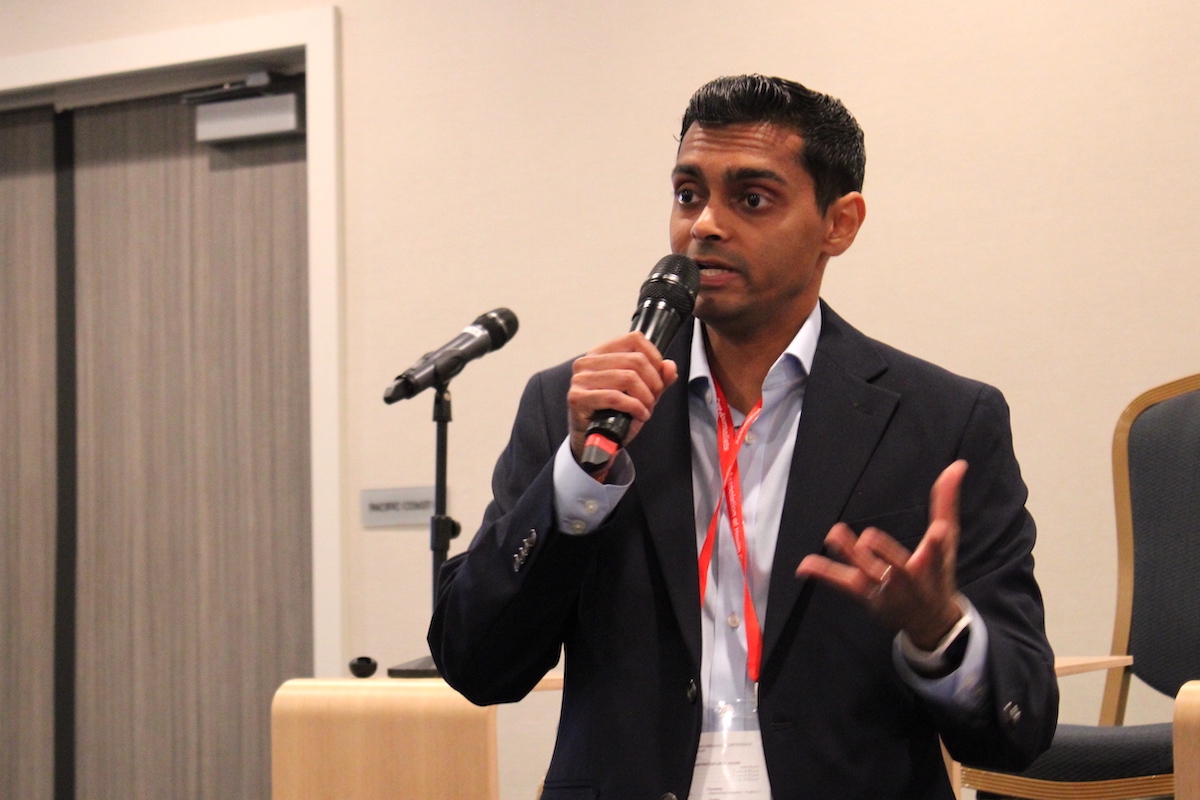
“It’s that lack of gravity that actually helps these cells retain their three dimensional structure, because they’re able to float,” Sharma said during his lightning talk at Health Journalism 2025.
In support of this research and related work, Cedars-Sinai launched the Center for Space Medicine Research in May. The center, which Sharma leads, will study the effects of space on human health and look for new ways to advance regenerative medicine.
“So, we’re interested in using these stem cells to make unique bioproducts in space, or things that can only be made in space,” said Sharma. “It’s a one-of-a-kind environment for stem cell research and biomanufacturing.“
Their initial research will use the organoids to test and develop new drugs for treating heart disease and to help regulate heart function. Sharma gave an example of how the Center might develop drugs to help regulate the speed of a heart’s beat through tests conducted on these “spontaneously contracting” organoids.
Currently, the heart organoids are just a “clump of muscle cells,” said Sharma, but among their future goals is advancing the organoids functioning by introducing blood vessels.
“Some of those intricate networks are very difficult to manufacture or bioengineer in the presence of gravity; they kind of fall apart. But in microgravity, we may be able to make some of those more intricate structures,” Sharma said. “It’s very early, but that’s something we want to explore.”
Aligned with his team’s research focus on the impact of cancer treatment on the heart, Sharma said with the more advanced organoids, “we’ll be able to better approximate what goes wrong in the real heart when someone receives a cancer drug and that cancer drug does off-target damage to the heart.”
Sharma said more advanced organoids and manufactured human hearts are a long way off. But he believes the International Space Station and microgravity will play a major role in what comes next.
Bonita Gooch is editor-in-chief of The Community Voice in Wichita, Kan., and Kansas City.