Writing tips you’ll use every day
By Emily Brindley, Equity in Health Journalism Fellowship
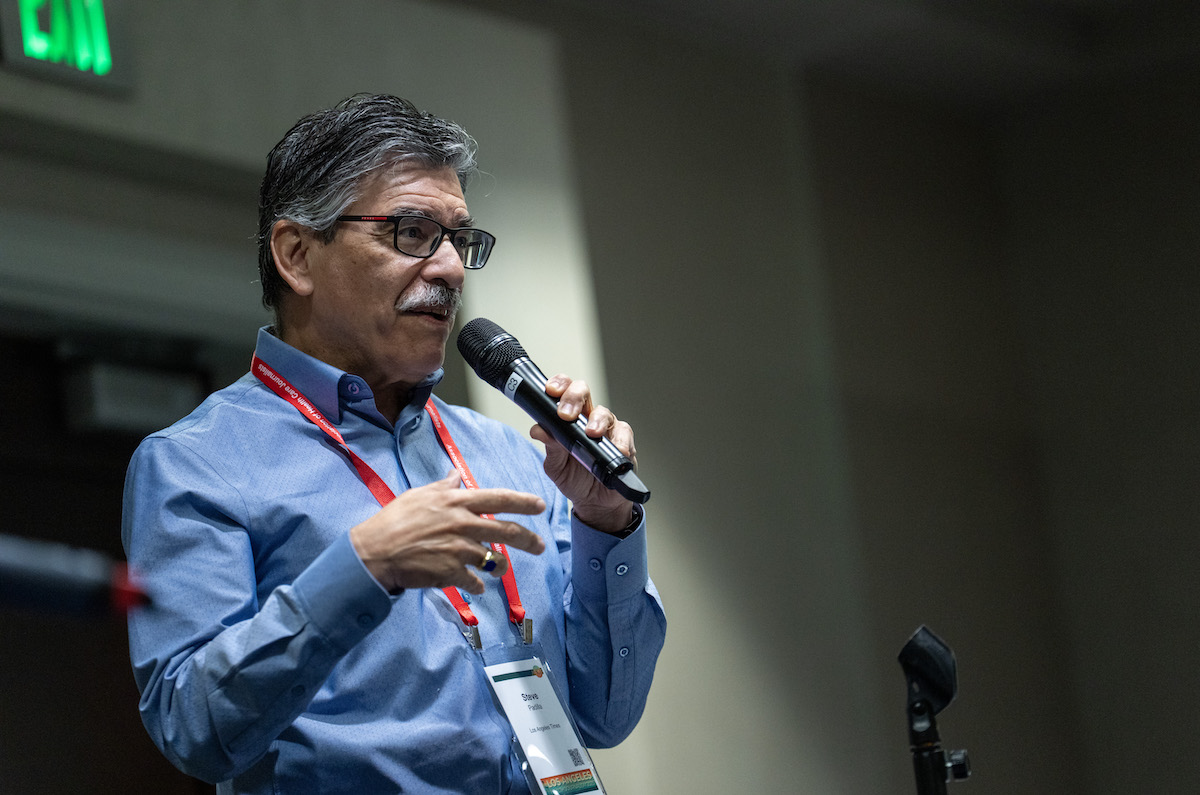
Steve Padilla wants his audience to think a little more like criminals.
“Good writing is like first-degree murder,” he said. “It’s premeditated.”
The Los Angeles Times editor led his workshop at HJ25 with flair. He spoke in anecdotes and analogies, flipping through a stack of notecards as he hit each point. (He also provided a full tip sheet, which you can find here.)
Here’s what Padilla wants writers to understand: It’s all well and good to play by ear, until your inspiration takes a day off and you still have a story to write. There’s a process to good writing, he said, and you can learn it.

Padilla began with the caveat that his writing session is not for beginners or for bad writers. For all others, he laid out three foundational concepts:
- Embrace revision as part of the process. “Writing is re-writing,” Padilla said.
- Choose your details carefully, so the reader feels each detail was worth carrying through the journey of the story.
- Know what you want to say. The meaning, the “what,” controls your words, not the other way around.
Once you’ve digested that framework, here are three tips Padilla gave to improve your writing:
- Read your work out loud. If you’re struggling to put the story together in the first place, compose it aloud, too.
- Select verbs that pop. They should showcase the depth of your reporting.
- Put the most interesting information at the end of the sentence.
Padilla thundered through a list of tips, many of them paired with a witticism.
- Partial quotes? Use them like capers (sparingly).
- Anecdotes? Structure them like Law & Order would, starting the scene in the middle where the action is already happening.
- Sentence structure? Put the interesting stuff at the beginning and end, and the boring stuff in the middle. Write like Shakespeare: “The queen, my Lord, is dead.”
And when it comes to the endings, Padilla said, chuck out the idea that you have to end with a quote. Challenge yourself to use your own voice to end the story.
After all, you’re the composer and this is your opus.
Emily Brindley is the health reporter at The Dallas Morning News.