Lauren Merz: Untangling race and genetic ancestry
By Cassandra Willyard, Wisconsin Health Journalism Fellowship
Race is a social construct, not a biological one. But the environment in which we evolved can shape our genetic makeup. Genetic variants can, as a result, be more or less prevalent among people of different ancestries.
Race is often used as a proxy for these genetic differences, but it doesn’t provide any insight into the underlying biology, a reality discussed by a featured speaker at Health Journalism 2025.
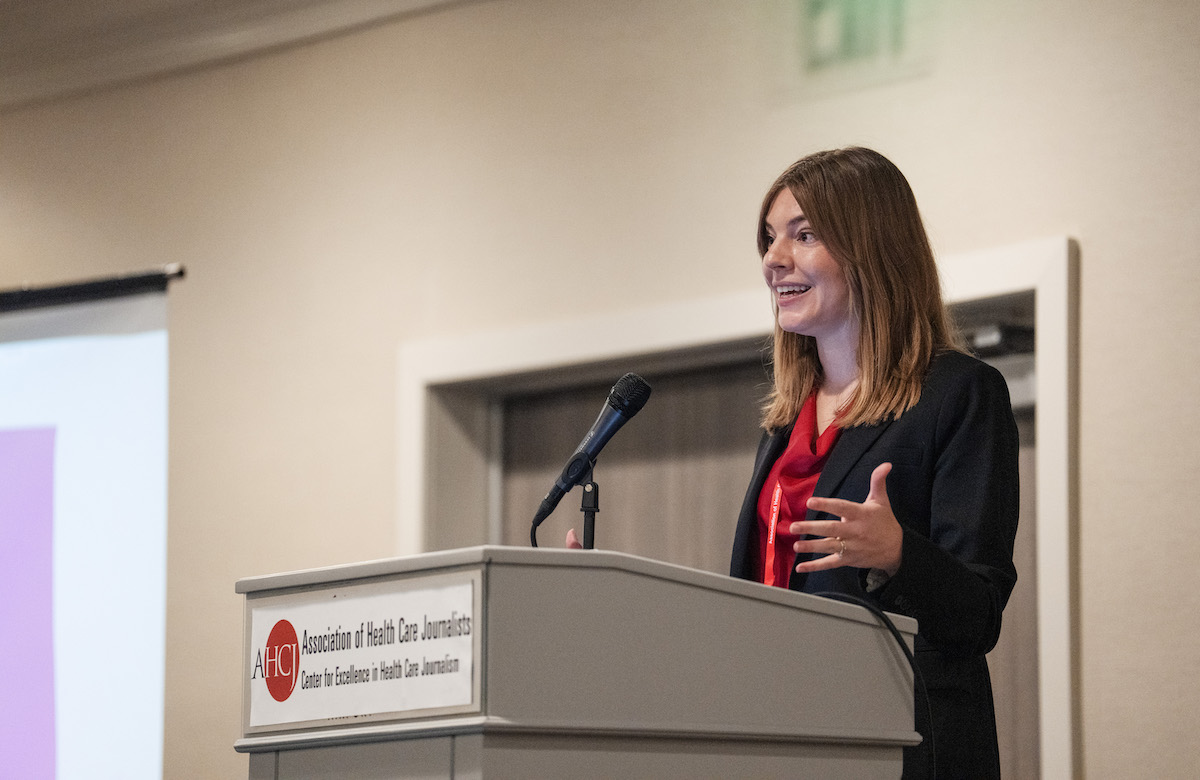
Lauren Merz, M.D., a hematologist and oncologist at the Dana-Farber Cancer Institute and Massachusetts General Hospital, shared the story of how one common genetic variant disproportionately found in Black people has led to misdiagnoses, unnecessary medical tests and increased health disparities, and how she and her colleagues are working to address the problem.
People who have this genetic variant lack a protein called Duffy in their red blood cells. Being “Duffy-null” appears to protect against malaria, which helps explain why the variant is common in West Africa, but it “kind of peters out as you move across the African continent and into the Arabian Peninsula,” Merz said.
In the U.S., two of every three people who self-identify as Black or African American lack the Duffy protein, in contrast to fewer than 1% of people who identify as white or Asian.
Duffy-null individuals, for reasons that aren’t entirely clear, tend to have fewer immune cells called neutrophils circulating in their blood. This difference doesn’t impact their ability to fight infections; they still have plenty of neutrophils in the spleen and bone marrow. “It’s simply a difference of where the neutrophils live,” Merz said.
However, because the standard reference ranges for neutrophils in the U.S. are based largely on people of European ancestry, Duffy-null individuals often appear to have neutrophil levels that are abnormal — sometimes dangerously low. Back-of-the-envelope calculations suggest that 6 to 7 million Americans with Duffy-null status will receive an abnormal lab result “despite the fact that they’re totally healthy,” Merz said.
Duffy null exemplifies a broader problem — that health disparities occur when diverse populations are overlooked in research and clinical studies. Many other such genetic variants exist, and there is growing awareness that they are likely being conflated with race because of past research practices.
In the case of Duffy null, the problem goes beyond the worry associated with an abnormal blood test. “There are very real, very dire consequences for patients,” she said. When a blood test reveals very low neutrophil levels, physicians often suspect cancer and order a bone marrow biopsy.
Low neutrophil levels can also exclude patients from clinical trials or prompt doctors to alter treatment regimens. Cancer patients may be forced to pause treatment or adjust their medication dosages when neutrophil levels dip too low. In one study, researchers assessed Black breast cancer patients treated with a medication called palbociclib. They found that Duffy-null women were more likely to have low neutrophil counts and receive a dose modification than women who had Duffy. Duffy-null women also experienced less clinical benefit.
Merz and other researchers are working to change this. They’ve developed new reference ranges for Duffy-null people they plan to roll out in early 2026. Some institutions already include those ranges as a footnote in lab reports, but Merz hopes that eventually electronic medical records can automatically apply the proper reference ranges based on Duffy status. They’re also conducting a pilot study to assess whether it’s safe to use the new reference ranges to guide medication decisions in breast cancer patients.
Merz also hopes to make it easier for patients to find out their Duffy status. The test costs about $10, she said. “We have the tools and the knowledge to be personalized, to be specific,” she said. “There’s just no reason to be using race.”
Cassandra Willyard is a freelance journalist based in Madison, Wis.