
Reducing homelessness through Medicaid programs
By Arren Kimbel-Sannit, Montana Health Journalism Fellowship
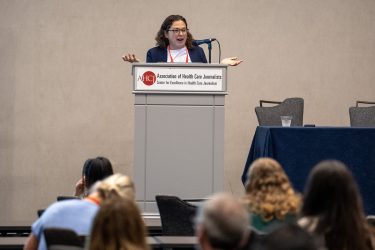
The Trump Administration’s slash-and-burn budget cuts are jeopardizing recent efforts to use Medicaid funding for housing and other social services at a time of record homelessness, panelists said at Health Journalism 2025.
About two dozen states have taken advantage of waivers that allow them to expand the services covered by Medicaid to provide housing support to the most vulnerable populations. But the White House and Centers for Medicare & Medicaid Services under newly confirmed director Dr. Mehmet Oz are working to roll back those programs, part of a broader push by the Trump Administration towards institutionalization and criminalization of homeless people and away from housing-first policies.
“The Trump Administration is really not only unraveling the waiver authority, but it’s ratcheting up a broad and large-scale criminalization approach to homelessness, in part by looking toward mandated treatment, by defunding housing programs, by attacking housing first,” said Angela Hart, a senior correspondent with KFF Health News and moderator of the panel.
The previous Trump Administration approved the first such waiver, allowing North Carolina to provide housing, food, transportation and other services to eligible Medicaid recipients. President Joe Biden encouraged other states to follow suit, and soon red and blue states alike were investing billions of dollars in similar programs.
Now, though, the Trump Administration has rescinded a Biden-era directive clarifying allowable uses for the funding and has said it will not renew any existing waiver programs, arguing the new services are duplicative and outside the core mission of CMS.
Meanwhile, evidence suggests only 10-15% of health status is driven by actual health care, Anthony Iton, M.D., J.D., MPH, a lecturer and impact fellow at the UC Berkeley School of Public Health, said. But the U.S. has continually spent money on downstream care rather than upstream prevention, creating a bloated medical system that spends twice as much money on medical care as other highly developed countries without the results to match.
“You can’t treat social ills with pills,” Iton said. “But, nevertheless, we try to do that.”
Medicaid housing and nutrition programs marked a philosophical change toward addressing these root causes. But the Trump Administration is pledging to undo these changes just as the programs are taking hold.
The regression reflects a broader shift in homelessness policy in the new Trump Administration, which is proposing massive reductions to Department of Housing and Urban Development programs and instead calling for mandated treatment, criminalization and institutionalization. This is a departure from the housing-first model of the last several presidencies.
But this hardline approach misunderstands the key reasons for homelessness, said Anna Gorman, the COO of Community Programs at the Los Angeles County Department of Health Services.
“The assumption is that people are homeless because they have a mental illness, they don’t want to get into housing, they have substance use issues,” Gorman said. “What is the real issue? Housing. People are homeless because they’re not in a house.”
Arren Kimbel-Sannit is a writer and journalist with The Pulp.