As with covering any outbreak or other type of ongoing, developing story, it’s helpful when writing about bird flu to provide context throughout your coverage for those who have not been following it all along. Consider including some of the news developments from the list of resources at the bottom of this post in your story to provide background or a sense of the timeline for your audience.
The biology of flu viruses
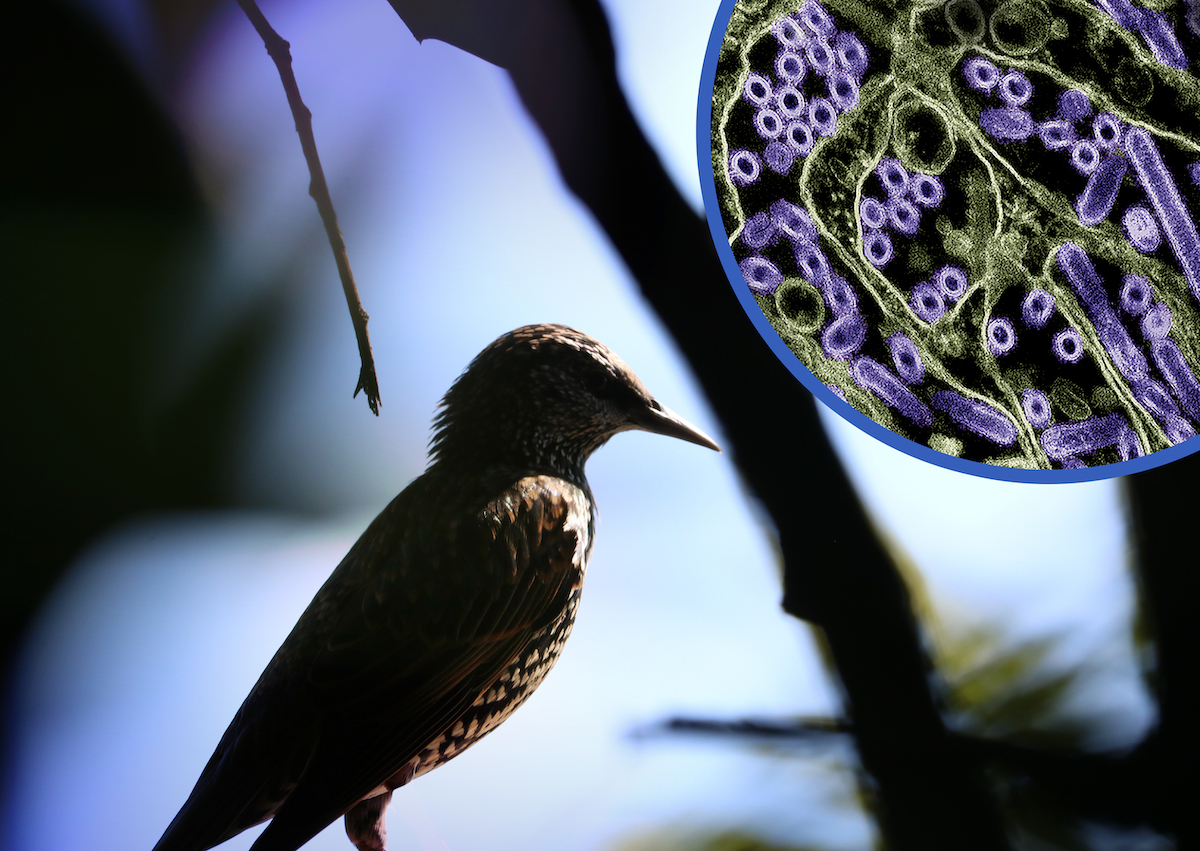
All influenza A viruses have eight genes that encode 11 known proteins. The subtypes are named for the subtypes of two proteins — hemagglutinin (H) and neuraminidase (N) — that appear on the virus’s surface. There are 16 known H subtypes and 9 known N subtypes that occur in both birds and mammals. (Two additional recently identified H subtypes, H17 and H18, and N subtypes, N10 and N11, occur in bats but no other species to date.)
Although scientists have mapped out which H and N subtypes occur in different species (see two helpful pictogram charts here), the way influenza viruses can reassort, or swap, their genetic strands may enable them to infect other species as they mutate. That’s how, for example, H3N2 influenza originated in birds but then spread to dogs.
Some of these combinations are regarded as low pathogenic avian influenza (LPAI) — lower risk than highly pathogenic avian influenza (HPAI). Past examples of HPAI besides H5N1 include H5N2, H5N8 and H7N9. But again, any of this can change: Some H5 and H7 LPAI have the potential to become highly pathogenic. Finally, flu A types can be divided further into different clades and sub-clades, which are groupings based on how genetically similar the viruses are.
Historical to present-day context for avian influenza
The potential for an avian influenza pandemic has been recognized since 1997, when an outbreak among people in Hong Kong with a 33% mortality rate alarmed public officials and was contained after slaughtering 1.5 million chickens. At that time, soon after the height of the AIDS pandemic, the recognition of the catastrophic potential of emerging diseases that spill over from animals to humans led to a greater public health focus on prevention rather than simply response.
In the 2000s, when a strain related to the one that caused the outbreak in Hong Kong emerged, an apparatus for monitoring the virus’s evolution was set up. Much of the pandemic preparedness that was put in place by the late 2000s was aimed at influenza spillovers, which is why some of it failed when the next big pandemic turned out to be a coronavirus, as health security historian Andrew Lakoff, Ph.D., of UCLA detailed in his 2024 book, “Planning for the Wrong Pandemic.”
“Ten or 15 years ago, if bird flu was infecting cattle and spreading wildly in poultry and even infecting cats, there would be a massive freak out. And there would be a lot of tracking and figuring out how to stop it,” says Lakoff. “But the political/scientific situation is different because there isn’t generalized bipartisan agreement that we should be preparing for a pandemic.”
That has become particularly evident in the current federal response to bird flu. Among the casualties of the broad cuts being made by Elon Musk’s Department of Government Efficiency (DOGE) were USDA employees working on the bird flu response. Although the agency reversed course and hoped to rehire those fired, it’s not clear how successful they were in that endeavor, and the federal response could have been hobbled in the process. Meanwhile, HHS Secretary Robert F. Kennedy Jr. has suggested simply letting the virus run wild, an approach experts roundly criticized, not least because of the increased potential for mutations.
That said, Kennedy does not have jurisdiction over USDA, which announced last month a $1 billion investment to combat highly pathogenic avian influenza (HPAI). The money is for supporting farmers with infected flocks, improving biosecurity measures to block spread from wild birds, continued vaccine development and therapeutics for chickens — but nothing toward the spread in dairy cattle.
But it’s clear federal surveillance is inadequate for the situation at hand. Although the data published by CDC and USDA (listed below) are reliable, they are incomplete and behind. When a friend of Katie Burke’s found a dead seagull in the mountains of Floyd County, Virginia, far from where seagulls normally show up, she reported it to local wildlife authorities. They told her to dispose of it and did not test it for avian flu. Because much of the bird flu surveillance relied on federal support, local testing programs are backlogged, and avian flu cases in wild birds in the United States are undercounted. Local stories and efforts can help fill in these gaps.
Information sharing from these federal agencies has also been hobbled. As science journalist Lauren Leffer discussed in a recent interview with Nilay Patel at Decoder, experts on influenza usually communicate daily or weekly with staffers at the CDC and USDA. That information exchange is critical to evidence-based, efficient responses to pandemic prevention, and it’s not happening. The CDC has also published and then unpublished concerning data on transmission from cats to people. Although poultry farmers are motivated to test and contain outbreaks, because the disease is lethal to their livestock, dairy farmers are undertesting and underreporting. Cases in people are also undercounted. Wastewater testing offers a sense of the bigger picture in humans.
Tracking the spending of limited resources for bird flu surveillance as well as any other federal initiatives to address HPAI should provide multiple story ideas, particularly at state and local levels. In an upcoming tip sheet, we’ll suggest more specific local story ideas.
Resources
Note: If any of these URLs no longer work due to changes from the current administration, use the Internet Archive’s Wayback Machine to find the most recently available page. Also, keep in mind, as noted above, that current surveillance is underfunded and inadequate, so these federal sources will have incomplete data, a reality that may be worth communicating to audiences in ongoing coverage.
General information
- The current outbreak of H5N1 avian flu in dairy cattle began March 25, 2024.
- The first (and only, as of March 20, 2025) U.S. human death from avian flu was reported Jan. 6, 2025 after the person had been hospitalized in December.
- All CDC avian flu pages, including news updates.
- The CDC’s “H5 Bird Flu: Current Situation” page, periodically updated, includes case counts in humans.
- General background of avian influenza from the CDC: “Highlights in the History of Avian Influenza (Bird Flu).”
- The CDC’s “Reported Global Human Cases with Highly Pathogenic Avian Influenza A” since 1997.
Information on human health
- The CDC’s “How CDC is monitoring influenza data among people to better understand the current avian influenza A (H5N1) situation.”
- The CDC’s “Prevention and Antiviral Treatment of Avian Influenza A Viruses in People” (a far more detailed, clinical version of all recommendations is here).
- The CDC’s guidance of employers of people working with animals here and here, and information for exposed workers here.
- The CDC’s “Food Safety and Bird Flu.”
- Information from the CDC on progress related to human vaccine development for avian flu: “Making a Candidate Vaccine Virus (CVV) for a HPAI (Bird Flu) Virus.”
- WHO’s page on H5N1 avian influenza: “Global Influenza Programme: Avian Influenza A (H5N1) Virus.”
Information on livestock and wild animals
- The CDC’s periodically updated “Current Situation: Bird Flu in Dairy Cows” page, including the number of states with infected herds and the total number of infected herds,
- The USDA’s “HPAI Confirmed Cases in Livestock,” updated weekdays by noon ET with new cases.
- Two agency pages publish data on bird flu cases in wild birds: The CDC’s periodically updated page “USDA Reported H5N1 Bird Flu Detections in Wild Birds,” including the number of birds, jurisdictions, and counties affected. The USDA’s periodically updated page “Detections of Highly Pathogenic Avian Influenza in Wild Birds,” with a table of date, location, bird species, and flu strain. Both these pages’ data overlap, and will certainly be an undercount of actual cases.
- The CDC’s periodically updated page “USDA Reported H5N1 Bird Flu Detections in Poultry.”
- The USDA’s periodically updated page “Confirmations of Highly Pathogenic Avian Influenza in Commercial and Backyard Flocks.”
- The European Union’s page on avian influenza, with a regularly updated timeline.
- The United Nations’ page on HPAI cases in Sub-Saharan Africa.