
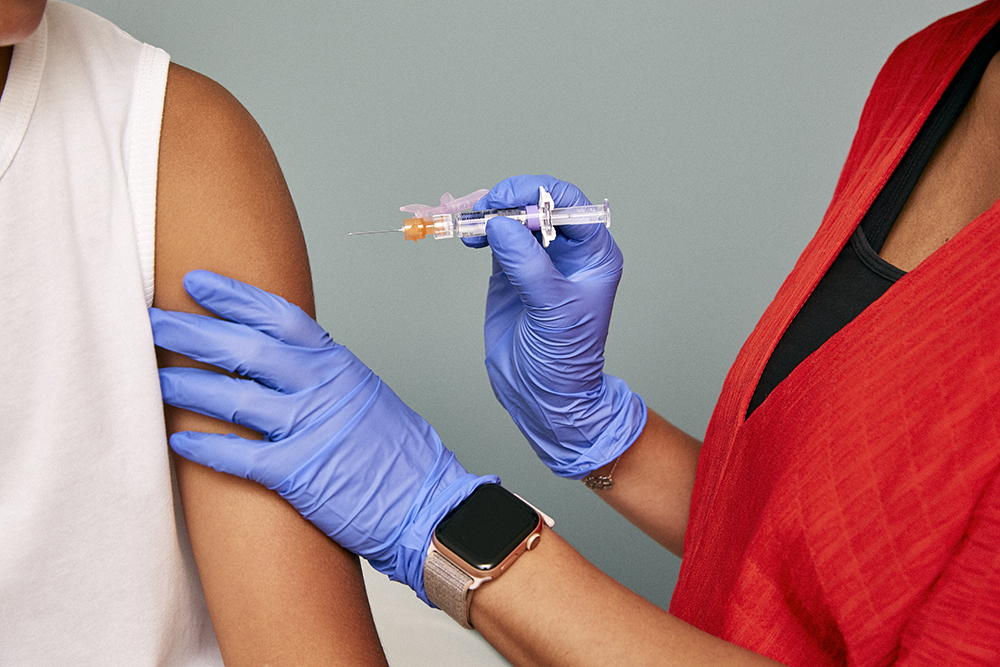
A measles outbreak that began in early December in Philadelphia appears to be ending, but health officials across the U.S. remain alert for the possibility of an outbreak in their jurisdiction. Cases in seven other states can quickly grow into an outbreak given how contagious measles is.
The CDC issued an official alert for measles cases in late January. Health journalists should also be aware of the heightened likelihood of measles outbreaks and the primary cause of them — low vaccination rates.
Measles was eliminated from the U.S. in 2000, which means no ongoing person-to-person transmission has occurred after at least one year of no continuous transmission. But elimination is not the same as eradication, so measles outbreaks still occur when the disease is introduced into a community.
The outbreak in Philadelphia began with a child who had recently traveled out of the country and returned with an infection. However, it eventually caused eight additional cases, first to three people at the hospital where the child was diagnosed and then at a local daycare when one of the parents did not follow quarantine recommendations.
Measles is one of the most contagious of human infectious diseases, with a basic reproduction number (R0) of 12-18. That means that one infectious person will, on average, cause an additional 12 to 18 cases. Fortunately, that didn’t happen in Philadelphia, but that’s because the city has high immunization rates — about 93% of children ages 6 years and older have been fully vaccinated against the disease as recommended by the CDC, according to Children’s Hospital of Philadelphia.
But 90% of people who aren’t immune to measles will contract an infection when exposed to the virus, according to the National Foundation for Infectious Diseases. With no treatment available besides supportive care, vaccination is the only way to prevent measles.
Vaccine hesitancy
Vaccination rates have fallen since the COVID-19 pandemic, initially because of logistical barriers to vaccination such as social distancing and lockdowns that prevented children from attending their wellness checkups. Vaccination rates also dropped when children who missed their vaccination appointments didn’t get caught up.
Vaccine hesitancy began growing again during the pandemic as anti-vaccine rhetoric took hold. As Brandy Zadrozny reported recently for NBC News, anti-vaccine advocates have been especially downplaying the threat of measles, including spokespeople for the Orwellian-named Children’s Health Defense, an anti-vaccine organization founded by Robert F. Kennedy Jr.
The U.S. is not the only country at risk for measles outbreaks. The U.K. and Europe saw a surge in late 2023, and five countries currently have more than 10,000 cases. Measles cases worldwide increased 18% between 2021 and 2022, and deaths increased by 43%, according to a November 2023 report from the CDC and the World Health Organization.
But the “staggering” rise isn’t surprising with the declining vaccination rates seen across the globe since the pandemic, according to John Vertefeuille, director of CDC’s Global Immunization Division.
More global cases means a greater risk of importing measles into the U.S., and lower vaccination rates leads to the disease spreading throughout communities. In January, CBS News revealed that at least 8,500 schools in the U.S. are at an increased risk for a measles outbreak.
Journalists can learn about local immunization rates using the CDC’s VaxView site and National Immunization Surveys. It’s also crucial for journalists to know their state’s vaccination requirements and school vaccination exemptions policies. To closely follow court cases related to vaccination law and litigation, contact Dorit Reiss at the University of California Law San Francisco and request to be added to her mailing list.
Finally, if measles outbreaks do rise in the U.S., journalists should be aware of the risk that other vaccine-preventable infectious diseases could follow suit. As a pair of Croatian researchers noted in 2019, measles outbreaks are somewhat like canaries in the coal mine.
“When vaccine coverage decreases, measles is the first disease to resurge only because it is the most contagious of all vaccine-preventable diseases,” they wrote. “Therefore, measles outbreaks are a warning sign that we might expect the outbreaks of serious illnesses, such as whooping cough, diphtheria or polio.”
Helpful articles
- Global measles threat continues to grow as another year passes with millions of children unvaccinated, CDC, Nov. 16, 2023
- Progress Toward Measles Elimination — Worldwide, 2000–2022, MMWR, Nov. 17, 2023
- How the anti-vaccine movement is downplaying the danger of measles, CBS, Feb. 5, 2024
- Data shows at least 8,500 U.S. schools at greater risk of measles outbreaks as vaccination rates decline, CBS, Jan. 30, 2024
- Vaccine Confidence Falls as Belief in Health Misinformation Grows, Nov. 1, 2023
Resources
- Dorit Reiss, UCSF Professor of Law — Request to be added to her mailing list to closely follow court cases related to vaccination law and litigation.
- VaxView — check local immunization rates with CDC data
- Vaccination Laws, CDC
- State Vaccination Requirements, CDC
- KFF COVID-19 Vaccine Monitor
- Measles & Rubella Partnership
- Gavi, the Vaccine Alliance
- WHO Measles Fact Sheet
- Global Measles and Rubella, CDC