Are you a health care reporter searching for credible data on firearm violence? Look no further.
The Gun Violence Archive is a nonprofit that provides comprehensive and detailed data on gun violence incidents in the U.S., and a resource I’ve used numerous times in my reporting.
This online archive collects information on incidents from 7,500 law enforcement, media, government and commercial sources daily to provide near-real time data about gun violence. It is an independent data and research group and is not affiliated with any advocacy organizations.
More about the archive
Gun Violence Archive researchers automatically scrape data, comb through the results, double-check sources and follow up with police and update the database. Most shootings make it into the system within 72 hours.
Their data has a wide array of categories, including: number of overall deaths and injuries, number of children and teens killed or injured, mass shootings, officers shot, suspects shot by an officer, home invasions, guns used defensively and unintentional shootings.
When I wrote about how gun violence spiked in 2020, I used both the archive and police data to show how firearm homicides and injuries occurred that year in Missouri. I also used the Gun Violence Archive’s numbers to break down which cities experienced the most violence in the state.
In 2022, I pulled data from the archive to explain how gun violence had spiked in Columbia, Mo., and to highlight the intersection of vacant land and shooting locations in St. Louis and Kansas City.
How to use this resource
Start by establishing some basic perimeters for your query: date, location and “incident characteristic.” The location can be by city, county or state. There are over 100 incident characteristics to choose from, allowing you to be as broad or as specific as you want. You can choose multiple filters at a time.
Incidents can be further filtered by:
- Date.
- Date range.
- Address.
- City.
- State.
- Number of victims.
- Number of subjects/suspects/perpetrators.
- Number of incident participants.
- Participant type, name, age, age group, gender, status, and subject/suspect/perpetrator relationship to victim.
- Gun types, numbers and whether the guns are stolen.
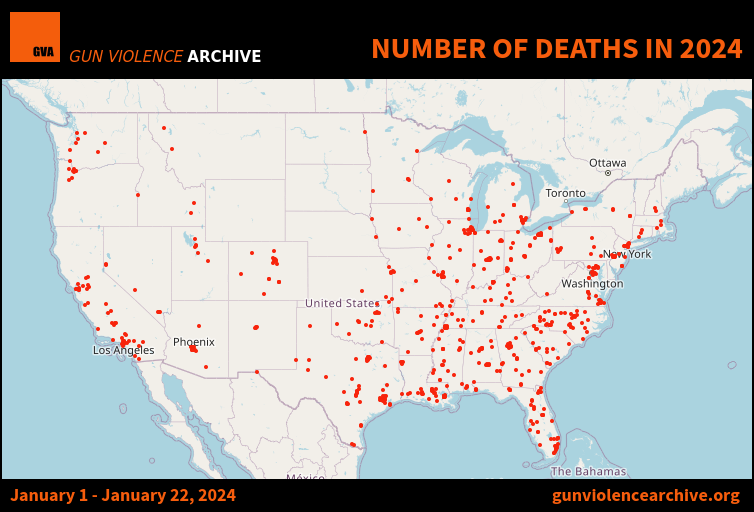
Once you get the results filtered and displayed to your liking, it’s easy to export the data as a CSV file and generate the results as an interactive map.
Beyond querying the data, the Gun Violence Archive publishes reports on the more popular searches, including mass shootings and accidental deaths.
The site also has a specific tab for all gun violence incidents that have occurred within 72 hours nationwide. And the site publishes charts and maps for different incident types.
The archive also compiles annual summary ledgers that cover total incidents, deaths, injuries, number of children killed and injured, number of teens killed and injured, officer involved shootings, home invasion shootings, defensive use and unintentional shootings.
Other reliable data resources
- The CDC maintains extensive data on gun violence in its National Violent Death Reporting System (NVDRS).
- The CDC’s death data is based on death certificates at the state level. Since each state has a different timeline for reporting that information, the figures are often delayed and not in real time.
- The FBI also reports gun violence data; however, there is a lag similar to the CDC’s. For example, 2022’s crime statistics were published in October 2023.