


Awards for Excellence in Health Care Journalism
Since 2004, the Awards for Excellence in Health Care Journalism have recognized the best health reporting in print, broadcast and online media. The contest was created by journalists for journalists and is not influenced or funded by commercial or special-interest groups. There are 16 categories.
New for 2025
We’re rolling out a new Television and Video Reporting category and making changes to the Audio Reporting category. The TV/video and Audio categories include a short-form and long-form/series option. Detailed information can be found on the Rules for Entry page.
“Every year produces amazing journalism about our health care, and it’s great to reward the very best of it,” said Jonathan Rockoff, AHCJ contest co-chair and an editor at the Wall Street Journal.
“It’s a privilege to oversee a contest that aims to highlight the best of the best in health reporting — to honor the passion and drive of journalists who go deep on stories, share them with the world and make an impact.”
Christine Herman
AHCJ Contest Chair and Freelance Editor
2025 Contest Entry Details
Early-bird entry deadline: Jan. 16, 2026, 5 p.m. ET
Regular entry deadline: Feb. 20, 2026, 5 p.m. ET
Please note, entry deadlines are final and there will be no extensions provided.
- AHCJ member early bird: $30 per entry
- Non-member early bird: $55 per entry
- AHCJ members, regular: $50 per entry
- Non-members, regular: $75 per entry
Student category
- AHCJ member early bird: $15 per entry
- Non-member early bird: $25 per entry
- AHCJ members, regular: $25 per entry
- Non-members, regular: $35 per entry
To claim the member entry fee, you must be a current AHCJ member. A team entry may claim the member fee if at least one member of the team is a member of AHCJ. If you’re not certain about membership status, email membership manager Tina Price at tina@healthjournalism.org. Not an AHCJ member? Now’s the perfect time to join. Join today and save on your entry fee for each entry.
First-place winners receive $500 and a framed certificate, as well as complimentary lodging for two nights and registration for AHCJ’s annual conference, where winners are recognized during the awards luncheon. The first-place winner of the Student category receives reimbursement for travel to the 2026 annual conference for up to $400. Second- and third-place winners receive certificates and are recognized at the luncheon.
- Audio Reporting — Long Form (All sizes)*
- Audio Reporting — Short Form (All sizes)*
- Beat Reporting (All sizes)
- Consumer/Feature (Large and Small division)
- Health Policy (Large and Small division)
- Investigative (Large and Small division)
- Public Health (Large and Small division)
- Business (All sizes)
- Television and Video Reporting — Long Form (All sizes)*
- Television and Video Reporting — Short Form (All sizes)*
- Trade (All sizes)
- Student Reporting (All sizes)
See more information on our Rules for Entry or FAQ pages.
*New or updated for 2025
Categories applying to “All sizes” will seek the best work in that topic category regardless of the size of the outlet.
For categories labeled “All sizes,” entries will be judged against one other regardless of the size of an outlet.
For categories labeled “Large division” and “Small division,” entries will be judged against work from similar-sized outlets.
The definitions for “Large” and “Small” depend on the number of editorial staff and the type of outlet that published or broadcast the entry. To calculate editorial staff, consider the number of full-time equivalents, or FTEs, of the outlet that published the work and any collaborating partners, if applicable.
A news outlet’s editorial staff includes any and all editorial roles, including but not limited to: reporters, editors, producers, hosts, anchors, photojournalists, board or camera operators, show or podcast staffers, social media and community engagement staff, and newsroom or programming managers and supervisors.
Part-time and contract employees should be included in the FTE count. (A half-time or quarter-time employee would count as 0.5 or 0.25 FTEs, respectively).
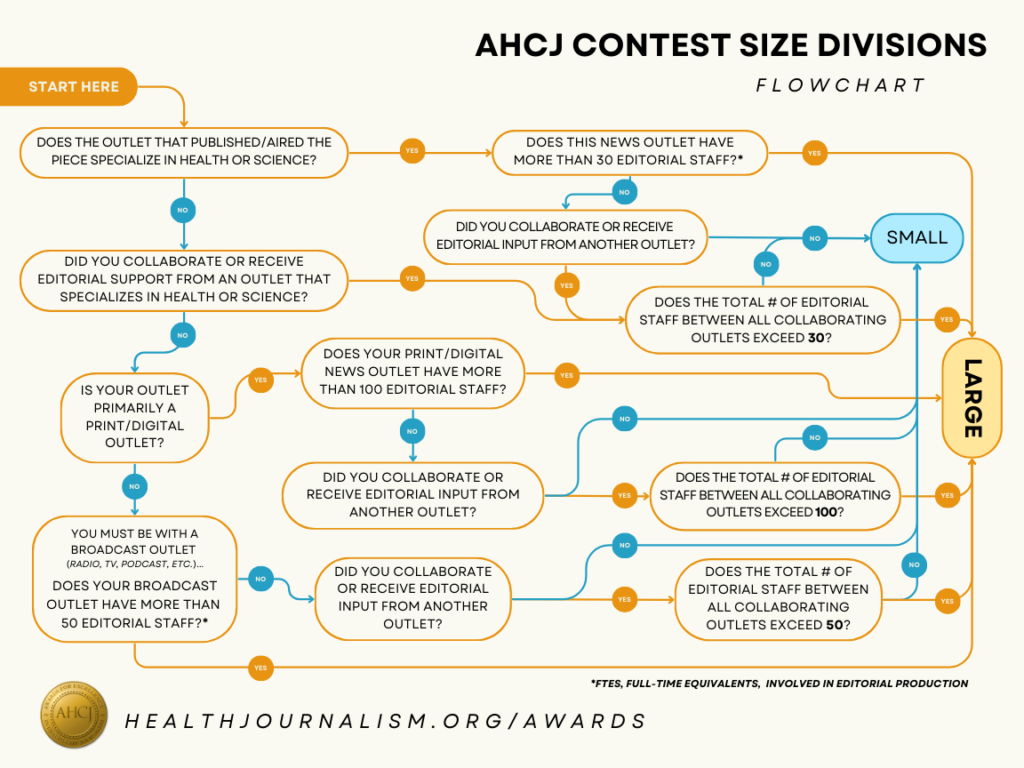
Large division
- Entries published in outlets specializing in health or science, with more than 30 editorial FTEs.
- OR — Any entry produced in collaboration with an outlet that specializes in health or science, in which the total number of editorial FTEs in all participating outlets exceeds 30.
- Entries published by print or digital outlets (including newspapers, magazines and online-only outlets) with more than 100 editorial FTEs.
- If the entry was produced in collaboration with another outlet, the total number of editorial FTEs in all participating outlets must be counted. If the total number exceeds 100, the submission belongs in the Large category.
- Entries produced by broadcast outlets (radio, TV, podcasts, videos) with more than 50 editorial FTEs.
- If the entry was produced in collaboration with another outlet, the total number of editorial FTEs in all participating outlets must be counted. If the total number exceeds 50, the submission belongs in the Large category.
- Any collaboration between Large and Small outlets.
- Any piece produced by a freelancer, or person employed by a Small outlet, that was produced for or in collaboration with a Large category outlet must enter in the Large category.
- Entrants may choose to default any entry into the Large category.
Small division
- Entries published in outlets specializing in health or science, with 30 or fewer editorial FTEs.
- OR — Any entry produced in collaboration with an outlet that specializes in health or science, in which the total number of editorial FTEs in all participating outlets is 30 or fewer.
- Entries published by print or digital outlets (including newspapers, magazines and online-only outlets) with 100 or fewer editorial FTEs.
- If the entry was produced in collaboration with another outlet, the total number of editorial FTEs in all participating outlets must be counted. If the total number is 100 or fewer, the submission belongs in the Small category.
- Entries produced by broadcast outlets (radio, TV, podcasts, videos) with 50 or fewer editorial FTEs.
- If the entry was produced in collaboration with another outlet, the total number of editorial FTEs in all participating outlets must be counted. If the total number is still 50 or fewer, the submission belongs in the Small category.
More About the Awards
Health journalism saves lives.
Everyone should have access to quality health care information so they can make informed decisions. Join AHCJ today for exclusive access to training and education to inform your community.