
Editor’s Note: Maggie Clark’s Two Million Kids series for the Sarasota Herald-Tribune has explored many facets of the state’s troubled Medicaid program: the dearth of preventive and specialty care in many communities, the problems faced by providers, the decade-long legal battle to reform the system. Clark also looked at the shortage of oral health care services for poor children in Florida.
By Maggie Clark
Dental caries, the disease that causes tooth cavities, is the most common chronic childhood disease in the United States and disproportionately affects low-income children. Even though routine dental care has been a required part of the children’s Medicaid program for more than four decades, less than half of American children enrolled in Medicaid get dental care each year.
The percentage is much lower in some states. In my state of Florida, just one-third of Medicaid enrolled children receive dental care annually.
Dental pain is one of the leading causes of school absence and missed work days for parents. A local school district here in Southwest Florida has identified it as the number one reason why elementary-age children stay home from school.
Ultimately, lack of dental care has contributed to a crisis in emergency departments as children and adults who have gone their whole lives without dental care crowd ERs with abscessed teeth and dental pain. In Florida, emergency department spending on dental care has quintupled in the last decade. Nationally, the tab continues to rise.
The state of children’s dental health is a story in every community in the country. Here are a few angles to consider:
The Price of Prevention
Simple investments, such as fluoride treatments in pediatric visits or sending a hygienist to preschools can help stop the progression of the disease that causes cavities. But these efforts are few and far between. Why aren’t they happening? What would it take to put these prevention systems in place?
Strain on the Safety Net
Emergency departments are inundated with people in need of dental care, yet few departments have dentists on call or even have local dentists affiliated with the hospitals. Emergency room doctors aren’t trained to treat dental problems and often send patients home with pain medication. How should large health systems work with dentists to keep their patients safe? Are those efforts underway in your community?
Education at Risk
Children suffering from dental pain are at high risk of becoming chronically absent, meaning they miss more than 10 percent of the school days in a year. Chronically absent children are less likely to read on grade level and are statistically more likely to fall behind and drop out of school altogether. Are there efforts in your community underway to address child dental care in schools before it becomes a drain on their school success?
Volunteer Care
Large-scale dental events such as Mission of Mercy or the Remote Area Medical clinic are favorites among doctors and dentists who like to volunteer and take care of immediate needs. The presence of such programs is revealing about the lack of affordable dental care in a community. If/when one of those events comes to your town, explore what options are left for regular dental care once the event is over.
Lack of Parent Education
Many parents don’t know they can take some simple steps to lower their children’s risk of developing caries. Limiting a child’s exposure to high sugar drinks can make a huge difference. Knowing not to put a baby to bed with a bottle can also have an enormous impact on preserving the quality of teeth and gums. Why aren’t these messages reaching young parents? Are there groups in your community working to change that?
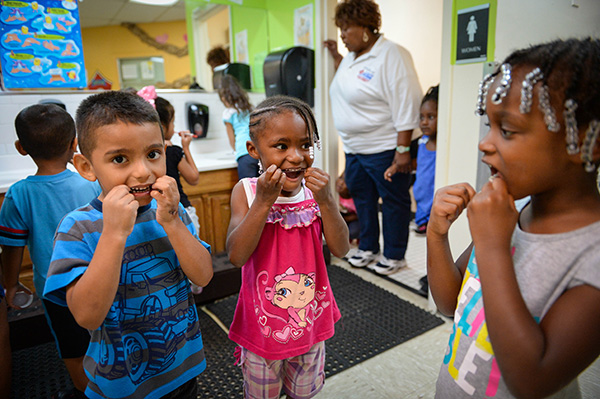
Felix Perlata, 4, Alani Waiters, 5, and Cymia Martin, 4, floss their teeth before heading back to class at Morton Clark Head Start preschool in Bradenton, Fla. (Photo: Rachel S. O’Hara /Sarasota Herald-Tribune)
If you are interested in exploring these and other child oral health topics, here are some key data sources and organizations to get you started:
Finding Data for Your State
The federal portion of the Medicaid program requires every state to provide all children with early and periodic screening, diagnostic and treatment services, also known as the EPSDT benefit. Each year, as part of the EPSDT requirements, states report detailed statistics to the Centers for Medicare and Medicaid on the number of children enrolled in their Medicaid programs, what services they should receive and how many kids actually received them.
The data is clean and organized into easily manageable Excel sheets directly downloadable from the CMS website. In addition to tracking things like primary care visits and lead screenings, the reports have seven categories on children’s access to dental care. The reports go back to 1995 and offer a longitudinal look at the improvement or decline of a state’s Medicaid program. Here’s a chart we made comparing Florida’s rates of access to dental care compared with the national average.
The Centers for Medicare and Medicaid’s CMS-416 form provides a great source of Medicaid performance data to see how your state’s dental care system stacks up against other states. Here are instructions on how states are supposed to report the data and what are counted in each line.
In addition to the required CMS-416 data, states voluntarily report additional performance data to the federal government that are included in the Core Set of Children’s Health Care Quality Measures for Medicaid and Children’s Health Insurance Program (CHIP), also known simply as the Child Core Set. Drawing upon data from these sources, the secretary of the U.S. Department of Health and Human Services issues a report each year on the quality of care for children enrolled in Medicaid and CHIP. The most recent secretary’s report covers 2015.
Each state’s Child Core Set also can be downloaded. Through the core set, you can directly compare how your state performs in comparison with other states without having to calculate every state’s percentages as you would need to if you only used CMS-416 data.
One caution: The trick with the child core set is that not all states report every indicator. If you find that if there’s an indicator your state is not reporting but that other states are, you can request the data from your state’s Medicaid office directly.
Don’t Forget Nonprofits
In addition to the federal government, nonprofit organizations also gather and analyze data on dental care in the United States. These groups include the American Dental Association’s Health Policy Institute, the Children’s Dental Health Project and the Pew Charitable Trusts Dental Campaign.
Local Efforts Can Also Yield Data and Stories
Your state’s dental schools also may have data and research on the condition of children’s oral health in your community. Also look for state or regional oral health coalitions that are working to bring dental care to underserved communities. I was surprised to learn that such a coalition was getting started in my community and participants were willing to discuss their work for this story: Local coalition fights back against dental disease.