5 tips for taking better photos
By Rose Hoban, North Carolina Health Journalism Fellow
In the 1980s, Al Franken performed a skit on Saturday Night Live’s Weekend Update as a reporter dispatched to the field with a notebook, a camera and a satellite strapped to his head. At the time, people thought it was funny.
But these days, it feels more true than not for reporters, who often get sent into the field equipped with no more than a notebook and an iPhone.
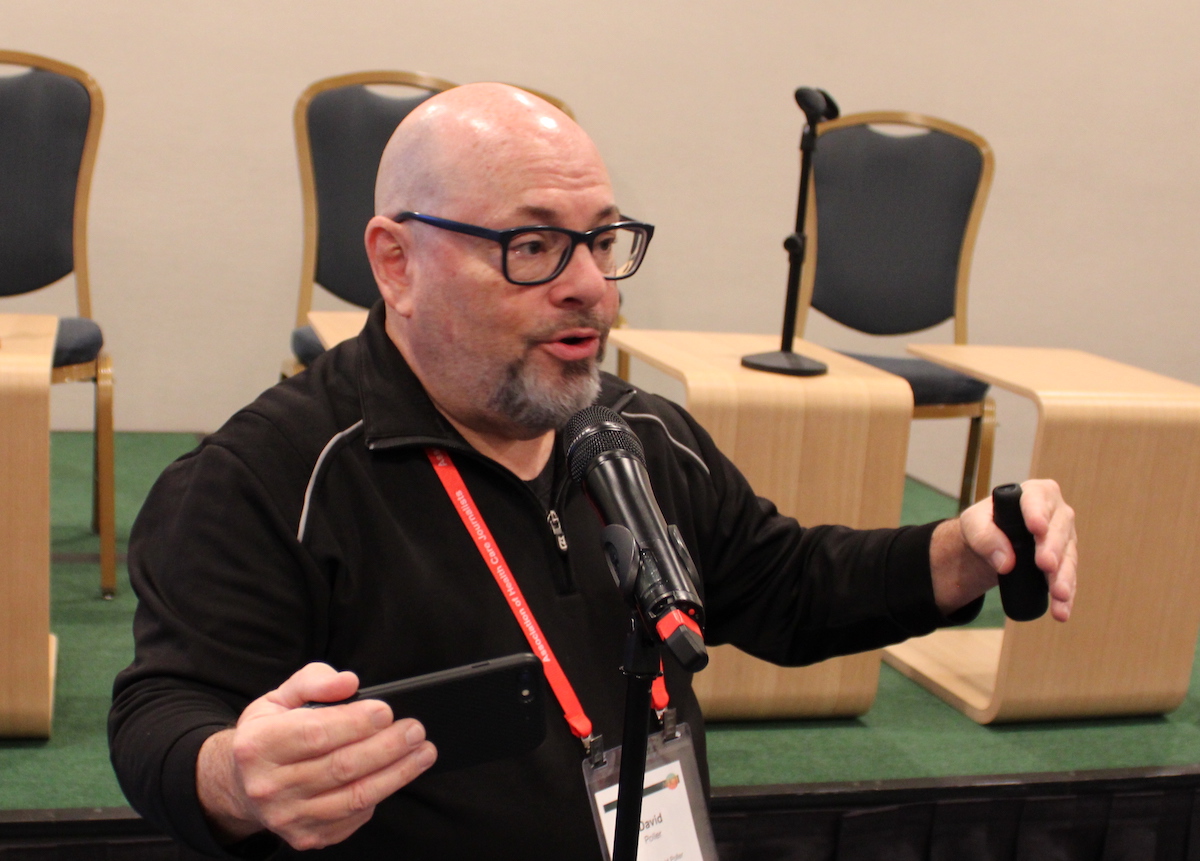
Which is why veteran photographer David Poller’s lightning session at Health Journalism 2025 on how to take better photos was a useful piece of training.
Poller, who has worked for three decades as a newspaper photographer, a commercial photographer and as a newspaper photo editor, boiled down his advice into five memorable phrases:
- Do the time warp. Take a moment to pause and consider your positioning for taking your photo. And then, as in the eponymous Rocky Horror Picture Show song, take a step to the left and then to the right to find your best position for getting the shot. One vital piece of advice: zoom with your feet. In other words, move closer to your subject wherever you can.
- Cheat. Make yourself the subject of your photo first before you put someone else in front of the camera.
- Get shady. Take a moment to reposition yourself so that your subject is placed in a spot that has diffuse, open shade: not too dark, but with plenty of light. Try not to have your subject backlit!
- Get weird. Once you get the basic, straight shot, mix it up. Shoot from below, above, the side, from behind a piece of equipment. Get horizontals. Get verticals. Break the rules of where you “should” be and you’re likely to get more interesting shots.
- You’ve got this. As the reporter, you’re uniquely qualified to be the photojournalist for your own story. You know the people, the issues, the locations, who is going to be affected by what you’re writing about. All of those things become subjects for your photos.
And a bonus tip: No faking. Be honest with your photos. No post-production photoshop that changes the essential character of the shot.
“You have to be honest with your pictures as you’re honest with your words and your editing,” he said.
Better yet, Poller lays it all out for you in this video that’s well worth 15 minutes of your time.
Rose Hoban is the founder and editor of NC Health News, as well as being the state government reporter.